
Drilling Sequence for a Hole Pattern Without Unnecessary Tool Changes
The drilling sequence for a hole pattern affects the datum, the number of tool changes, and the risk of defects. Let’s look at how to separate tools and transitions for smoother work.
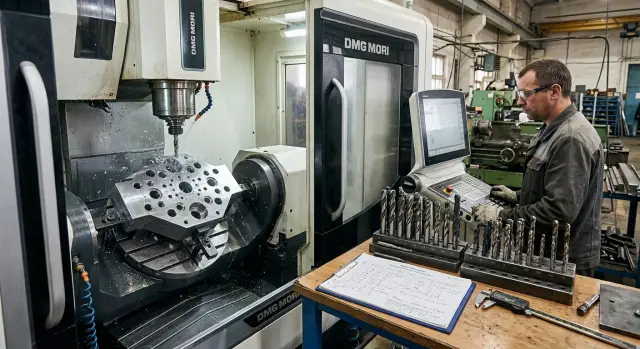
Why the usual order fails
The rule “first the large holes” only works well on a simple part with few dimensions and almost no tight positional tolerances. As soon as one operation includes different diameters, countersinking, re-drilling, and precise fits, this approach often starts to get in the way.
The problem is not the large diameter itself. The problem is that it creates extra transitions. The operator installs one tool, then another, then returns to the first coordinates, checks the stickout again, cleans the work area again. Each such return adds a small error, even if the machine is in good condition.
The datum usually “drifts” not because of one major cause, but because of a sum of small things. Chips got under the clamp, the part was slightly released and tightened again, a heavy drill created more force, the metal heated up locally. Each one by itself may add very little, but for a hole pattern and several related dimensions, that is already enough.
Extra transitions increase not only the risk of shifting. They also increase the chance of defects in the hole shape itself. After a large drilling pass, the edge may raise a burr, a thin wall may slightly distort the part, and a second pass with a small tool no longer happens under the same conditions as at the start. In the end, time goes to rework instead of cutting.
The order for drilling a hole pattern often breaks down on parts where holes are tied to datum planes or to already machined features. If you make the large holes first and then spend a long time on the small ones, you can lose the most important thing — stable geometry in one setup.
One rule does not fit every part. A thick steel housing follows one logic. A thin plate, a flange, or a long overhang part follows another. Even on a good CNC machine, it is better to build the order not by the principle of “from larger to smaller,” but by where the part holds size securely and where it starts to move.
In practice, the most expensive failure looks ordinary: the program runs without crashes, all holes are in place, but one group shifts by a few hundredths. Then the extra inspection starts, the setup is redone, and the cause becomes a topic of argument. Usually the culprit is not one tool, but the wrong sequence of transitions.
What breaks when you start with large holes
When the operator starts a hole pattern with the largest diameters, the part gets the highest load right at the beginning. A large drill pulls the material harder, creates more torque, and presses more strongly on the clamping. If the part is thin, long, or not fully supported, the datum may shift slightly right after the first passes. The shift can be small, but the small holes then end up off by tenths, even though the program is written correctly.
The problem is not only force. After a large tool, burrs, exit marks, and fine chips often remain around the cutting zone. A small drill then enters not a clean plane, but an uneven starting point. It is easier to pull it off line, especially if the holes are close together and the material stretches and sticks to the cutting edge. That is how the drilling sequence for a hole pattern starts affecting not only cycle time, but also the geometry of the part.
There is another unpleasant issue: after large diameters, you almost always have to go back. You need to drill out the small holes, pass an intermediate size, or remove what remains after the first pass. This adds a tool change on the CNC, extra rapid moves, and another approach to the same datum. Each return is small on its own, but on a batch of parts it stretches the cycle and creates more chances for error.
On a simple part, this is obvious right away. Imagine a plate with two 18 mm holes and six 6 mm holes. If you do the 18 mm holes first, the clamp gets a sharp load, chips collect around the large holes, and the 6 mm drill then starts in worse conditions. If you do the small diameters first, the part usually holds position more steadily, and the surface stays cleaner to the end.
So the sequence for drilling holes should be built not on the rule “start with the biggest,” but on how the part holds its datum and how the tool enters the material. Otherwise, you lose time on returns and then chase deviation where it could have been avoided.
What determines the order
The order is set not only by diameters. First, look at the datum surfaces and how the part is held in the fixture. If the very first pass weakens the support, the next holes may already drift in coordinates even when the program is correct.
Usually, you start with the holes that do not disturb the datum and do not remove unnecessary stiffness from the part. This is especially noticeable on plates, flanges, and housings with thin walls. Drill a large hole too early — and you get local bending, then spend a long time looking for the reason behind the offset along neighboring axes.
Diameter and depth also affect the drilling sequence for a hole pattern, but not by themselves. A small shallow hole is often logical to place first if it helps set the axis accurately and does not overload the part. But a deep hole with a large drill is better moved further down the route, when you are already confident in the part position and have chosen a stable cutting regime.
If several axes are close together, do not think of them as separate points. A thin web remains between nearby holes, and it heats up and loses stiffness very easily. In such a zone, it helps to think not only about the diameter, but also about how much metal will remain after each transition.
A simple principle often helps:
- first, operations that preserve the datum and stiffness;
- then, groups of holes with similar tooling and cutting conditions;
- after that, heavier passes on large or deep holes;
- leave the final size for the end, when the forceful transitions are already done.
Tool stickout deserves separate attention. A long drill likes a rigid setup and a short path to the cutting zone. If the part is clamped insecurely or access is awkward, it is better to change the order than to chase runout, deflection, and a burr at the exit.
Roughing and finishing passes should almost never be mixed without a reason. Rough drilling and re-drilling create load, heat the metal, and may slightly shift the size. A finishing pass with a reamer or boring tool is better done after that, when the area will no longer take an extra hit.
In practice, the drilling sequence for holes often looks less “pretty” than sorting from small to large, or the other way around. But this order gives fewer tool changes on the CNC, holds the datum, and lowers the risk of defects. If you are unsure between two options, choose the one where the part stays rigid longer.
How to lay out the tools and transitions step by step
A good drilling sequence for a hole pattern starts not with the largest drill, but with datum logic. First, separate the holes that define the part location from the ones that can be done later. If a large hole removes a lot of metal or sits close to the edge, it changes the behavior of the blank too early.
Next, group the holes by diameter, but not mechanically. Look not only at size, but also at accuracy, depth, and position on the part. Two holes of the same diameter do not always belong in the same pass if one is datum-related and the other is secondary.
In practice, the chain usually looks like this:
- Start with datum holes and the places from which the rest of the location is referenced.
- Use center drilling only where the drill entry may wander: on an uneven surface, near a chamfer, or where positional tolerance is tight.
- Then process holes of the same diameter as one group, so you do not create unnecessary tool changes on the CNC.
- Move large diameters closer to the end if they weaken the area, pull up burrs, or can shift the datum.
- For tricky spots, leave a backup move in advance: a pilot hole, a separate transition, or a lower feed.
This order is also convenient because the transitions are easy to read. First you lock in the geometry, then remove the main volume, and leave the finishing operations for the end. Do not try to finish one hole completely while neighboring groups are still untouched. Otherwise, the operation map quickly becomes fragmented.
A simple example: a plate has four 6 mm holes, two 12 mm holes, and one 22 mm hole near the edge. If you start with the 22 mm hole, the edge may relax slightly, and then the 6 mm holes may come out worse in position. If you do the 6 mm holes first as datum-related holes, then process the 12 mm holes as one group, and leave the 22 mm hole for last with a pilot pass, the risk is noticeably lower.
That is usually how the drilling sequence for a hole pattern is arranged in a normal metalworking shop: fewer unnecessary changes, fewer random deviations, easier inspection. If the operator can look at the transition chain and immediately understand why each step is where it is, the scheme is a good one.
A simple example for a part with different diameters
Let’s take a simple part: a steel plate with four 6 mm holes and two 18 mm holes. All six points are already in the program, and the operator sets the datum from one plane and two sides. On such a part, it is easy to see why the drilling sequence for a hole pattern should not be built on the principle of “all the large ones first.”
If you start with the two large holes, the tool removes more metal right at the beginning. After that, the plate may settle slightly differently on the supports, and chips and burrs around the large holes sometimes interfere with a clean pass through the small diameters. This does not always lead to defects, but there is no need for extra risk here.
A calmer route works better. First, the operator sets the datum, checks the clamping, and runs the small group: four 6 mm holes and, if needed, a common short center punch or center drilling for all points. The small holes are done quickly with one tool, and the datum hardly changes.
After that, you can move on to the two large diameters in a separate transition. This usually looks like this: first a pilot drill for the 18 mm hole, then a finishing pass with the required drill or a boring tool if tighter size and a cleaner wall are needed. This order is easier to control because the large holes no longer affect the accuracy of the small group.
The difference in tool changes is also noticeable:
- Option 1, starting with the large holes: center drill, pilot drill, 18 mm drill, then 6 mm drill. This often ends up as 4 changes, and sometimes one more for edge cleanup.
- Option 2, starting with the small group: center drill, 6 mm drill, pilot tool for the large holes, 18 mm tool. Still 4 changes, but the route is shorter and has no return to the small operations.
At the end, it is worth checking two things: did the center of the large hole match the pilot pass, and is the edge clean without a noticeable burr? In practice, this drilling sequence for holes usually gives a more predictable result than trying to process the largest diameters first.
How to reduce changes without losing accuracy
Extra tool changes usually appear not because of the part, but because of the route. When the operator goes through each hole separately, the machine spends time on calls, returns, and repeated approaches. Accuracy does not improve. On the contrary, the datum can start to drift if the part has time to heat up or receives extra load at an awkward moment.
It is much better to group similar diameters into one working block. If 6.8 and 7 mm holes are done with one drill and a finishing step afterward, there is no need to split them into different transitions without a reason. This order for drilling a hole pattern usually means fewer changes and a steadier machining rhythm.
One point calls for caution: do not mix operations just to save a few seconds. If a large drilling pass weakens the area and small holes are still nearby, it is better to do the ones that hold the geometry first. Otherwise, the clamp is still there, but the datum is already behaving worse.
A simple rule works well: for similar operations, keep the tool stickout the same. If one drill sticks out more and another is shorter, you are changing not only the tool, but also the cutting behavior. In a series, that quickly shows up as variation in depth, burrs, and axis drift.
Before starting a batch, it is useful to quickly check a few things:
- where neighboring diameters can be combined into one route block
- which transitions duplicate each other and add no benefit
- whether feed and speed match for similar holes
- whether a full retract is needed after every hole
The last point is often underestimated. In many programs, an unnecessary retract is placed after every operation just out of habit. If the fixture and safety allow it, some of these moves can be removed and kept only where a safe height is really needed.
In practice, it is simple. Suppose the part has holes of 5, 6, and 6.5 mm, and then one 12 mm hole. It makes sense to process the small diameters first as one block with similar settings and the same stickout, then move on to the larger one. That way the machine changes tools less often, and the part keeps its support until the end.
If the route becomes shorter, that is already good. If, after the first test part, the dimensions stay put and the datum remains stable, the route can stay for the batch.
Mistakes that often ruin the datum
Even a good drilling sequence for a hole pattern breaks down over small details. Most often, the problem is not the program itself, but how the technologist arranged the transitions and what the operator does between them.
The first common mistake is simple: the large drill is put first out of habit. The logic seems clear — remove more metal first, then pass the small diameters. But on a part with several hole groups, this move can easily shift the dimensional datum. A large tool creates more load, pulls the part harder, and reacts more strongly to weak clamping.
Mixing datum holes and secondary holes is no less harmful. If a hole takes part in fitting, assembly, or sets the reference for later operations, it should not be placed in the same row as ordinary fastening holes just for convenience. First, keep a stable datum, then finish the rest. Otherwise, one
Quick check before starting
Before starting the cycle, it helps to go through the route with your eyes, not just in the program. It takes a couple of minutes, but then you do not have to chase datum shift, extra tool changes, and holes that have “drifted” after the middle of the job.
It is convenient to check five things.
- See whether the datum holds through the whole cycle, not just the first pass. If the clamp may loosen after several holes, it is better to change the operation order before fixing defects later.
- Run the tool from lighter to heavier operations. First center drilling, then standard drills, then heavier transitions such as re-drilling, countersinking, or reaming. That way the part shifts less, and the spindle does not take an extra hit at the start.
- Remove repeated returns to the same diameter. If a 6 mm drill is needed in three places in the program, it is better to group those passes into one block. Otherwise, the machine wastes time on unnecessary changes, and the operator has a harder time spotting a logic error.
- Check where the chips will go after each hole. If the next point is close by, chips can interfere with entry, especially in deep drilling. In that case, add air blast, a pause, or change the order of the points.
- Place inspection dimensions right after the highest-risk transitions. Usually this is the first large diameter after the pilot hole, the finishing pass, and the operation after which the shift is hardest to correct.
In practice, it is simple. If a part has 4, 6, and 12 mm holes, it is not always wise to go straight to 12 mm just because it is “the main one.” Often it is safer to process all the light holes first, then gather the same tool into one block, and only after that move to the heavy diameter.
On a machining center, this check is especially useful when the program is long and has many transitions with similar meaning. One quick route review before starting usually saves more time than the fastest tool change.
What to do next
If you have already found a working order, do not keep it “in your head.” For similar parts, it is better to create a short card: which datum you start from, which holes go in the first pass, where you change tools, where you check size. In a month, that note will save more time than yet another rushed program edit.
Then compare the calculation with what really happens at the machine. On paper, the route often looks neat, but the cycle grows because of two things: extra tool changes and returns to already machined areas. Time 3–5 runs and see how many changes actually happened and where the machine loses seconds. Sometimes one rearrangement of transitions removes up to a minute from the cycle without any loss of accuracy.
Separately note the places where the datum shifts most often. Do not look for the general reason right away. Check by operation: after which drill, at what stickout, after which re-clamp, or under which clamping condition the shift appears. That way, you can more quickly understand what to change first — the transition order, the tool, or the method of locating.
It is useful to keep a short template nearby for repeat parts:
- part name or group of similar parts
- hole transition order
- actual number of tool changes
- the operation after which the datum most often shifts
- what changed after the last run
If the part runs in a series, there is no need to keep fixing the same symptom in the program every time. In that case, it makes sense to discuss the whole route with EAST CNC: which machine fits it best, which fixture will reduce unnecessary changes, where extra rigidity is needed, and how service can help keep the result stable. The company has experience in selection, supply, commissioning, and maintenance of metalworking machines, so the conversation will be practical.
When you have a record, a cycle time measurement, and marked problem points, the drilling sequence for a hole pattern stops being a habit. It becomes a clear working rule for the whole production run.