
Drilling Intersecting Holes: How to Prevent Drift and Burrs
Drilling intersecting holes requires the right operation order, solid part support, and a clean drill exit. Here we look at ways to avoid drift and heavy burrs.
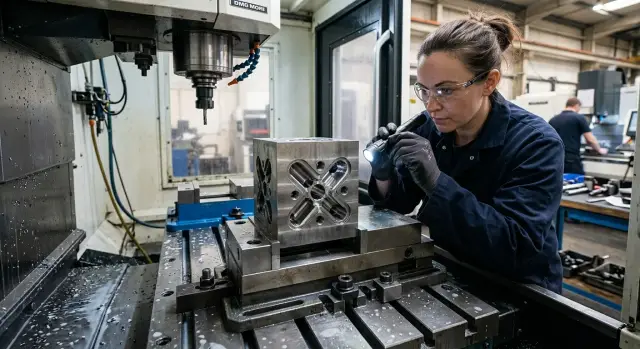
Why drift and burrs appear at the intersection
When drilling intersecting holes, the problem begins the moment the drill stops cutting solid metal. As long as the tip moves through continuous material, the load on both cutting edges is more or less even. When the tool reaches an already drilled hole, part of the tip suddenly ends up in empty space, and support disappears.
Because of that, one edge keeps cutting while the other hardly works at all. The drill immediately pulls toward the intersection. The smaller the diameter, the longer the overhang, or the harder the feed, the more noticeable the drill drift becomes.
There is a second reason too. A thin metal edge remains along the intersection line, and it acts like a guiding step. The tool catches on that edge and moves away from the intended axis. Sometimes the shift looks small, but on the next operation it already leads to a bad size, a rough wall, or a shifted exit.
A burr at the exit appears for a similar reason. When the drill comes out into a zone where the material is already weakened by the neighboring hole, the metal has no proper support. Instead of a clean cut, a thin bridge remains, and the drill does not cut it but tears it away. That is how a burr forms at the exit, sometimes with tearing along the hole edge.
Even a small mistake in the first hole ruins the second one more than it seems. If the first hole drifted by a few hundredths or became slightly oval, the second drill will meet the intersection earlier or later than the calculated point. Then the load becomes uneven again, and the tool starts repeating the earlier error.
On a simple housing part, this is easy to see. First a longitudinal hole was drilled with a slight downward shift. Then a cross hole was drilled to nominal, but at the intersection it dropped into the existing cavity, pulled slightly downward, and left a torn exit. The defect outside looks small, but inside the holes no longer intersect the way they were intended to.
So drift and burrs here are not random. They are caused by the geometry of the intersection itself, and any weak setup, clamping play, or error in the first hole only makes the effect worse.
What affects the result before drilling even starts
Problems do not begin the moment the drill reaches the intersection. Usually they start earlier, during the evaluation of the part, the tool, and the clamping setup. If the wall near the future hole is thin, the metal flexes more easily, and the drill is more willing to move sideways as soon as it feels the void of the second hole.
The shape of the part also changes the picture. A short rigid bushing and a long housing behave differently even with the same diameter. If there are thin webs, pockets, or protrusions near the intersection area, the part handles the load worse, and the edge at the exit tears more strongly.
What should be checked on the drawing before starting:
- how much metal remains around the intersection
- the diameter of the main and cross holes
- how long the drill overhang needs to be
- what kind of edge is needed right after drilling
The difference between the two hole diameters often matters more than it seems. When one hole is noticeably larger than the other, the drill loses normal support as it enters the intersection zone. If the hole is also narrow and deep, drift grows even faster. In drilling intersecting holes, this is a common cause, not a rare exception.
Tool overhang affects things directly. The farther the cutting part is from the chuck, the easier it is for it to deflect. Weak part clamping creates the same problem. Even a good tool will not save the process if the part shifts slightly or vibrates under feed.
Feed direction also cannot be ignored. If the drill approaches the intersection through a more rigid area, it holds the axis better. If it reaches the void or a thin wall too early, burrs appear more often at the exit. This is especially noticeable on small housing parts where the distance between holes is small.
One more point is often underestimated: what edge is needed after the operation. If the part cannot be finished by hand for long afterward, the requirements for the cutting conditions, support, and drill geometry become stricter. It is better to account for that right away than to remove burrs later in a place that is hard to reach with a tool.
How to choose the order of operations
When drilling intersecting holes, the order of operations matters more than it seems. If you choose it by eye, the drill often drops into the intersection cavity, and burrs grow at the exit. Then the part has to be saved with manual finishing, and the size starts drifting.
First, establish the reference and check where the main hole will start. The reference is chosen not for convenience in clamping, but for the surface that best holds size and direction. If the main hole defines a fit, alignment, or the position of the hole in the assembly, it should be the priority.
Next, look at wall stiffness. Usually, the hole is made first where the metal supports the drill more reliably. If one wall is thin and the other is massive, it is better to start from the stiffer side. That way the tool is pulled sideways less when it approaches the intersection zone.
When it is better to leave the intersection toward the end
If the edge at the intersection is sensitive, do not bring it out in the early operations. First complete the holes and bores that define the geometry of the part, then move on to the intersection. This sequence often reduces burrs at the exit because you already understand the real wall thickness, the hole position, and the allowance for later cleanup.
The burr removal plan also needs to be set in advance. It should not be left for later with the idea, “we’ll deal with it after the first batch.” It is better to decide right away how the burr will be removed, from which side, and whether that operation will damage the edge or the size.
On a CNC machining center, it is useful to check five things in advance:
- which reference the main hole starts from;
- where the wall is stiffer;
- at which operation the intersection appears;
- what will remove the burr;
- which part will be the control sample.
On a simple housing part, it looks like this: first the base planes are machined, then the main hole is drilled, and after that the cross hole is made. If the technologist decides to swap these two holes in the middle of the batch, the very next part must become the control part. Otherwise, you can end up with a series with a different drill drift and a different exit burr.
For serial work, the rule is simple: approve the sequence, make a control part, check the intersection, and only then start the full batch. In drilling intersecting holes, an unauthorized change in the order of operations almost always costs more than ten extra minutes spent on checking.
How to hold and support the part
Even a good drill will not help if the part is moving in the fixture. When drilling intersecting holes, this shows up immediately: the entry looks fine, but at the exit you get drift, a torn edge, or a noticeable burr. The reason is simple: at the moment of exit, the wall is already weaker, and any extra flexibility pulls the tool off course.
Support should be placed as close as possible to the exit zone, especially if the wall is thin. That does not mean the part should be clamped extremely hard on all sides. You need support that holds the metal at the weak point but does not block the drill path or the chip exit.
If the part is clamped in a chuck, check the overhang. An extra 20–30 mm in the part, the arbor, or the tool itself often creates more trouble than expected. The shorter the whole setup is, the less it flexes under load. This is especially noticeable with long, small-diameter drills.
Where support helps, and where it gets in the way
Good support holds the wall, but does not create a chip trap. If the chips have nowhere to go, they start rubbing against the edge, heating the cutting zone and damaging the exit hole. That is why support often has a small opening, a relief, or is placed slightly to the side so the chips can escape freely.
It is useful to check the part not only by eye, but under load too. Clamp it in the fixture as it will sit in production, and apply a light force by hand or with an indicator toward the drilling direction. If the part flexes noticeably, the clamping or support layout is weak. Then it is better to move the stops, add a support pad, or shorten the overhang.
On a simple housing part, it looks like this: the hole exits into a thin side wall, and without support the edge tears. If you bring support almost up to the exit point and remove unnecessary tool overhang, the exit mark usually becomes cleaner on the first try.
Before the batch, it is worth making one trial pass and looking specifically at the exit mark:
- is the edge crushed;
- does the burr pull to one side;
- has the center shifted;
- has chip buildup formed near the support.
One trial part often saves an entire shift of rework. If the exit is clean and the part does not flex, the clamping setup can stay in production.
Step-by-step sequence
When drilling intersecting holes, the error usually appears not at the end, but right at the beginning. If the drill entered with drift or started into the material too aggressively, it will almost always show up at the intersection as a shift and a torn edge.
It is better to keep the same sequence of operations. Then it is easier to find the cause of the defect and not adjust the cutting conditions at random.
-
First, mark the hole with a short and rigid tool. A center drill or short spotting drill defines the entry point and keeps the main drill from wandering in the first revolutions. On an uneven surface, this step often solves half the problem.
-
Start the main drilling calmly. In the first few millimeters, do not use extra feed, even if the material cuts easily. The drill should enter straight, not force its way through. On a small part, the difference is immediately visible in the sound and in the chip shape.
-
When the drill approaches the intersection zone, reduce the feed in advance. Not at the moment of drop-in, but a little earlier, while the cutting edge is still fully supported by solid metal. On a CNC machine, this is easy to build into a separate section of the program. With manual feed, the operator should rely on depth with a safety margin of a few tenths of a millimeter.
-
Watch not only the depth number, but also how the drill actually exits into the intersecting hole. At that moment the load changes sharply: one edge is already hanging in empty space while the other is still cutting metal. If the feed stays the same, the drill easily pulls sideways, and the burr grows at the exit.
-
Check the edge and size right after the pass. Do not leave inspection until the end of the batch. Look at the exit in the intersection, remove any small burr if it appeared, and check the diameter at least on the first parts. If the size drifts or the edge tears, it is much easier to find the cause from a fresh mark than an hour later.
This sequence does not look complicated, but it holds the result well. For drilling intersecting holes, it is often enough to eliminate drill drift, reduce burrs at the exit, and avoid wasting time on unnecessary finishing.
Example on a simple housing part
Take a simple housing with a longitudinal oil hole and a cross hole. According to the drawing, the cross hole must meet the axis of the longitudinal one precisely. It looks straightforward, but this is exactly the kind of assembly where you can clearly see where drill drift and exit burrs come from.
Work starts with the reference surfaces. On the housing, the support planes are machined first, then the part is aligned on axis. If the reference is set incorrectly, later drilling will not fix the situation. The cross hole will enter the longitudinal one with a shift, even if the tool is sharp and the machine holds size.
After that, the longitudinal hole is drilled. It should not be left unchecked. If the drill already drifted on this step, the intersection will be uneven, and the inner edge will be torn. Usually the axis position, depth, and the actual hole exit are checked.
For such a part, the working sequence is usually simple:
- Machine the references and clamp the housing securely.
- Set the axis by the references.
- Drill the longitudinal hole and check for drift.
- Then drill the cross hole, reducing feed before the intersection zone.
Reducing the feed before the intersection makes a noticeable difference. When the cross drill approaches the longitudinal hole, one cutting edge enters empty space before the other. At that moment, the tool is easily pulled sideways. If the feed stays unchanged, the metal tears more strongly at the edge, and the burr becomes larger.
On a simple housing part, it helps to reduce the feed a short distance before the intersection and keep the clamping rigid closer to the drilling area. This is especially useful if the wall is not very thick. Then the housing flexes less, and the exit becomes cleaner.
Right after the exit, it is worth checking two areas: the outer edge of the cross hole and the inner edge in the longitudinal hole. Outside, look for a torn exit and crushing. Inside, check whether a burr is hanging at the intersection point. If you catch this immediately, you can quickly remove the burr and adjust the process before the full batch starts.
Where people make mistakes most often
Defects in this operation usually do not come from a complicated geometry, but from a couple of familiar shop-floor decisions. When drilling intersecting holes, a small detail quickly becomes a problem: the drill wanders at the intersection, and a rough burr remains at the exit.
Errors that most often cause defects
The first common mistake is using a long drill just because it is already available in the tool rack. If a shorter drill can easily reach the required depth, use it. A short drill is stiffer, wanders less, and passes through the intersection zone more calmly.
The second mistake is making the second hole right away without checking the first one in practice. On the drawing, everything may look fine, but the real axis sometimes shifts by fractions of a millimeter. On an intersecting hole, that is already enough for the second drill to meet the void earlier or later than expected. Then the operator sees the drift, but there is nothing left to correct.
The third mistake is related to feed. Many people keep the same setting all the way to the exit, even though conditions change sharply at the intersection. The drill loses proper support, starts pulling sideways, and the edge tears the metal instead of cutting cleanly. A slight reduction in feed before the exit often gives a cleaner edge than trying to remove the burr by hand afterward.
Another common miss is clamping the part far from the machining area. From the outside everything looks rigid, but in operation the part or a projection starts to flex slightly. That is enough to create vibration, and vibration quickly ruins both size and the hole surface.
And probably the most stubborn self-deception is blaming the burr on the material. Yes, tough metal is more difficult to handle. But if the burr appears on the same part only after the operation sequence changes or after a different setup method, the issue is usually not the material.
If the defect repeats, it helps to quickly check three things:
- whether a shorter drill would be enough;
- whether the first hole matched the calculation in the actual part, not just on paper;
- whether the feed was reduced before the exit and the clamp brought closer.
This is usually where accuracy, time spent on rework, and part of the batch are lost.
Quick check before starting the batch
Before a series, do not assume the burr will be removed by hand later. When drilling intersecting holes, a small mistake in setup or cutting conditions quickly repeats across the whole batch. Five minutes of checking before the start usually saves both time and material.
If the part needs to be reclamped, start with the reference. After the second setup, the part should return to the same position, not float by a few hundredths. It is better to check this with two or three trial setups using a control dimension or an indicator than to look for the cause of defects after the tenth part.
Before starting, it is convenient to go through a short checklist:
- Make sure the drill protrudes only as far as needed for the task. Extra overhang often causes drill drift, especially before the hole intersection.
- Check that the program reduces feed before the intersection zone and before exiting the material. That is where the drill loses support and more often tears the edge.
- Verify the first part not only by diameter. Look at axis shift, intersection cleanliness, and the exit edge.
- Agree with the operator in advance where the defect will be checked first. If the control points are not defined, a small drift is easy to miss.
- Keep burr removal as a separate operation, not as a way to hide poor drilling.
In practice, it is useful to look at the first part under simple magnification and immediately feel the exit edge with a gloved finger or a gauge. If the edge is torn, the problem is already there, even if the size still holds. Often the issue is not speed or spindle speed, but weak part support or a tool that is too long.
For a small housing part, this set of checks is usually enough to decide whether the batch can continue. If one item fails, it is better to stop and correct the setup, overhang, or feed. On the first part, that takes only a few minutes. Once the series starts, the count quickly reaches dozens of damaged holes.
What to do next
If you have already eliminated drill drift and a rough exit on a trial part, do not start the batch from memory. First, create an operation map with the real sequence of transitions. Write down not only the route itself, but also the small details: where the part is supported, when you change the reference, when you retract the drill to clear chips, and how you remove the burr after the holes intersect.
For this kind of operation, that is not a formality. When drilling intersecting holes, a small change in the sequence of actions quickly changes the result. Today the operator drills the longitudinal hole first, tomorrow the cross hole comes first, and the geometry at the exit is already different.
After a successful trial, lock in the settings that gave a clean exit. You need simple, precise notes:
- spindle speed and feed
- drill type and overhang
- drilling depth and number of intermediate retractions
- clamping and support setup
- what you consider acceptable for the exit edge
If you do not record this right away, in a few days the process will start to be "adjusted" by feel. That is usually how drill drift and exit burrs come back.
Then assess the process layout honestly. Sometimes the problem is not the cutting conditions, but rigidity. If the part is poorly supported, the clamp is far from the drilling area, or the tool sticks out too far, good results will be random. In that case, it is better to change the fixture, add support, shorten the overhang, or move the operation to a more suitable machine than to keep changing the feed by a few percent.
If you are choosing equipment or want to launch such an operation without unnecessary theory, EAST CNC can help you choose the machine, tooling, and startup setup. This is especially useful when you need more than just to buy equipment—you need repeatable results on a real part.
Start with one control part. Check the hole intersection, the exit edge, and dimensional repeatability. Then make a few more identical parts under the same conditions. Only after that should you move the process into production. One successful trial proves nothing. Stable results on several parts are already a solid basis for launching the batch.