
A Drawing Without Measurement Datums: What to Ask Before Quoting
A drawing without measurement datums often leads to a dispute after the first batch. Let’s look at what to clarify with the customer before quoting price and lead time.
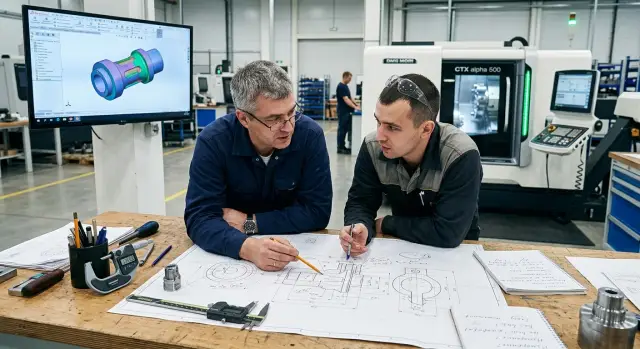
What is the problem with this kind of drawing
When a drawing does not specify datums, everyone reads it differently. The designer may mentally start from one end face, the technologist from another, and the inspector may place the part in whatever way is easiest to measure on the table. The dimensions on paper are the same, but the meaning is already different.
Such a drawing without measurement datums almost always creates hidden uncertainty. This is especially clear on parts with several steps, holes, grooves, or mating surfaces. If it is not clear from which plane or axis to measure a dimension, the point of reference is lost, and with it a shared understanding of the part.
The same dimension starts being interpreted differently in several places:
- the distance between a shoulder and a hole is measured from different end faces;
- the groove depth is measured from the outer diameter or from a neighboring surface;
- the hole position is checked from the edge of the part, even though the designer meant the center axis;
- the length tolerance is applied to the whole part, although it is needed only for the working zone.
The first batch is usually where the dispute appears right away. The shop makes the part according to its own logic, the customer’s QC measures it according to theirs, and both sides are sure they are right. Formally, the dimension may even fall within tolerance, but the part will not fit in assembly or will shift relative to adjacent elements. Then the discussion quickly moves away from geometry and into claims: who understood what, who promised what, and why this was not clarified earlier.
This is also bad for pricing. If the part measurement datums are not defined, the manufacturer builds in risk. They either raise the price because they leave room for rework and extra inspection, or they quote too optimistically and then end up in a dispute after the first batch. Both options are bad.
In practice, the problem is rarely in one dimension. More often it sits in a chain of dimensions. One unclear reference pulls along the setup method, tooling choice, inspection time, and even the scrap rate. That is why, before quoting, it is better to spend ten minutes and remove the ambiguity than to argue later over already finished parts.
What you need to clarify before quoting
When a drawing arrives without measurement datums, the price is almost always only approximate. The same dimension can be taken from different surfaces, and then the part may be “to drawing” in your shop and at the customer’s, but still be different in practice.
First, clarify which surface or axis should be used for inspection. For a turned part, this may be the end face, the outer diameter, the fit, or an already machined step. If this is not agreed, the shop will calculate the size from one end face, while the customer will check it from another and see a mismatch on the first batch.
Next, find out which dimensions affect assembly. Not all deviations hurt equally. For example, a slight shift in a groove may not affect operation, but the distance between a bearing seat and a thrust face often decides whether the assembly goes together at all.
Also ask about tolerances that cannot be changed without written approval. During quoting, a technologist often sees where machining can be simplified and where nothing can be touched. If the customer silently expects one accuracy class and you build in another, a dispute is almost inevitable.
Another common gap is the inspection method. You need to know what the customer will use to measure the finished part: calipers, a micrometer, a bore gauge, a gauge, or a coordinate measuring machine. The same dimension, especially runout, concentricity, or the depth of an internal recess, can be shown differently by different tools.
These direct questions work well:
- Which datum do you use for linear dimensions and runout?
- Which dimensions do you check first during assembly?
- Which tolerances cannot be revised even to reduce price?
- What tool and inspection method will you use to accept the batch?
- Do you need an inspection report for the first batch or for the first part?
Many people remember the last point too late. If the customer expects a report, it is better to agree on it before quoting: which dimensions will be included, who signs it, and whether it is needed for the whole first batch or only for the initial sample.
These questions about the drawing take little time, but they remove the most expensive uncertainty. Fifteen minutes spent agreeing on datums and inspection is usually cheaper than reworking a batch and arguing about who “understood it wrong.”
How to ask the questions in the right order
If you have a drawing without measurement datums, do not start with the price. First remove every place where two sides could understand the dimension differently. A short call helps, but the dispute usually starts later, so the order of questions and written confirmation matter more.
It is better to move from the document to acceptance. That way you will not miss the point where quoting and inspection already diverge.
- First, request the latest version of the drawing. Check the revision number and date, and ask whether there are changes in email or chat that have not yet made it into the file.
- Then mark all dimensions that do not have a clear datum. These may be lengths from an unspecified end face, concentricity without saying what to measure from, or holes defined only through a chain of dimensions.
- After that, collect questions for each disputed point. It is better to write them not in general terms, but point by point:
Which dimensions should be treated as key
If you are looking at a drawing without measurement datums, do not put all dimensions in one line. For quoting and process planning, the important dimensions are the ones that determine assembly, fit, and acceptance inspection. The rest often only describe the shape and should not drive unnecessary precision.
First separate fit dimensions from reference dimensions. Fit dimensions usually include bearing-seat diameters, shaft holes, threads, lengths between thrust faces, and groove width for a retaining ring. If a dimension affects whether the part will fit into the assembly and how it will sit there, handle it immediately. If a dimension only describes a section that does not mate with anything, mark it as reference until clarified.
On turned parts, the dispute usually starts not with the diameter itself, but with the relationship between surfaces. One diameter may be within tolerance, but the part still will not pass because of runout. So ask right away from which surface or axis concentricity, radial runout, and face runout should be measured. If the customer expects the bearing seat and outer diameter to stay on the same axis with minimal deviation, that changes the setup, inspection, and price.
A simple example: a shaft has a bearing seat, a thread, and a flange. For appearance, the flange may be secondary, but flange runout relative to the bearing seat may be a strict requirement. If this is not discussed before quoting, the first batch can easily trigger a dispute even when the individual dimensions look fine.
Another common question is the condition in which the dimension is needed. Clarify which size the customer considers final: after heat treatment, after grinding, or after coating. Otherwise, the shop will make the dimension before the finishing operation, and after coating it will move positive. Heat treatment is the same story: the part may warp, and then allowance for finishing is needed.
Also ask which surfaces must not be turned again or ground. The reasons vary: a seal works there, the original surface finish is required, a coating layer is already specified, or machining would remove hardness from the working area. This kind of restriction strongly affects the process route.
Usually, four direct questions are enough:
- Which dimensions do you check first during acceptance?
- From which surface or axis do you measure runout and concentricity?
- Is the nominal size needed before or after heat treatment and coating?
- Which surfaces are forbidden to re-turn, grind, or correct?
If the customer answers these in writing, the quote becomes more accurate. And the shop gets a clear basis: what to hold tightly, where to leave allowance, and what to treat as a reference dimension.
How to lock in the agreements
If the drawing has no measurement datums, verbal agreement is not enough. The account manager, technologist, and inspector may all understand the same dimension differently. Then the first batch is already finished, and the argument is no longer about the part, but about what each side meant.
It is better to gather one set of documents and answers right away. The basic idea is simple: the customer sends a drawing with the datums marked clearly, and you record every place where the meaning was previously ambiguous. If the customer cannot quickly issue a new drawing, an agreed file with notes will do, but without any “we’ll sort it out later.”
The most convenient way to lock in the agreements is in one email, report, or approval sheet. Usually five points are enough there:
- the drawing version and the file with the measurement datums marked;
- a list of disputed dimensions with the customer’s written answers;
- the inspection method for each tight tolerance: what to measure with, from which datum, and in what position the part should be;
- the rule for the first part: who accepts the sample and what counts as confirmation;
- the name and position of the person authorized to approve drawing changes.
The point about the measurement method is often skipped, and that is a mistake. A 40 ±0.02 dimension can be checked with calipers, a micrometer, a CMM, or a special fixture. The result may differ if the part is seated differently or a different datum is used. If you do not write down the inspection method, a dispute is almost guaranteed.
It is better not to rush the first part. Make it a sample and agree on it separately: photos, an inspection report, datum markings, and the responsible person’s signature. Only then should you start the batch. Otherwise, you risk a situation where the first piece “seems fine,” but the tenth suddenly becomes scrap under a new interpretation.
You also need a simple change procedure. If the customer changes the datum, tolerance, or measurement method, that should not come through a messenger app without confirmation. One authorized person on the customer’s side approves the change, and you save the new version next to the quote and the order.
This kind of documentation does not slow the work down. It saves days of rework and removes disputes after the first batch, especially when the tolerance is measured in hundredths of a millimeter.
An example from the shop
A housing comes into the shop with a hole and two end faces. The drawing shows a dimension from the hole to an end face, but there is no common datum. One end face looks like the fit face, while the other is used for clamping. Because of this, everyone reads the drawing differently.
The technologist puts the part in a fixture using the convenient end face and holds the dimension from there. For the machine, that makes sense: it is easier to set up the part and keep repeatability. The inspector in the shop measures it the same way and gets a normal result.
The customer sees the same dimension differently. For them, the datum is the fit face, because that is how the part is assembled later. They take the first batch, place the part on a plate, measure from the fit face to the hole axis, and see a shift of, say, 0.12 mm. By their inspection, the batch fails.
At the same time, the shop did not make scrap in the usual sense. The shop held the dimension from the datum it chose during machining. The customer was not wrong either. They checked the part from the datum that matters in assembly. The dispute appears not because of the machine or the measurement accuracy. It appears because the sides did not lock in the measurement scheme before quoting.
That is usually how a drawing without measurement datums shows itself. While the part is still on paper, the problem is almost invisible. After the first batch, it immediately turns into missed deadlines, a price recalculation, and extra rework.
In such a situation, only a pre-agreed scheme helps, not a dispute after shipment. Usually, four things are enough to agree on:
- which end face or diameter is datum A
- from which datum the hole dimension is measured
- how the part is positioned during inspection
- which tool gives the final result: gauge, indicator, or CMM
If the part is made on a CNC lathe and then handed over for assembly, these points are better marked directly on the inspection sketch. In the supply and equipment start-up work that EAST CNC handles, such details often decide the fate of the first batch faster than the choice of machine model itself.
One sheet with agreed datums removes the dispute immediately. Without it, both sides are sure they are right, and both can find numbers in their favor.
Where people most often make mistakes
The most expensive mistake starts with a simple thought: “it’s obvious where to measure from.” If the drawing has no clear datums, the shop often chooses the surface that is easiest to place on the table or to measure with calipers. That may be convenient for machining, but for assembly that logic often breaks down.
Reference dimensions and mandatory dimensions are often confused. A dimension in parentheses is many people’s idea of an acceptance requirement, although it may be given only for orientation. As a result, the part is made “to all dimensions at once,” and then it fails on the dimensions the customer actually controls.
With a drawing without measurement datums, this is especially dangerous. One specialist treats the end face as the datum, another the outer diameter, and a third the hole axis. All three are sure they are reading the document correctly, but the batch turns out different in reality.
Another common mistake is treating a verbal answer as the final decision. The manager was told on the phone, “measure from this plane.” The technologist passed that to the shop. Two weeks later, the customer checks the parts from a different datum and says nothing was agreed. If there is no note on the drawing, in the technical requirements, or in an email with a clear statement, a dispute is almost guaranteed.
Form and position tolerances are often overlooked as well. Dimensions may match, but the part still will not fit the assembly because of runout, concentricity, parallelism, or perpendicularity. This is common in turning: the diameter is held, the length is held, but the axis shifts by hundredths, and the problem shows up only at assembly.
A failure usually looks like this:
- measuring from a surface that is convenient in the shop, not the one needed in the product
- checking only linear dimensions and not geometry
- treating reference dimensions as mandatory
- trusting verbal agreement without written confirmation
- starting the full batch before checking the first part
The last point hurts the most. The first part is not for formality, but to verify the measurement principle itself. If the customer confirms the first part with a clear inspection scheme, work becomes much calmer after that. If that step is missing, even a good machine and careful machining will not save you from a dispute after the first batch.
Quick check before starting
If you have a drawing without measurement datums, do not assume the shop, QC, and customer will understand it the same way. Before starting the batch, it is better to do a short check. It often takes less than half an hour and can save you from reworking the entire first batch.
Check this before starting:
- The dimensions that affect assembly and fits have datums, or there is separate written agreement.
- The customer has confirmed exactly how they will measure the part and from which surfaces.
- The setup operator and technologist understand which surfaces must be kept in one setup.
- QC has the same inspection tool the customer uses, or the difference has been agreed in advance.
- The first part is sent for approval before the full run begins.
In practice, disputes often start not with machining, but with the checking method. The shop measures a dimension from one end face, while the customer measures it from another. On paper, both are right, yet the part still ends up in the disputed zone. This happens especially often with holes, slots, and dimensions between machined and cast surfaces.
If the part is made in two or three setups, the shop should decide in advance which surfaces preserve the geometry of the whole part. Otherwise, one dimension may be within tolerance while the neighboring one drifts after the part is flipped. For turning and milling parts, this is a common mistake: using the convenient datum instead of the one used later for inspection.
Also recheck the measuring tool. If the customer checks the part on a coordinate measuring machine, and your shop only uses calipers and a micrometer, a mismatch can easily appear even on a simple part. Not because someone made a mistake, but because the measurement method is different.
The first part should become a point of agreement, not just a trial piece. Make it, check it, send a report or photos with dimensions, get a response, and only then move to production. This order is especially useful when the drawing arrives with incomplete datums and the deadline is already tight. It is better to delay the start by a day than to recalculate the whole order later.
What to do next
If the drawing does not have clear datums, a pause is better than rushing. First, gather one working file: the drawing itself, the list of questions, screenshots of the disputed areas, notes on dimensions, and the customer’s answers. When everything is in one place, the team does not lose details in email and messengers.
At this stage, it is better not to name the price and lead time even “preliminarily.” One unclear dimension can easily change the setup method, tooling choice, and inspection time. Because of that, the quote almost always looks good only on paper, and the dispute starts after the first batch.
Then check whether the technologist, operator, and inspection team read the drawing the same way. If the shop measures a dimension from one surface and QC checks it from another, the problem is already built into the launch. For a simple check, take 2-3 of the most sensitive dimensions and ask each person separately to show from where they will measure them.
A convenient order is:
- gather one file with questions and notes;
- send the customer a short list without extra wording;
- wait for the answers and record them in the same file;
- only then calculate the price, lead time, and process route.
Sometimes it helps to add a small example directly in the drawing comment. For example: “Do we measure dimension 48 from axis A or from end face B?” Such a question reads better than a long email full of general phrases. It is easier for the customer to answer quickly, and you are left with a specific record you can rely on later.
If the part is only being planned for series production, it is worth looking broader than one disputed drawing. For such a part list, the machine, tooling, and inspection method are often selected together. At EAST CNC, you can discuss not only the machine itself, but also the drawing requirements, the right equipment configuration, and support before start-up. That is especially useful when the part is complex and the tolerances are tight.
A good finish before launch is simple: you have one agreed file, clear measurement datums, the same reading of the drawing in the shop and in inspection, and only then the quote. That order takes a little more time at the start, but it saves weeks of rework and disputes.