
Drawing for cycle time calculation: what to specify right away
A drawing for cycle time calculation should show datums, dimensions, material, stock allowance and surface finish. We explain what to specify for an accurate estimate.
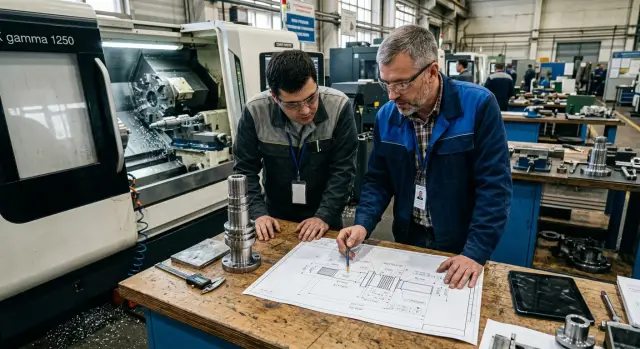
Why you can't calculate cycle time from a general sketch
A general outline of the part is not enough for a reliable cycle time calculation. On the machine they don't count the silhouette, they count operations: how many times the tool will enter the material, where roughing is needed, where finishing is required, when a tool change is necessary and how long setups take.
The same sketch can lead to very different cycle times. A shaft with a shoulder looks simple on paper, but the drawing may reveal a precision fit, a groove for thread runout, chamfers, a relief or an area with tight tolerances. Visually the part is almost the same, but the cycle is different.
Datums matter a lot. If the drawing doesn't show how the part will be located and how the dimension chain is built, the engineer starts choosing a clamping method: chucking by OD, working from the face, flipping the part or doing all operations in one setup. Each option changes time and tooling.
Material can't be left as a default either. Steel 45, stainless and aluminum cut at different speeds even with similar geometry. Cutting regimes, tool life and overall cycle speed change. Without material, the estimate stays a rough approximation.
The same goes for surface requirements. If surface finish and tolerances are missing, you don't know whether a single pass is enough or if finishing passes, additional inspection and stops for measurement are needed.
Typically a general sketch is missing four things:
- clear datums and the method of fixturing
- part material
- dimensions with tolerances
- surface finish requirements and specific surfaces
So from a general sketch you can only get an approximate price and lead time. To calculate close to actual machining, the drawing must show how the part will be set up, what exactly the machine will remove and what result is required.
What to put on the drawing right away
If the sheet shows only the general contour, the estimate will almost always be off. You need all dimensions that determine metal removal: not only overall diameter and length, but steps, grooves, reliefs, drilling depth, thread length, chamfers and radii. Even a small groove for a snap ring adds a separate operation and time.
Specify datums immediately. One datum is for the setup, another for inspection, and it's better not to mix them in the same dimensioning logic. When the datum is unclear, the engineer assumes one clamping method and the quality inspector another, and the resulting time and tooling diverge.
Also indicate material and the type of blank. Steel, stainless, aluminum and cast iron machine differently. Bar, forging, casting or a prefabricated blank with allowance lead to different amounts of material removal.
Usually five groups of data are enough:
- dimensions of all machined surfaces
- datums for setup and measurement
- part material
- blank type and stock allowance, if known
- tolerances, threads, chamfers, radii and surface finish
It's useful to separate normal and precision surfaces right away. If one journal is for a bearing with tight tolerance and the adjacent diameter is only a free fit, don't assign the same requirements to both. Otherwise the estimate will include unnecessary finishing passes where they aren't needed.
On a simple shaft this is obvious: the bearing fit, threaded end and face for an axial stop require different approaches. When that's clearly shown on the drawing, it's easier to understand how many setups are needed, what tooling is required and where the cycle will increase most.
Which dimensions affect cycle time the most
Not all dimensions influence cycle time equally. Some barely change the estimate, while others immediately increase the number of passes, change the choice of tool and even the fixturing scheme.
External material removal is usually faster than internal. Boring with a long tool is more cautious, especially when the hole is deep and narrow. A 20 mm diameter at 100 mm depth and the same diameter at 30 mm depth are different conditions, different time and sometimes different tooling.
Length of the machined section often matters most. A 40 mm diameter section over 25 mm length and the same diameter over 180 mm require different time. If there is a large stock allowance on top of that, one pass won't be enough.
The features that increase cycle time the most are:
- narrow grooves and undercuts
- long internal sections
- long or fine threads
- intersecting holes
- zones with tight tolerances and low surface roughness
Grooves and narrow spots are often underestimated. On paper they look minor, but on the machine they require careful approach, short feeds and careful tool exit. Because of one thin relief, a fast route can stop being fast.
Also call out zones with tight tolerances separately. If the whole shaft can be made in normal mode but one journal for a bearing requires precise size and a fine surface, cycle time grows because of that area. Additional measurements, finishing passes and sometimes a separate tool appear.
How to show datums without confusion
First choose the primary datum for the first setup. From it the engineer understands how the part will be clamped, which side machining starts from and which dimensions can be achieved in one setup. If the datum isn’t shown or is ambiguous, the estimate becomes rough.
A common mistake is simple: some dimensions are given from the face, some from a shoulder, some from the axis, but it's not explained which datum is used in the first operation. As a result one specialist plans the process with a reposition, another without. For a simple turned part this already makes a noticeable difference in time.
What to mark on the drawing
It's convenient to mark datums with letters A, B, C and keep that logic throughout the sheet. For the first setup one main datum and one auxiliary datum are usually enough.
- From one datum give dimensions that will be achieved in the first setup.
- From the other give dimensions that are built after re‑clamping.
- Show the inspection datum separately if measurement will be done differently than clamping.
- Mark surfaces that must be concentric to the datum axis.
- Note areas that must not be chucked or regripped with centers.
This is especially useful for shafts, bushings and parts with multiple fits. If the bearing fit must be concentric with the thread and the journal for the seal, state it explicitly instead of leaving it to guesswork.
Short notes close to the problematic area work well: "do not regrip", "inspection from datum A", "concentric to A". Such clarifications often remove unnecessary questions before the estimate.
Material, blank and stock allowance
If the drawing only says "steel", the time estimate will almost always be inaccurate. The same geometry machines differently depending on whether it is steel 45, 40Kh, stainless or aluminum. For the engineer this immediately affects cutting regimes, insert selection and number of passes.
Prefer specifying the exact material grade. If the material is supplied in a certain condition, note it too: normalized, hardened, tempered, drawn bar, cast blank. When hardness is known, the estimate gets more accurate. A simple note like HB 220-240 or HRC 28-32 is enough.
Blank type also needs to be stated. Bar, forging and casting give different starting shapes and therefore different removal volumes. For turning it's especially noticeable: round bar is usually processed faster than a forging with extra allowance and irregular OD.
The minimal dataset here is:
- material grade
- supply condition or hardness
- blank type
- blank dimensions before machining
- stock allowance per side or by diameter
Don't leave allowance as a default. If the final OD is 60 mm and the blank is 70 mm, the machine removes a very different volume than with a 63 mm blank. That immediately changes time for roughing passes, tool load and sometimes even chuck choice.
Also state whether heat treatment is applied. If done before machining, cutting regimes are one thing. If after, you need to know where to leave stock for grinding or a final pass. Without that, tooling and cycle time can be off.
How accuracy and surface requirements change the estimate
Tolerance and surface quality often affect the estimate more than the part shape itself. The same shaft can be made quickly if workplaces are not demanding, and significantly slower if fits require small tolerances, low roughness and runout control.
In production this is not a formality on the drawing. A small tolerance almost always means a lower feed, an additional finishing pass, more measurements and sometimes a different fixturing scheme. So set precise requirements only where they matter for the part's function.
Good practice looks like this:
- apply tight tolerances only to functional diameters and lengths
- indicate surface finish by specific zones, not a single blanket note
- mark bearing, bushing and seal fits separately
- tie runout and concentricity to the necessary surfaces
- note finishing pass requirements next to the relevant feature
If these are missing, the estimate becomes too optimistic. A drawing might show a simple cylinder, but in the shop it turns out one journal is for a bearing, the next surface works with a seal and the face must meet runout. Time increases after production starts.
General notes at the bottom of the sheet often do more harm than good. If runout, concentricity or finishing pass requirements are buried in text, they can be missed. It's much more reliable to attach each requirement directly to the respective surface.
How to prepare the drawing step by step
Start not with overall length and diameter, but with the part's function. The maker should immediately see which surfaces are functional: where the fit is, where concentricity is required and which surfaces are secondary. After that it's easier to build the rest of the drawing.
A convenient order is:
- Mark functional surfaces. For a shaft this could be the bearing fit, the threaded end and the face that stops in assembly.
- Assign the datum for the first setup. If you don't show it, the estimate will likely be based on assumptions.
- Provide dimensions for all transitions: steps, grooves, chamfers, reliefs, threads, radii, depths and distances between features.
- Indicate material, blank type and stock allowance.
- Check zone requirements: where a precise size is needed, where a standard tolerance is enough, where low surface roughness is required and where it is irrelevant.
Mark controversial points directly on the drawing. Short notes like "tolerance to be confirmed" or "blank may be substitute by forging" save a lot of correspondence and prevent padding extra time into the estimate.
A good drawing shouldn't be overloaded, but an empty sketch doesn't work either. If a part has two precision zones and one rough area, show that. For estimating it's much more useful to have clear logic than a neat but silent sheet.
Example: a shaft with a thread and a bearing fit
Take a simple shaft in steel 45, length 120 mm. The main portion has a diameter of 35 mm. If the blank is close to that size, the OD can be turned fairly quickly.
But the same shaft may include a bearing fit, for example Ø30 h6 over 20 mm. That changes the estimate: a separate finishing pass and an in‑process check between passes are often needed, because a few hundredths make the part scrap.
Threads are not done "along the way" either. If an M24x1,5 thread 18 mm long is required at the end, the machine needs a different tool, a separate program section and time for threading in and out. Even a short thread noticeably changes the cycle compared to a smooth shaft.
A groove for thread runout also changes the route. Without it the thread often cannot be cut properly. A groove may seem minor, but it adds another operation.
Blank size strongly affects time. If the 35 mm part is made from Ø36 bar, the removal is small. If the blank is Ø42, the machine removes more metal, tool load increases and another roughing pass may be needed.
With such an example they usually check four things: where the main stock can be removed quickly, where a precision fit is needed, what threads exist and how much extra material must be removed from the blank. Real cycle time is assembled from these factors.
Where mistakes happen most often
Most problems are caused not by complex geometry but by missing data. From such a drawing you can understand the part's shape, but you can't properly calculate operations, time and tooling.
A typical mistake is a single general tolerance applied to the whole drawing. It looks neat on paper but is bad for estimating. If it's unclear where a precision fit is needed and where standard machining is enough, the estimate includes a safety margin—sometimes too large, sometimes too small.
Lack of blank data causes no less confusion. If material, starting size and blank shape are not specified, you can't determine removal volume. For turning the difference between bar, forging and tube immediately changes the process plan.
People often forget "small things" that on the machine aren't small: chamfers, radii, grooves, reliefs for tool exit and approach areas. If a shaft has both a thread and a bearing fit but no thread runout, the engineer must invent how to perform the transition.
Another mistake is giving surface finish only in a general note. For estimating you need to know which surface requires Ra 0.8 and which can be rougher. Otherwise it's hard to tell where a finishing pass, grinding or special tool is required.
Dimensioning that can't be related to each other also fails. One dimension is given from the left face, another from a centerline, a third without a clear datum. First you have to reconstruct the part logic, then calculate machining. That's when extra questions arise.
Quick checklist before sending the drawing
Before sending the drawing, look at the sheet as someone who sees the part for the first time. They should immediately understand how to chuck it, what datums to measure from and which surfaces require separate passes or higher accuracy.
A quick pre‑send check usually comes down to five questions:
- Are datums visible right away?
- Are there enough dimensions to build the machining route?
- Is the material specified precisely, not just the word "steel"?
- Are surfaces with special requirements marked separately?
- Is the blank explicitly named with its starting size and allowance if known?
One such check often saves a lot of time. A shaft may look simple, but an unnoted stock allowance on the OD changes tool choice, number of passes and the final estimate.
If after one review another specialist can name the sequence of operations, the document is ready. If not, add the missing data before sending.
What to do next
Send the final drawing together with data without which the estimate would remain a guess. Usually the drawing is enough; if available, include a 3D model, state the batch size and say what's most important now: lead time, price or accuracy. It helps to indicate what can be changed and what is mandatory.
This often decides a lot. If it's clear in advance whether the blank can be substituted, the tooling simplified or a different fixturing method used, cycle time can be estimated faster and more accurately. Sometimes using a forging reduces allowance and saves minutes per part. For small batches it's sometimes simpler and cheaper to take a different blank.
Also state where compromises are unacceptable. For example, the bearing fit and the working journal's surface finish may be strict, while the face form or a secondary chamfer may be flexible. Then the estimate is closer to reality and there is less back‑and‑forth.
If you also need advice on suitable equipment and the machining route, EAST CNC can help at the consultation stage. The company supplies CNC lathes and machining centers and supports commissioning and service, so it's convenient to resolve ambiguous drawing points before the project starts.
The fewer unclear items at the start, the smoother the launch.