
Deep Drilling on a Machining Center: Where the Standard Cycle Ends
Deep drilling on a machining center often causes chip clogging, tool heating and size drift. We explain the warning signs, standard drill limits and what to check.
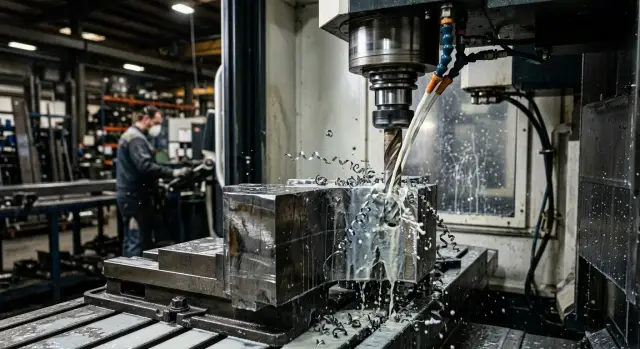
Why the standard cycle starts to fail
Failures in deep drilling rarely happen suddenly. At first everything looks fine: the drill cuts cleanly on entry, chips evacuate, the sound is steady. That makes it easy to assume the process will stay stable. But with increasing depth conditions change fast.
When the hole is short, chips have space in the flutes. Then they get cramped. They either break into fine crumbs or stretch into long ribbons. Both are bad. Dark, fine crumbs usually point to friction and overheating. Long ribbons catch on the tool, hit the wall and get pulled back under the cutting edge.
Often sound warns earlier than the part. Steady cutting turns into a hum, a whistle or short impacts. That means the drill is not only cutting but rubbing, and chips come out in bursts. If you keep the same cycle, temperature rises quickly and the edge wears out well before it should.
At depth several factors combine. Coolant reaches the cutting zone worse. The tool deflects more easily. Chips don’t fully clear the hole and return under the edge. At the start of the cycle the standard scheme still works, but the margin runs out fast.
It shows not only on the tool. Hole size starts to drift because the drill no longer runs steadily. The bottom looks dirtier, and walls show scores and rubbing marks. Most often those marks are left by chips that didn’t exit in time.
The issue is not always the drill itself. More often it’s the combination of cutting data, cycle, coolant feed and the actual hole depth. The process sends signals first: sound changes, the tool heats up, chips look odd, and hole quality slowly declines. If you only watch the first seconds of cutting, it’s easy to miss.
Where the standard drill’s margin ends
It’s more useful to assess a standard drill’s limit not in millimeters but by depth-to-diameter ratio. A 12 mm hole 60 mm deep and a 12 mm hole 24 mm deep are different tasks despite the same diameter.
For many common spiral drills steady work stops after about 4–5 diameters of depth. Sometimes you can go farther, but only with a favorable combination of material, cutting data, machine rigidity and precise setup. Past that point any small issue becomes critical.
The first reason is simple: chips find it harder to exit. With a short channel the flutes carry chips out without excessive rubbing. When the hole is long, chips snag on the walls, break irregularly, pack into the flutes and fall back under the cutting edge. Then the drill cuts not only the material but also its own chips.
As depth increases external coolant influence weakens. At the hole entry coolant still works, but it reaches the tip less effectively. Early in the cut this is barely noticeable, but nearer full depth overheating comes quickly: chips darken, the edge wears, and the internal surface roughens.
Another common source of trouble is runout. At shallow depth it may be unnoticeable. Over long travel even small misalignment is amplified: one cutting edge takes more load, the drill drifts sideways, and the wall gains scratches and slight taper.
Before starting, ask four simple questions:
- What is the depth in diameters rather than just millimeters?
- Can chips clear the flutes without packing?
- Does coolant reach the tip, not only the entry?
- Is there any runout in the spindle, holder or tool?
If at least two of these are near the limit, the operation stops being trivial. In that situation merely lowering feed or speed often won’t help. Changing the cycle, the drill type, or using through-tool coolant usually gives better results.
What chips, sound and wall marks tell you
Deep drilling almost always warns in advance. The most reliable signals are chips, cutting sound and the hole surface on the first parts.
Short dark chips often indicate overheating. The drill cuts poorly and rubs more. This happens with weak coolant supply, too long a cut without proper chip evacuation, or an unlucky feed/speed pair. If chips are light at the entry but darken further in, heat at depth is not escaping as it should.
Long spiral chips look harmless at first. Deep in the hole they snag in the flutes, kink and exit intermittently. Then they start rubbing the wall. You’ll see longitudinal scratches and size drift after only a few holes. This is a common sign that a standard drill is at its limit even if the numbers on the program look normal.
Sound is also readable if you’re not treating it as background noise. A steady tone usually means chips evacuate consistently. A dull, intermittent noise often accompanies flute clogging. If slight vibration and short load spikes join it, the process is already on the edge.
Wall marks show what you can’t see during cutting. A clean surface without clear bands typically means even chip flow. Repeating bands, shiny rings and local burrs indicate chips exiting irregularly — a pattern that often appears before the operator decides to change the cycle.
On the shop floor it looks simple. At first the hole makes normal chips. Then dark crumbs appear mixed with long ribbons, and the sound goes dull. Waiting for the next part to be fine is usually futile. The process is already asking for a different scheme.
What to check before changing the scheme
Don’t immediately swap the drill or rewrite the cycle. Often the root cause is a basic issue: excessive overhang, weak clamping, runout or coolant drop. If you skip these checks, a new regime may fail for the same reason later.
First check tool overhang and clamping. The longer the overhang, the easier the tool is to deflect, especially on entry. Sometimes removing a few millimeters noticeably increases rigidity.
Then check runout — not only in the holder but at the drill tip. A small deviation at the nose quickly turns into drift, rising load and poor chip evacuation.
Next compare actual spindle speed, feed and peck depth with the tool card. Machines often keep old values from another job or material. Even a close regime can break chips where you don’t want them or create long spirals instead of short chips.
After that check coolant delivery through the whole cycle, not only at start. Pressure and flow must remain stable once the drill is deep. If the pump droops, filters are clogged or the supply loses pressure, chips start packing even if everything looks normal at the entry.
Only after these checks run a short test at reduced depth. Don’t go straight to full size. Let the tool go partway into the hole, stop and inspect chips, sound and wall marks. This test quickly shows whether the adjustments helped.
If the drill still sings, heats up, draws long chips or leaves rough marks, the issue is beyond small tuning. Then change the approach: peck depth, drill type, coolant feed or the whole cycle.
When the process needs a different scheme
Switch the scheme earlier than it seems necessary. While depth is moderate, the standard cycle holds. Later size begins to drift, walls darken and scrap appears.
A clear sign: the hole holds size only at a greatly reduced feed. Technically the part may be within tolerance, but the machine wastes time, the drill heats longer, and its life drops quickly. If after adjusting speed, feed, peck depth and coolant the tool still dies fast, the problem is not a single number in the program.
Often the weak point shows in the last millimeters of depth. The drill moves fine through the first section, but near the bottom you see scores, burrs, taper or a damaged exit. That means chips and heat are accumulating faster than the cycle can remove them. Trying to rescue the process by further slowing feed is a poor trade: cycle time increases but quality doesn’t return.
In practice the decision to change the scheme follows several signs together:
- chips exit in bursts and return into the cutting zone;
- size only holds at very slow feed;
- the drill wears quickly despite standard tuning;
- scrap appears at the end of depth.
For example, a 10 mm hole to 120 mm depth can run fine to 80–90 mm, then start rubbing the wall and ruining the exit. If the operator already reduced feed and increased pecking but wall marks remain, a new regime alone won’t fix it.
At that point people change the whole approach: use a drill with internal coolant, pick a different tool geometry for the material, or redesign the operation. Sometimes it’s cheaper to split the operation into stages than to push a standard cycle farther.
A simple shop example
On a machining center they drilled a long hole in a steel sleeve. Early parts were fine: size held, surface was smooth and the drill didn’t overheat. Then diameter started wandering by hundredths, and by the end of the batch variation was no longer random.
The operator noticed two things right away: a long chip hanging at the exit and a dull knocking sound when the tool reached depth. That sound rarely ends well — it usually means chips are cramped in the channel and the drill is rubbing much more than cutting.
The check took little time. The hole was long, the material tough, and the cycle was nearly the same as for a shallower hole. That had been enough for the short section. When depth grew, the regime could no longer evacuate chips properly. The drill first cut, then started rubbing, heating and slightly pulling the hole off axis.
It wasn’t just one feed or speed. Several small issues combined: the peck depth was too large for that length, returns didn’t clear the channel, and the standard drill had reached its limit.
They changed the scheme: installed a tool better suited to the depth, reduced the peck increment, rebuilt the chip-extraction cycle and separately checked coolant feed. On the next series the sound smoothed, chips became shorter and size stopped drifting.
The notable point: the first parts looked normal, so the process seemed stable while the margin was already nearly gone. On the shop floor this is common. While depth still forgives mistakes the standard cycle appears to work. But once chips stop evacuating cleanly, tool life falls quickly.
Mistakes that quickly spoil the process
Failures in deep drilling often start with attempts to save the process on the fly. The operator hears bad sound or sees wall marks and immediately reduces feed close to minimum. This looks cautious, but in practice the drill starts to rub more than cut. Heat builds, chips stretch longer and the wall doesn’t improve.
The same goes for adding extra retracts. They are often added when chips already run irregularly. But if coolant pressure is insufficient, extra retracts don’t solve the root cause. They only lengthen the cycle and sometimes knock the drill on re-entry.
The fastest ways to ruin the process are common moves:
- too low feed so the edge rubs the metal;
- excessive tool overhang to ease access;
- extra retracts without checking coolant pressure and flow;
- blaming size drift solely on “tough material”;
- continuing the series after the first signs of overheating.
Overhang is an especially common mistake. While the hole is shallow the machine tolerates it. But as the drill goes deeper it deflects more and holds size worse. If you can shorten the assembly even a few millimeters, that often helps more than lengthy tuning of cutting data.
Size drift is rarely explained only by the part material. Yes, a batch can be harder or tougher than usual. But before that conclusion check runout, chuck condition, actual overhang, coolant feed and edge wear. Otherwise the shop looks for the cause in the wrong place.
The most expensive mistake is continuing a run once overheating is visible. Blue or dark chips, the smell of burnt oil, a matte band on the wall or a shriek on exit are not minor. After the first two or three bad holes stop and inspect tool, regime and coolant. One short pause is usually cheaper than dozens of ruined parts and a broken drill.
Short pre-run checklist
Ten minutes of checks before a series can save the tool, the part and the shift. In deep drilling those ten minutes matter.
First check runout of the assembled tool. Look not only at the shank but at the cutting portion. Even a small nose deviation at depth quickly pulls the hole off axis and increases rubbing.
Then reduce unnecessary overhang. An extra 10–15 mm softens the assembly more than you expect and the drill begins to wander on entry. If you can use a shorter setup, do it.
Next ensure coolant pressure and flow don’t drop. If the jet weakens after a few seconds, chips no longer evacuate properly and the cycle begins to punish the tool. Check filters, nozzles and actual flow, not just the number on the panel.
Always inspect chips on a trial pass. Normal chips come predictably, without long tangled ribbons or clear signs of overheating. If chips crumble to dust or, conversely, stretch into a string, the regime or the scheme needs adjustment.
One more commonly missed point: measure size across the full depth on a test part. Measuring only at the entry says almost nothing. If the hole tapers, grows toward the exit or shows wall marks, that appears only at full depth.
It helps to listen to the process too. A steady sound usually means cutting, not rubbing. If at the same depth you hear howling, crunching or short impacts, stop immediately and find the cause instead of waiting for scrap.
What to do next
If the cycle fails consistently at the same depth, don’t treat it with random tweaks. First record the failure point: workpiece material, drill diameter, actual depth, spindle speed, feed and the moment chips stop evacuating properly. Even this simple log quickly shows where the standard drill’s limits are and whether the issue is program data or coolant.
Keep a short table across a few parts. If failure repeats after 6D on one steel but not on 4D, you already have a working guideline rather than a guess. This saves time and tools.
Then compare the intended scheme with what’s actually on the machine. Often the program assumes one rigidity, one overhang and one coolant feed, while in practice a different holder or a simpler tool is used. Then even a careful cycle reaches its limit fast.
Re-check four things: actual tool overhang, coolant feed stability, the spindle’s ability to hold speed without droop, and whether the drill suits not only the diameter but also the depth and the material.
If the part goes into series, decide early rather than after many trial blanks. At that stage it’s important to discuss not only cutting data but also the machine, tooling, coolant feed and service.
For such tasks an outside view from people who do both equipment and commissioning is useful. EAST CNC, the official representative of Taizhou Eastern CNC Technology Co., Ltd. in Kazakhstan, works on machine selection, commissioning and service. If deep drilling becomes the bottleneck, that discussion helps quickly see where you can push the current scheme and where you should change approach.
A good next step is simple: don’t run another random test — gather facts on the failure and check them against your machine and tooling. After that the decision usually becomes obvious.
FAQ
At what depth does a standard drill typically reach its limit?
For a common twist drill, the safe working range often ends after about 4–5 diameters of depth. It can go deeper only if material, setup, machine rigidity and coolant all suit the task.
How can I tell the standard cycle is starting to fail?
Start by listening and watching the chips on the first parts. A dull hum, squeal, short impacts, dark crumbly chips or long ribbons usually appear before size goes out of tolerance.
Which is worse for a deep hole: long chips or dark crumbs?
Both are bad but in different ways. Long ribbons snag on the tool and scratch the wall, while dark fine crumbs usually indicate friction and overheating.
Will simply reducing the feed help?
Don’t rush to lower feed. Too low a feed often turns cutting into rubbing, and heat rises faster.
What should I check before changing the drill or the cycle?
First check runout, clamping, tool overhang and actual coolant delivery. Then compare spindle speed, feed and peck depth with the tool card — old program values often break the process.
How much do overhang and runout affect deep drilling?
Very much so. Extra overhang makes the assembly softer, and even small runout at the tip on deep cuts quickly pulls the hole off axis and overloads one cutting edge.
When is it time for a different tool or internal coolant?
Change the approach when size holds only at very slow feed, the drill wears quickly, or scrap appears at the last millimeters of depth. At that point internal coolant, a different tool type or a new cycle usually help.
How do I safely test a new regime before a production run?
Make a short test not at full depth. Let the drill run part of the hole, stop, and immediately inspect chips, sound and the wall — this shows quickly whether the changes helped.
Why shouldn't I measure the hole only at the entry?
Measure size through the full depth on a test part. Measuring only at the entry rarely reveals taper, exit damage or wall marks that appear deeper in the hole.
What should I record if the failure repeats at the same depth?
Log the material, diameter, depth in diameters, spindle speed, feed and the exact point where chips stop evacuating. If the failure repeats at the same depth, you’ll know whether it’s the tool, the program or the machine.