
Non-standard tooling: when it's cheaper than shop losses
Custom fixtures pay off when frequent changeovers, scrap and manual shimming eat time, accuracy and profit.
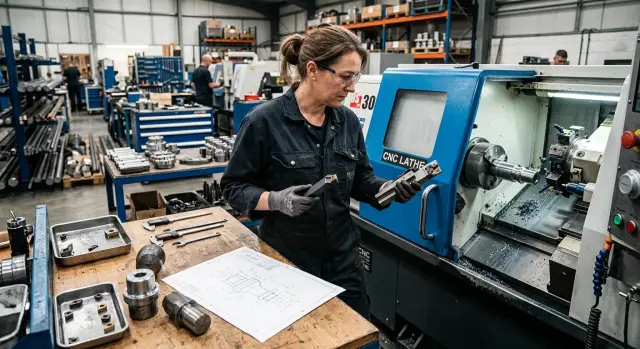
Where money is lost without special fixtures
Money isn’t spent only when ordering a fixture — it is lost every time a new batch is started almost from scratch because there’s no quick and repeatable way to locate the part.
Without special tooling, changeovers drag out across every shift and every re-clamp. The machine isn’t cutting metal while the operator selects stops, sets the size and checks whether the part shifted after clamping.
The most expensive small thing in the shop is manual shimming. The operator inserts a plate, washer or spacer to "stretch" the datum and the solution seems to work. But on the next batch they use a different thickness, clamp with different force and get a different result.
Because of that, the dimension often drifts not immediately but after a re-clamp. The first side was machined normally, the part is flipped, clamped again, and the datum sits slightly differently. On the drawing it’s a few hundredths; in practice it means extra measurements, trimming and scrap.
These losses are very tangible: the spindle idles during adjustment, the setter spends hours on temporary fixes, first parts of the batch go to inspection and rework, and the operator lowers cutting parameters because they don’t trust the clamp. Some parts end up as scrap after the second clamping.
Worse, people get used to these losses. If a setter repeatedly spends almost a shift on the same part, that’s no longer a one-off failure but a permanent expense.
A simple example familiar to many shops: a run of housings where the operator sets the height with shims each time, then catches runout with an indicator. One setup takes not 10 minutes but 35. If there are four such runs per shift, nearly two hours of pure machining time are lost.
In metalworking this is the main problem without custom fixtures: losses accumulate a little every day. Individually they seem small, but together they consume machine time, the setter’s labor and dimensional stability.
What to count in real losses
When shops count the cost of tooling, they often look only at the maker’s invoice. That’s too narrow. Money is lost every time an operator spends an extra 8–15 minutes setting a part, catching the size after a trial cut and re-checking the datum. If there are several such changeovers per shift, losses add up quickly.
Scrap and rework are a separate item. A written-off blank costs money, but the expense doesn’t stop there. The shop loses machine time, cutting tools, operator hours and repeated inspection. Even if the part goes to rework instead of scrap, it still occupies machine time that could have been used for the next batch.
Idle time between batches must also be counted in money, not shrugged off as "well, it stood for half an hour." While the machine waits for the next setup, no product is produced. On serial parts this is especially noticeable: one prolonged changeover can shift a schedule by a whole shift. The foreman then rushes to catch deadlines, and the risk of errors grows.
There is a less obvious cost too — tool wear. With weak fixturing a part can wander and cutting becomes uneven. Inserts are changed earlier, dimensions drift, surface finish degrades. On thin-walled and long parts this is visible almost immediately.
To see the full picture, five numbers are usually enough:
- how many minutes it takes to set up and align one batch;
- how many parts go to scrap or rework per month;
- how long the machine stands idle between batches;
- how often tools are changed due to unstable clamping;
- how many orders had shipments delayed because of such delays.
If at least two of these numbers look bad, custom tooling no longer seems expensive. For a shop turning repeat parts on CNC lathes, it often doesn’t buy "convenience" but predictable output without needless fuss.
When ordering already makes sense
Order custom tooling when losses repeat, not when they appear once a quarter. A one-off complex part can be managed by hand. But if the part returns every month, temporary tricks quietly eat money.
The first clear signal is when setup takes longer than the machining itself. If a part cuts for 7 minutes but setting, clamping and checking take 20, the problem isn’t the operator. Usually it means fixturing is inconvenient, the clamp is unstable, or the operation sequence needs a different locating scheme.
There are other signs. The same batches keep returning without changes, one operation consistently produces a shift or vibration, the operator keeps a set of shims and spacers nearby, and after each shift the setup is almost reassembled from scratch. If a surface requires an extra re-clamp, losses become systemic.
Scrap at the same operation is especially telling. If the defect always appears in one operation, the cause often lies in the clamping. Here special fixtures for CNC give not only time savings but eliminate the source of scatter.
Shims and spacers are another bad sign. As a temporary measure they’re normal. As a permanent practice they’re dangerous. Today the operator uses one plate, tomorrow another, and the dimension drifts. In a month no one remembers which set was the "correct" one.
Extra re-clamps also get expensive quickly. Each new grip adds minutes, risk of shift and extra checks. For a series part this is almost always a bad trade: the shop didn’t order a fixture, but each cycle became longer and more stressful.
If at least three such signs persist for two to three months, the fixture usually costs less than the losses. Continuing to debate "do we need it or not" becomes pointless. You need a calculation: setup time, scrap rate, number of re-clamps and the machine hour cost.
How to calculate payback
Count monthly losses without the fixture, not the price of the tool alone. In many shops custom tooling seems expensive only until the first honest calculation.
Take one typical month for a specific part or a family of similar parts. Don’t pick the best period. You need a real month with repeated runs, adjustments and several questionable parts.
- Record how many minutes one changeover takes. Include everything: removing the old setup, installing the new one, aligning, trial part and first inspection.
- Multiply that time by the number of runs in the month. If the same batch is loaded 10 times, count all 10 repeats.
- Convert lost hours to money. Usually use the machine hour cost including the operator. If an hour costs 25,000 tenge and extra setups took 8 hours, that’s 200,000 tenge in losses.
- Add scrap and rework. Count material, machine time, tooling, repeated inspection and operator work.
- Compare the monthly total with the fixture price. If a special CNC fixture costs 600,000 tenge and losses are 180,000 tenge per month, it pays back in about 3.3 months.
Simple formula: fixture price / monthly losses without it = payback period in months.
If you get 2–6 months, ordering usually looks reasonable. If it’s more than a year, re-check volumes, order stability and the process itself.
On CNC lathes such losses are often underestimated. Fifteen minutes for shims and re-alignment seems small, but at 12 runs per month that’s 3 hours of pure idle time, and that’s without scrap and rework.
To be more accurate, use not averaged report figures but the last 3–5 real batches. Such a calculation quickly shows whether you need custom tooling now or can postpone the order.
Simple example for a series part
A shop makes a flange in small batches of 40–60 pieces. The part returns to production several times a month, but fixturing is standard and lacks precise height locating. So the operator sets the part each time with shims and spends time on trial cuts.
On paper losses look small. In reality they appear in almost every batch. While the operator selects shims, the machine doesn’t cut. When the height "floats" a few hundredths, the first ten parts often show noticeable scatter.
Typical picture: two parts go to scrap, a couple need finishing, and the process engineer checks dimensions again. If the batch is at the end of the shift, the rush only adds errors.
For such a flange a custom fixture solves the problem simply. The jig sets the correct support height and removes extra clamping. The operator places the part in the same position, clamps it in one motion and gets a stable start from the first piece.
Numbers show the difference:
- old setup takes 25 minutes per batch;
- with the fixture it takes 8 minutes;
- previously the shop lost 2 parts out of 50 at batch start;
- after the fixture scrap nearly disappears.
If the batch repeats 8 times a month, the shop saves 136 minutes on setups alone — more than two hours of pure machining time. Add scrap cost, repeated measurements and finishing, and the savings become significant.
Assume one damaged part costs 6,000 tenge in material and time. Previously the shop lost on average 16 parts a month across batches; after the new fixture losses drop to 2–3. Even without complex calculations the difference quickly covers the fixture cost.
This example is familiar where repeat parts and frequent changeovers occur. If the flange returns every month, the habit of "tacking on another plate" almost always costs more.
When it’s better to wait on ordering
Custom tooling isn’t always necessary. Sometimes it removes losses, other times it only masks another problem. If the cause of failures isn’t the clamp, ordering just adds expense.
The simplest case is a rare part. If you run it once every six months, special tooling often sits idle longer than it’s used. In that time people forget setup details, and at the next run time is again lost on trial cuts and adjustments.
Worse is when the drawing changes almost every batch. Then the fixture is made for a temporary version of the part. After a month the datum, allowance or clamping area changes and the solution no longer fits without rework.
Another common situation: the clamp seems guilty but the problem is in the process route. For example, the part is flipped unnecessarily, the datum selection is inconvenient, the tool affects size, or chips interfere with the finishing cut. In this case a fixture won’t cure the root cause; it only makes the weak process more expensive.
Check the machine itself. If it can’t hold repeatability, a fixture won’t help. Backlash, thermal drift, a worn chuck, weak hydraulics or an unstable turret create scatter no clamping can remove.
Before ordering do a few basic checks:
- verify machine and chuck repeatability;
- remove unnecessary re-setups from the process route;
- run 2–3 batches with the same drawing;
- estimate how many parts will realistically be in the series.
There is also simple economics. If volume is small, the investment doesn’t pay off. For a short run it can be cheaper to live with standard tooling, soft jaws or temporary shims than to pay for design and manufacture of a separate jig.
A good pause point is when the process still "floats." First achieve a stable drawing, a clear operation route and acceptable machine repeatability. Then fixtures for metalworking will give a noticeable effect instead of being an expensive experiment.
Mistakes when ordering and launching
More often money is lost not on the fixture itself but on rushing before the order. People see inconvenient clamping, manual shims and long changeovers but don’t measure how many minutes each operation takes and how many parts go to scrap. Decisions are made by feeling, not by numbers.
Because of that it’s easy to miss the real task. The shop thinks the clamp is the problem, while the actual loss comes from poor locating of the blank or the operator manually correcting the setup each time. If you don’t record real times, count scrap and check dimensional repeatability, the new fixture may not produce a noticeable effect.
Another common error is copying an old clamping scheme without verification. What was tolerable on a small run can cause distortion, clamp marks or unstable size on larger volumes. Before ordering, run a trial batch and observe how the part behaves across a normal shift, not just in one lucky cycle.
Designers often forget simple things:
- where chips will go from the locating area;
- whether the tool has enough clearance for all operations;
- whether the operator can quickly clean supports and clamps;
- what will wear first and how to replace it without disassembling the whole jig.
If these aren’t considered, the fixture quickly gets temporary fixes. Operators pick chips with a hook, add shims, or loosen clamps more than needed. After a week the setup no longer resembles the original drawing.
Another problem is launching without training. Even a good special fixture for CNC doesn’t work by itself. The operator needs a clear routine: where to place the part, the sequence for tightening clamps, what to clean before the next cycle and which dimensions to check on the first parts of the shift.
In practice a short briefing and a trial run help more than extra drawing tweaks. When the setter, operator and designer watch the first working day together, results appear faster and with fewer reworks.
A quick check before deciding
The decision isn’t in a catalog or the supplier’s promises but in what happens at the machine every day. If the same batch returns again and again and the setter spends extra minutes on adjustments, the fixture no longer seems expensive.
Look at repeatability. A one-off order rarely pays for a dedicated jig. But if a part runs in series monthly or at least several times a quarter, losses accumulate quickly. Fifteen extra minutes per batch over a year become tens of hours.
Another clear sign is weak locating. The size "floats" though the program didn’t change, the tool is fine and the machine holds accuracy on other parts. In that situation the issue is often how the part sits in the clamp, not the cutting regime.
If the setter constantly uses shims, foil or manually finds the position, the shop already pays for a temporary solution. These tricks save a rush order but for a repeating part they are too expensive: they add time, give varying results between shifts and more often lead to scrap.
Check the number of re-clamps. When a part needs a second or third clamp, not only the cycle grows but so does the risk of shifting, runout and accumulated dimensional error. Sometimes one thoughtfully designed clamp removes two problems at once: it shortens the cycle and stabilizes the size.
For a quick assessment five questions are enough:
- does the batch repeat regularly?
- does the size drift at the setup stage?
- does the setter often use shims?
- are there second or third re-clamps?
- does a failed batch cost almost as much as a future fixture?
If at least three answers are yes, you should count the cost of not having a fixture rather than its price. Especially if the error leads not only to scrap but also to missed deadlines, extra setups and repeated batch launches.
A simple guideline: if one failed batch eats the cost of the future fixture or comes close, don’t delay.
FAQ
When is it worth ordering special tooling?
Order it when losses repeat every month, not when they appear once. If setup takes longer than machining, the part returns regularly, and the operator keeps shimming the part manually, the shop is already losing more than it seems. A good rule of thumb: if the payback calculation shows about 2–6 months, the decision is usually justified.
How can I tell that the problem is the clamping?
Look at the moment when the dimension shifts. If the program didn’t change, the tool holds size on other parts, and the error appears after clamping or re-clamping, the cause is often fixturing. Another clear sign is constant use of shims, foil, washers and manual adjustment before starting a batch.
What should be counted in losses besides scrap?
Count not only scrap. Add the extra minutes for setup, spindle idle time, trial parts, rechecks, rework and earlier tool changes. If the part is machined more cautiously because of weak clamping, the shop also loses productivity. These losses often exceed the price of a fixture.
How to quickly calculate payback?
Take one normal month for a part or a family of similar parts. Multiply the extra minutes by the number of setups and convert the lost hours into money using the cost per machine hour, including the operator. Then add scrap, rework and repeated inspection. Divide the fixture price by this monthly loss to get payback in months.
Can I get by with shims and spacers?
For an urgent one-off run — yes, shims and spacers can work. For a recurring part that comes back often, this approach quickly adds time and gives variable results between shifts. Today the operator uses one thickness, tomorrow another. Often the size drifts after a re-clamp, leading to extra checks, trimming and disputed parts.
When is it better to wait before ordering?
Don’t rush if the part runs once every six months, the drawing changes frequently, or the machine simply can’t hold repeatability. In those cases, a fixture won’t remove the root cause and will only add cost. First check the machine, the process route and the series stability. If the process is still unstable, fix that first, then order a fixture.
How many re-clamps count as a problem?
If a part needs a second or third re-clamp, the risk of shift grows noticeably. Each extra clamp adds minutes, checks and the chance to accumulate dimensional error. For a series part this is almost always a bad trade. Often one well-designed clamp shortens the cycle and stabilizes dimensions.
What should I prepare before ordering tooling?
Prepare the drawing, material, tolerances, batch size and a short description of the current setup. Also show where the operator places shims, how long setup takes and on which operation scrap appears. The more accurate the input data, the lower the risk of getting a fixture that must be reworked on the shop floor.
Why do first parts of a batch often end up as scrap?
Because at start-up the operator re-establishes the height, checks runout and adjusts the clamp in place. While they search for the correct position, the reference often differs each time. A custom fixture removes that lottery. The part seats the same way every time, so the batch starts correctly from the first pieces.
What does custom tooling give for a series part?
It shortens setup, eliminates extra shimming and makes the location repeatable. The operator spends less time on trial cuts and is more confident to raise cutting parameters. For repeating parts the effects are visible quickly: less scrap at the start of the batch, less rework and more productive machine hours per month.