
Counter Spindle or Second Setup: How to Know Which Is Faster
Counter spindle or second setup: a simple way to compare cycle time, setup, scrap risk and understand when one cycle actually delivers a real gain.
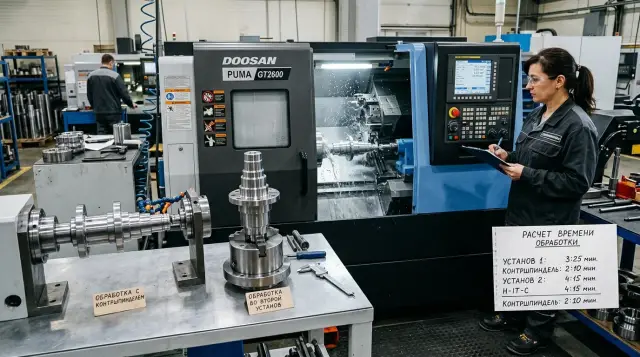
What the choice is really about
Choosing between a counter spindle and a second setup isn’t about which machine is “better.” It’s about where you actually lose time on this part — during the cycle itself or before the batch starts.
If you can hand the part to the counter spindle and finish it in one clamp, the operator does fewer manual actions. That often reduces the per-piece time. But this scheme almost always complicates startup: you need to set up the transfer, check the clamping, measure after the handover and make sure the series will run stably.
On paper, one-cycle machining often looks like a clear winner: shorter cycle, no part repositioning, fewer pauses between operations. The problem is that the shop doesn’t live by cutting time alone. If the counter-spindle setup adds several hours to startup, that overhead can easily eat the whole gain on a short or medium batch.
So the debate “counter spindle or second setup” almost always comes down to two counters. The first shows how many minutes it takes per part. The second — how many hours are needed for setup: tooling, jaws, alignment, part transfer, tool adjustments and measuring after the handover. Looking at only one of them will almost certainly lead to a wrong conclusion.
Faster doesn’t always mean cheaper. Say the cycle shortens by 35 seconds. Sounds good. But if the setter spends half a day getting a stable transfer and the first parts go to enhanced inspection, the order can end up both more expensive and later.
People make the same mistakes again and again. They compare only cycle time and ignore setup. They forget about scrap and program tweaks at startup. They use calculations for large runs and apply them to small batches. They don’t consider that the second side can sometimes be done very quickly in a simple setup.
On the turning line you see it quickly. For a repetitive part in a large series, one cycle often works well. For a new part, a trial run or a complex capture, a second setup is frequently calmer and faster in real lead time. The point isn’t to eliminate the second setup at any cost. It’s to avoid paying extra for complexity that won’t pay back.
When one cycle really shortens lead time
One cycle delivers real savings when the part almost always needs two-sided processing. If after the first side you remove the blank, flip it, reestablish datums and clamp again, time is spent not on cutting but on unnecessary hands-on movements.
This is most visible on repeat batches. On 10 pieces the difference may seem small. On 300 identical parts even a 30–40 second saving per piece becomes hours of pure time saved.
This approach is especially useful when re-clamping introduces a noticeable risk of runout or datum shift. That’s common for long shafts, thin-walled parts and mating surfaces where after the second clamp you have to chase the dimension, perform extra checks and sometimes scrap the part.
If the operator changes the clamp, flips the part, checks runout and re-ties the tool between operations, the counter spindle pays back primarily by removing manual work. In a good scenario the machine itself picks up the part and immediately machines the second side with no pause for human factors.
Usually one cycle wins when several conditions align: both sides of the part are in the route for almost every piece, the batch is large and repeated in the same scenario, the second clamp regularly causes runout or dimension drift, and the manual actions between operations take more time than reports suggest.
A simple example: the first side is turned and a groove cut in 45 seconds. The second side needs a face trim and center drilling — another 20 seconds. The cutting itself is a little over a minute, but removing the part, flipping it, reclamping and checking add 50–60 seconds. In this scheme the decision is easy: if the batch runs regularly, one cycle shortens lead time not just on paper but in reality.
The most common sign is simple: re-clamping takes longer than the machining itself. Then a more complex setup often pays off, because afterwards the cell runs smoother and the operator intervenes in each cycle less often.
When a second setup is simpler and better
On the shop floor what matters most is not the machine’s rated capability but how long it takes to the first good part and how calmly the series runs after startup.
The second setup often wins where the transfer makes setup too long. The idea of one-cycle processing is good, but it doesn’t always deliver a fast start. If the setter spends half a day dialing in the capture moment, jaw positions, tool offsets and cut-off modes, the per-piece saving simply disappears.
There’s another practical point: tooling for counter-spindle work often becomes more complex. Special jaws, soft-form pads and sometimes bespoke solutions for thin walls or short clamping are needed. That’s not just money — it’s time for manufacture, fitting and re-checking.
Problems often begin after the handover. The part has been cut off and transferred to the second spindle, and now it doesn’t hold as securely as in the first clamp. If the part is thin, long or has awkward geometry, holding stable dimensions is harder. In that case a second setup on a separate, well-understood datum can give a calmer result.
Usually a second setup is more economical if the batch is small, the opposite side is quick to machine, the transfer makes it hard to hold size and runout, the one-cycle option needs expensive tooling, or the order must start today without long trials.
A small batch quickly shows the difference. If you need 20, 30 or 50 parts, an extra 2–3 minutes per piece on the second setup can be cheaper than another day of tuning a complex scheme. For hundreds of parts the picture changes. For a small run — not necessarily.
A good example is a simple bushing where one side has turning and drilling and the other only a small chamfer and face trim. In theory the counter spindle can do everything in one cycle. In practice the operator may be faster: do the first side, move the part to the second chuck on a ready datum and finish calmly with no risk of botching the startup.
If the deadline is tight, the second setup often gives a more predictable start. The scheme is simpler, fewer mistakes occur, and the first good part is produced earlier. Sometimes that matters more than the elegant idea of doing everything in one clamp.
How to calculate the effect quickly
It’s better to count hours for the whole batch than seconds for a single part. One option may look faster on the machine screen but lose out after setup, inspection and a few reworks.
First take clean machine time without guesses. For the one-cycle route record the processing time for that cycle. For the two-setup route add both setups including flip and any repeat datum pass if needed.
Then add what people usually forget: CNC lathe setup, jaw changes, tool touch-off, the first inspection part, time to measure after re-clamping and the time to achieve a stable transfer if there is one.
Simple formula
Total hours for a batch can be estimated like this:
(machine time per part x quantity) + setup + inspection + expected rework.
Count rework separately. If you expect 3 parts out of 100 to need a re-pass or extra check with the one-cycle route, multiply that risk by average repair time. Then you see not an ideal route but what the shop will actually experience in a real shift.
Batch size changes the decision a lot. If the machine-time saving is 35 seconds per part but the complex setup eats 2 extra hours, the saving won’t pay off on a 20-piece run. On 500 parts the same difference yields notable total time reduction.
If the order repeats
Repeatability also affects the choice. If the part returns every month, don’t count the first complex setup the same for every order. Once the program, jaws and inspection scheme are worked out, some costs drop.
In the end compare two numbers: hours for the whole batch by the first route and by the second. If the difference is less than an hour, more often the simpler-control, lower-scrap-risk option is preferable. If the difference is large and the order repeats, the more complex scheme usually pays back faster.
Example on a part
Take a simple part: a steel pin 110 mm long. One side needs a seating turned and a thread; the other side needs a face, groove and chamfer. Geometry is ordinary, but coaxiality between the two sides is important.
In the first option the operator turns the first side, removes the part and mounts it in the second chuck or in the same jaws reversed. On paper the scheme looks straightforward. In a real shift, clean cutting time gets added to removing, flipping, reclamping and a quick check that the part sat correctly.
Suppose the first side takes 2:30, the second 2:00. The second setup with clamping and check adds another 35 seconds. Total is 5:05 per piece. The setter starts such work in 40–50 minutes because the logic is simple.
In the second option the machine itself transfers the part with the counter spindle. The operator doesn’t touch the semi-finished part between sides. The first side still takes 2:30, the transfer 15 seconds, the second side 1:50. Total is 4:35 per piece. There’s a gain, but not huge: 30 seconds.
Now calculate for the batch. On 20 pieces the saving is only 10 minutes of pure machine time. If the counter-spindle setup took 1.5–2 hours longer, the scheme won’t pay off. For a small batch the second setup is often calmer and cheaper.
On 500 pieces the picture changes. The same 30 seconds becomes about 4 hours of pure savings. If the part runs weekly, one-cycle processing typically becomes advantageous.
There’s another often underestimated point: scrap. Suppose unstable transfer or an error in the second setup causes an extra 1% scrap. In a 500-piece batch that’s 5 parts. If one part costs 18,000 tenge, you immediately lose 90,000 tenge, not counting machine time and rework.
Looking only at cycle-time reduction is insufficient. If the part is easy to re-clamp and size holds after the second chuck without surprises, the simple second setup is often smarter. If the batch is long and the transfer is stable, the counter spindle usually wins.
What to check on the part before calculating
It’s premature to count minutes on the machine if the part itself already hints which way to lean. The deciding factors are part geometry, tolerances and how much trouble the second side causes.
First look at part length and stiffness. A long blank with a thin wall tolerates extra removal and re-clamping worse. It’s easier to shift the size, and after transfer you may get runout where the drawing looked safe. If the part is short and stiff, the second setup is usually less risky.
Check tolerances for coaxiality, runout and mutual position. If both sides must align precisely, one-cycle processing often gives a more predictable result. The reason is simple: the part is re-clamped less, so there are fewer chances to build up clamping errors.
But not every part benefits. Sometimes the second side takes very little time: face trim, a chamfer, finish a short neck. Then the counter spindle adds a complex setup and the time gain is nearly zero.
Five quick questions are enough for a rapid assessment:
- How long and thin-walled is the part relative to its diameter?
- Are there strict coaxiality requirements between the first and second side?
- How much real time do the second-side operations take?
- Is the part easy to capture by shape and datums?
- How long does inspection take after processing?
Part shape also changes the picture. A plain cylinder is easy to transfer. A cast, forged or partially machined blank with awkward datums can behave differently. If there’s nothing reliable to grab the part with, one-cycle processing looks good on paper but turns into a long search for a stable clamp on the shop floor.
Another common miss is forgetting inspection. After the operation people often count only machine time, while checks can take minutes rather than seconds. If after the second setup the operator spends a long time checking coaxiality, basic dimension and runout, that is part of the cycle and must be included in the calculation as honestly as tool changes and feeds.
A simple rule: if the part is flexible, sensitive to re-clamping and requires precise relation between the two sides, consider one-cycle processing seriously. If the part is rigid, the second side is quick and inspection is fast, the second setup often stays the calmest and cheapest option.
Mistakes that skew the choice
Most decisions break down at the simplest point: they compare only rated cycle time. On paper one-cycle processing almost always looks faster. But the rating doesn’t show how long it takes to select jaws, set up the transfer, check offsets, adjust tools and run first trial parts.
Because of this, the counter-spindle scheme can seem more beneficial than it really is. If the batch is small, an extra 3–5 hours of setup easily eats the entire per-piece time gain. For a run of 20 parts that’s one calculation; for 2,000 parts it’s another.
A second frequent mistake is treating setup as a one-off and therefore not including it. On the shop floor setup is rarely “free.” Even if some tooling exists, people still spend time installing, checking, making trial parts and tuning the program.
A third mistake is transposing a successful scheme from one part to another. If the counter spindle worked great on the last series, that doesn’t mean it will be as good on a thin sleeve, a long shaft or a part with awkward datums.
And one more common oversight: not counting operator interventions. Sometimes the problem isn’t the second setup or the counter spindle but chips, measuring, awkward part removal or an unstable clamp. If that bottleneck isn’t found, you can complicate the entire route and gain almost nothing.
Quick checks before deciding
Before choosing, answer a few short questions.
- If the batch is under 50 pieces, verify the payback of one cycle especially carefully.
- If both sides require strict coaxiality, calculate the single-cycle option separately.
- If a re-setup takes more than 30 minutes, compare whole-shift numbers rather than per-piece times.
- If the operator often intervenes, first find what exactly stops them.
- If scrap after re-clamping repeats, compare the current route with a counter-spindle route using actual figures.
It’s useful to run a short test on your part. Take 10–20 pieces and record clean machine time, setup time, number of operator interventions and scrap rate for each scheme. Then calculate not planned speed but time per one good part. This calculation usually sobers up debates around the machine.
If the second setup runs calmly, produces little scrap and takes a couple minutes, there’s often no reason to complicate the process. If re-clamping repeatedly breaks coaxiality and slows release, one-cycle processing usually yields steadier production across the shift.
What to do on your shop floor
Pick a real part that often comes through and regularly takes the machine or the setter’s time. Best is a position with stable demand where scrap, cycle time and re-clamp losses are already known.
Make a simple calculation for both schemes. Compare not only clean machine time but also everything people forget a week after a chat at the machine: re-datuming, inspection, operator interventions, setup and scrap losses.
The idea is straightforward. For the second-setup option honestly record time for the first operation, part removal, re-clamping, the second operation and inspection after re-clamping. For the one-cycle option add the transfer, cut-off, possible sync pause, longer setup and any special tooling. Compare for a realistic batch size. On 20 pieces you get one picture, on 500 — another.
Separately estimate how many hours of setup per month this part consumes if it repeats. Very often that single line decides. A one-off or small order is frequently better handled with the simpler scheme. A recurring series can quickly pay back a counter spindle if the second setup consistently eats 1–2 minutes per part.
Discuss the startup with the equipment supplier not in general terms but about the specific part: how it clamps, where the transfer is, how much tooling is needed and what weak points exist for stiffness and accuracy. If such a discussion is needed for a real job, it makes sense to have it with EAST CNC. The company supplies CNC lathes for metalworking, helps with selection, commissioning and service, so the conversation can cover not only the machine but also how to launch the part on your floor.
The conclusion is simple. If one cycle shortens not only the seconds on the screen but the total batch time, implement it. If the gain is theoretical and startup becomes more complex and longer, the second setup will remain the more sensible choice.
FAQ
When does a counter spindle actually save time?
A counter spindle most often pays off when you process both sides on nearly every part and you spend a lot of time removing, flipping and re-clamping. If the series repeats and the operator spends more time with handling than the machine does cutting, one cycle usually delivers real savings.
When is it better not to remove the second setup?
A second setup is usually better for small batches, urgent starts and parts where the opposite side takes very little time. If the setter spends hours dialing in the transfer while a simple flip runs quickly and reliably, there’s no point in complicating the process.
How to quickly compare both options?
Don't count seconds on the screen — count hours for the whole batch. Take the machine time per part, add setup, inspection, operator interventions and expected rework, then compare both routes with that formula.
From what batch size does one cycle usually start to pay off?
There is no fixed number, but for 20–50 parts a long setup often eats the entire gain. For hundreds of parts, even 30–40 seconds per piece turns into hours and becomes profitable.
Which matters more when choosing: cycle time or startup time?
Setup often matters more than the cycle-time difference. If one option is half a minute faster but needs 2–3 extra hours to set up, the order can end up longer and more expensive.
Which parts most often win from processing in one clamp?
Look for long, thin and re-clamping-sensitive parts, and for dimensions where both sides must align precisely. Those parts often benefit from a single clamp because there are fewer chances to accumulate clamping errors.
In which cases does transferring via a counter spindle create extra complications?
Problems start when the part is hard to hold reliably after cut-off or lacks stiffness. Then sizes drift, runout increases, and the setter spends time finding the right jaws, offset and capture moment.
Should inspection and scrap be included in the calculation?
Count inspection and scrap as part of the route, not as random loss. If one scheme needs extra checks or causes a 1–3% scrap rate, that quickly erases the machine-time advantage.
Is a counter spindle suitable for an urgent order?
Often yes for urgent jobs. A second setup is simpler to start, has fewer surprises in the first shift, and usually gives the first good part sooner.
How to verify the decision on my shop floor without long arguments?
Run a short test with 10–20 parts and record clean machine time, setup time, number of operator interventions and scrap rate for each scheme. Then compare not the planned speed but the time to one good part for each route.