
Coolant Through the Tool: When It Actually Pays Off
Feeding coolant through the tool doesn't always deliver gains. We analyze how pressure, flow and channel depth affect cycle time, chips and tool life.
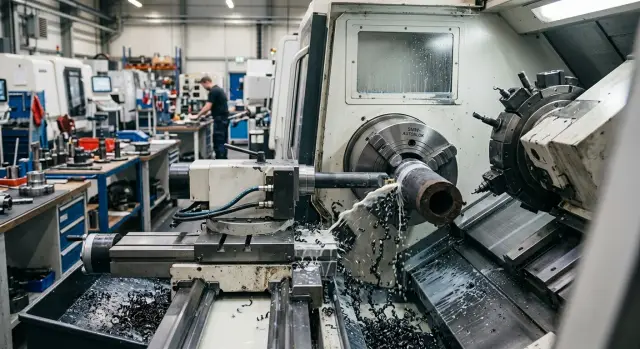
What the debate looks like in practice
On the shop floor the argument usually comes down to the job details. One technician says: coolant-through-tool immediately fixes chip issues and shortens cycle time. The other replies: if external nozzles are set properly, you can avoid the expense of a pump, holders and plumbing.
Both sides are right to an extent. For open external turning, external coolant is often enough. But once the cutting edge goes deeper into the part the picture changes. Chips, the holder and part geometry block the cutting zone and an external jet starts to hit "nearby." There may be plenty of fluid overall, but it doesn’t reach the cutting edge well. That’s where heat, built-up edge and long chips remain.
This costs more than just the tool. The machine keeps cutting, but the cell repeatedly loses time to small interruptions. Chips wind onto the part, scratch the surface, force lower feed or stop the cycle. On a single part it’s barely noticeable. Over a series, minutes quickly turn into hours.
Another contentious point is tool life. On one batch an insert lasts as expected; on another it fails sooner under the same parameters. Often the reason isn’t a "bad insert" but changes in stock allowance, material, chip form or coolant access to the edge. External feed is usually more sensitive to such variables.
This question appears most often in operations where chip control is hard and cutting happens deep inside the part: deep drilling and boring, turning with long overhangs, machining stainless and gummy steels, cutoff, grooves and in series production where even 10–15 seconds per cycle matters.
So different shops reach different conclusions. If the part is simple and access to the cutting zone is good, external coolant is often sufficient. If the machine regularly loses time to chips, overheating and inconsistent tool life, coolant-through-tool stops being an optional extra.
What changes in the cutting zone
When the system works properly, coolant doesn’t go "somewhere nearby" but right into the narrow contact between edge, chip and part. That changes the cutting process itself. The jet more quickly flushes hot chips from contact and the edge rubs less on heated metal.
With external feed some coolant simply can’t reach the needed point: chips, rotation and the tool itself block the path. Internal channels deliver the flow more precisely, so the difference is most obvious in drilling, boring, deep grooves and turning gummy materials.
Operators usually notice this in the chips. They break earlier, come out shorter and are less likely to form long ribbons. Windings on the chuck, part and holder decrease. As a result the machine runs steadier and you don’t have to reduce parameters purely for safety.
The second effect is thermal. Temperatures in the cutting zone are high while contact area is small. If coolant hits that spot, it removes heat from the edge more effectively and partially from the chip. In practice that often results in more even wear, less re-cutting of chips and more consistent part-to-part dimensions.
There’s another important point. When chips evacuate predictably, the process engineer can keep normal feed and speed instead of leaving a safety margin. So coolant-through-tool affects not only tool life but also cycle time. In series work this is especially clear: even a small improvement quickly reduces stoppages, the number of insert changes and size variability.
What the result depends on
The same system can give different results on two parts. On one you immediately see shorter cycle time and steadier tool life. On another almost nothing changes. Multiple parameters act together in the cutting zone.
Pressure matters not by itself but as a means to get the jet to the cutting edge and help break chips where they tend to stick or get re-cut. If pressure is insufficient, the fluid works nearby rather than in the cut.
But pressure alone isn’t enough. Flow must be maintained for the entire pass. A common mistake: the pump provides a good peak, then flow drops. On a short cut you might not notice, but on a long pass the effect quickly disappears. The tool heats up, chips darken, and the surface starts to "float."
Where the effect is lost
Much depends on the fluid path inside the tool. Channel length and diameter change flow resistance. The longer and narrower the channel, the more losses. On paper the pressure may look fine, but at the outlet the jet is already weak and inconsistent.
Part material also changes the picture. On gummy materials that form long, sticky chips, coolant-through-tool often gives a clear advantage. On materials producing short, dry chips the difference can be smaller. Don’t mix roughing and finishing: internal feed often helps clear chips during roughing more, while finishing may yield smaller cycle-time gains but better size and surface control.
To summarize a check, look at five things: is there enough pressure at the cutting edge, is flow maintained over the whole pass, do narrow channels choke the stream, what kind of chips does the material produce, and is it roughing or finishing. If a couple of these items are weak, the system may not show the expected effect. When everything is tuned to the task, the difference is often visible from the first series.
When cycle-time gains are visible immediately
You see the biggest cycle-time gains where external coolant cannot reach the cutting edge and chips begin to interfere with cutting. In those operations coolant-through-tool eliminates not just "cosmetic" issues but real pauses: chip clearing, redoing passes, reduced feed and extra machine stops.
This usually happens in deep grooves and internal passes. The deeper the channel and the poorer the view of the cutting zone, the more frequently chips jam at the edge. A jet through the tool better ejects chips from the narrow area, and the operator doesn’t have to run conservative feeds.
You see the same on gummy steels and materials that form long chips. Without directed feed chips wind up, catch the part and force the operator to slow down. When both pressure and flow are sufficient, chips break more reliably and feed/speed don’t need to be reduced for safety.
A good candidate for the system is internal machining, long tool overhangs, a series where losing 8–15 seconds repeats hundreds of times, or an operation regularly stopped by chip build-up. Long overhangs are particularly telling: the tool already operates near stiffness limits and chips near the edge add jerks and vibration. If the cutting zone is cleaned better, the regime stays steadier and tool life typically increases along with reduced cycle time.
On series parts the effect becomes very tangible. A 12-second gain per part looks small, but on a batch of 800 pieces the machine saves more than two and a half hours of pure machining time. On the first shift it’s usually visible not on the stopwatch but in the cell’s operation: fewer stops, less manual cleaning, fewer cases where the operator reduces feed "just in case."
How to calculate payback
Don’t base payback on someone else’s case or pump advertising. Use your own part, material and a single stable operation where chips or heat already cause problems. That way coolant-through-tool will show real effect, not pretty theory.
First build a baseline without internal feed. Measure average cycle time for a batch, count how many parts one insert lasts, and separately record all stops due to chips per shift. If an operator uses a hook twice to clear the cut, that’s a loss even if it doesn’t appear in the report.
You need five figures for a calculation: cycle time per part, insert life in parts or minutes, number of chip-related stops per shift, price of an insert including replacement, and the cost per minute of the machine with the operator.
Then run at least two tests with internal feed on the same batch. Don’t change everything at once. Compare two pressure levels at similar flow, for example moderate and higher. If the part is long and the channel deep, you’ll often see a difference in chip form and number of stops.
Экономия на цикле за смену = (старое время цикла - новое время цикла) x число деталей x цена минуты станка
Экономия на инструменте = (старый расход пластин - новый расход пластин) x цена пластины
Экономия на простоях = сокращение минут остановок x цена минуты станка
Потери от брака = старый брак - новый брак
Чистый эффект = все экономии - допзатраты на СОЖ, обслуживание и энергию
Срок окупаемости = вложения / чистый эффект за месяц
Don’t look only at speed. Sometimes cycle time shrinks by 4% but scrap almost disappears and the insert lasts 20% longer. That case pays back faster than an aggressive regime with impressive minute savings but frequent insert changes.
A simple example: if the cycle shortens by 18 seconds, the machine produces 250 parts per shift and a machine minute costs 1,200 tenge, one shift already yields a noticeable sum. Add one less insert change and 15–20 minutes the operator no longer spends on chip clearing and the picture is clear.
If you choose a new machine or a high-pressure option, ask for a test on your part. For these tasks specific numbers for your batch matter more than general promises. At EAST CNC such discussions usually start from a concrete operation, material and required result, not an abstract pressure spec.
Example on a series part
On a production bushing the difference shows over the whole shift, not from one lucky pass. Imagine a steel bushing with a deep bore: the cutter works far inside, chips are cramped and any hiccup forces lower parameters.
Without internal feed the operator often plays it safe—reducing speed and feed to prevent chip clogging and surface scratches. Sometimes the operator retracts the tool, cleans the area and only then continues. On a single part this is minor. Over a series it’s lost time.
With coolant-through-tool the jet reaches the edge and helps eject chips after the pass. Cutting runs smoother, sound stabilizes, and the operator doesn’t have to tweak parameters every few parts to avoid long ribbons.
A simple example: a batch of 400 steel 45 bushings per shift. Without internal feed the cycle is 3:20 and the insert is changed every ~55 parts. With steady internal feed the cycle drops to 3:08 and the insert lasts ~75 parts. A 12-second gain per part yields about 80 minutes per shift.
Those 12 seconds alone aren’t impressive, but repeatability is. The machine produces more parts in the same time, the operator changes the insert less often, and the risk of surface damage from chips drops. On repeat jobs a small gain in cycle time and tool life quickly becomes a notable saving.
Where the system doesn’t pay back
Feeding coolant through the tool doesn’t generate value by itself. If chips evacuate fine, the cutting zone is open and the tool life is normal, an expensive internal-feed setup often won’t recover its cost.
The simplest case is a short, open pass. In external turning with good access an external jet often hits the cut well enough without high pressure. Here cycle-time difference is almost invisible and tool life changes little.
The same happens on easy-cut materials. If chips are short, non-sticky and the edge doesn’t overheat, a high-pressure jet doesn’t solve a big problem. You pay for a pump, holders and setup and get a modest improvement.
Batch size also breaks the economics. For small runs you must buy tooling, check seals, set pressures, tune flow and run trials. If there are only 20–30 parts, preparation may cost more than the minutes saved.
Another trap: nominal pressure versus real cutting conditions. The pump may show the required value unloaded but sag when multiple consumers open or when coolant runs through a long path. You planned for 50 bar but the cut sees much less. Then chips don’t break as needed and the whole idea loses sense.
Thin tooling has limits. Internal channels reduce cross-section and sometimes stiffness. On small drills, thin boring bars or long slender tools this can produce vibration, size drift and poorer surface finish. If accuracy suffers, cooling benefits won’t save the process.
That’s why before buying you should honestly answer: is the pass short and fully accessible to external feed? Is the material easy to cut without overheating? Is the batch small? Does the pump hold pressure under load? Will thin tools lose stiffness due to channels? If yes, the system may remain an expensive add-on instead of a way to cut costs.
Common mistakes with pressure and flow
The main confusion is simple: many focus only on pressure and ignore flow. The gauge shows a nice number but at the cutting edge the jet is still weak. For coolant-through-tool that isn’t enough. Low flow won’t carry chips or cool the edge effectively.
Often the channel causes the issue — it’s made too narrow and the flow "chokes" before it reaches the cutting area. On paper the pump is powerful, but in practice the jet is thin and ragged. This shows up fastest in deep drilling, cutoff and machining gummy steels where chips need to be pushed out decisively, not "a bit at a time."
A more mundane reason is a dirty filter. While the system is new or just serviced pressure holds, then the filter clogs, the pump starts sagging and results vary from shift to shift. The operator sees tool life drop and looks for causes in the insert or regime while the real problem is coolant flow.
Mistakes also happen during testing. One pass uses one insert, the other uses another. Workpieces come from different batches. Sometimes overhang or stock allowance changes. Such tests can’t honestly show whether internal feed helped. Change one parameter at a time.
Another typical error is expecting a quick gain where it rarely appears. If chips already clear freely and the edge doesn’t overheat, cycle time may not change at all. That’s normal. The system usually adds value where you need to push a jet directly into the cutting zone and quickly remove chips from a groove or bore.
A proper test is simpler than it seems. Take identical parts from one batch, use the same insert and regime, measure actual pressure and flow at the tool, check filters and channel cleanliness, then compare cycle time and edge wear on a small series. If cycle time drops a few percent and the insert lasts longer and more consistently, the system is worth considering. If there’s no gain, don’t keep increasing pressure—first check flow, channel diameter and cleanliness. The issue is often there.
What to check before deciding
Start not with the pump catalog but with the operation itself. If the operator regularly stops the machine to clear chip windings, uses a hook or cleans parts after a pass, that’s a strong signal. In such cases internal feed often helps faster than small adjustments to parameters.
Then honestly evaluate the external feed. The jet should hit directly under the cutting edge, not on the holder, chuck or nearby. If on a short overhang external feed works but at depth the channel stays dry, external feed usually loses out in both tool life and process stability.
Next, calculate the money for your operation. How much does a machine minute cost here, including the operator, loading and downtime? If the part is rare and the cycle short, the time gain may be too small. In series work everything changes: even 10–15 seconds and fewer unplanned stops quickly add up to a significant monthly sum.
Many misjudge coolant pressure the same way. They look at the pump spec and assume it’s enough. In practice what matters is whether the system maintains required pressure throughout the cycle when the spindle runs, valves open and coolant flows through real channels. Flow rate is equally important. With good pressure but weak flow, chips can still hang in the channel.
There’s also an organizational question: who will maintain filters, tank cleanliness and the channels? If no one does, the system quickly loses value. Dirty coolant and clogged channels eat the benefit before you can measure improvements.
A short check is usually sufficient: are there chip problems? Does the edge receive current coolant? How much does a machine minute cost? Does the pump hold pressure under load? Is there someone on the cell to keep the system clean? If most answers are "yes," internal coolant looks less like an option and more like a working solution.
What to do next on your shop floor
Start not with broad modernization but with one operation that already causes losses—deep drilling, boring, machining gummy material or any place where chips shorten tool life. If the problem is diffuse, you won’t be able to assess payback.
First record a baseline for the current process. One shift or one representative batch is enough if conditions are stable. Record not only cycle time but things often left out: how many parts one tool lasts, how often the operator stops for chip clearing, the rate of dimensional or surface rejects, minutes spent changing inserts and how the process behaves at the start and end of a batch.
Then run a short comparison on the same batch. Keep material, program, tool and regimes as identical as possible. Change only the parameter you’re testing: feed method, pressure or flow. Otherwise you get random coincidences instead of a test.
Don’t judge by one part. Sometimes cycle time falls by 6–8 seconds but the main gain is the insert lasting 1.5 times longer and the operator stopping less often. Over a shift that often yields more than the initial runtime saving suggests.
If results are marginal, calculate over the whole shift, not one piece. Aggregate cycle savings, reduced downtime, tooling consumption and scrap percentage. That quickly shows if the payoff is real or if the effect only appeared in a lucky test.
Sometimes the issue isn’t the idea but the machine’s capabilities: the pump can’t hold required pressure, turret channels aren’t available, or tooling doesn’t suit the task. In that case discuss the specific operation and part, not an abstract "system." If you select equipment for metalworking, EAST CNC can be useful at this stage: they supply CNC lathes and machining centers and help with selection, commissioning and service. When the discussion starts from the part and process rather than a nice specification, payback becomes much easier to assess.
A good test outcome is simple: fewer stops, predictable tool life and steady shift operation. If that isn’t achieved, it’s too early to buy new equipment. First identify what exactly impedes the process.
FAQ
What does coolant-through-tool actually provide in practice?
Usually it delivers three things: cleaner chip evacuation, less heating of the cutting edge, and a steadier cycle. This is especially noticeable where an external jet doesn’t reach directly under the cutting edge. If the operation is open and simple, the difference can be small. But for deep machining, grooves, boring and tough-to-cut steels, the benefit often appears during the first shift.
When is a regular external coolant enough?
For a short, open cut, external coolant often suffices. If the nozzles hit the cutting zone accurately, chips don’t entangle and the tool life is stable, internal coolant may not give a noticeable advantage. This typically happens in standard external turning and on materials that produce short chips. In such cases it’s better to first check nozzle settings rather than immediately buying a new system.
On which operations is the effect noticeable right away?
Most often you see gains with deep drilling, boring, grooves, cutoff operations and turning with long overhangs. There the chip pack-up quickly blocks the cutting zone and external jets start missing the target. On series parts the effect is most visible. Even 10–15 seconds per part becomes significant when hundreds of pieces are produced.
Which is more important — pressure or flow?
You must look at both. Pressure helps get the jet to the cutting edge; flow carries heat and chips away from the cutting zone. If the gauge shows a good pressure but the actual flow is weak, the benefit is limited. Conversely, high flow without enough pressure won’t solve problems in a deep channel.
Why does rated pressure often not match actual cutting conditions?
Because the pump and the tool are different parts of the path: losses occur in long or narrow channels, on dirty filters and under real load. The pump may show the rated pressure unloaded, but the cutting zone can receive much less. Check the process behavior rather than just the dial. If chips darken, smear or re-engage the cutter, it means the coolant isn’t reaching the edge as expected.
How do you know the system is already paying off?
Start by measuring the baseline on a stable operation. Compare cycle time, how many parts one insert lasts, and how many minutes are lost to chip-related stops. If after enabling internal coolant the cycle shortens, inserts last longer and the operator spends less time clearing chips, the system is already delivering value. It’s best to evaluate over a shift or a batch, not just one piece.
When does internal coolant not pay off?
If the pass is short, the cutting zone is open, and chips evacuate normally, the costly internal-feed setup often doesn’t pay back. For small batches, the preparation and tooling can cost more than the saved minutes. Be cautious with thin tooling: internal channels reduce cross-section and sometimes stiffness, which can cause vibration or dimension drift instead of benefits.
What mistakes most often prevent getting a result?
Too-narrow channels, a clogged filter and flow drop on long passes are common culprits. Another mistake is changing several variables at once and then assuming the result is due to internal coolant. A proper test keeps the same part batch, the same insert and the same regime, changing only the coolant feed method, pressure or flow. Otherwise the conclusion will be unreliable.
How to run a proper test on your shop floor?
Start with one problematic operation where chips already slow the process. Keep the same material, program and tooling as much as possible, then compare external vs internal supply on a small series. Don’t focus only on seconds per cycle. Edge wear, number of stops and surface rejects often tell the real story beyond a single successful pass.
Can coolant-through-tool worsen machining?
Yes — it can. Thin or long tools can lose stiffness when channels are added, causing vibration and dimensional drift. This risk is real for small drills, thin boring bars and tools with long overhangs. Before buying, test the actual operation on your part rather than relying solely on general promises.