
Coolant Filtration for Fine Chips: How to Choose a System
Coolant filtration for fine chips: how to choose mesh, filtration fineness and abrasive removal scheme to extend coolant life and reduce pump wear.
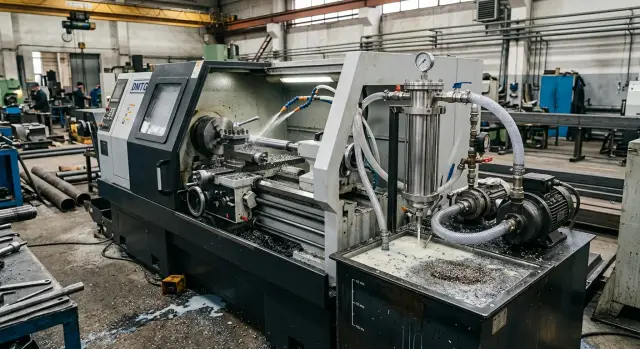
Why fine chips spoil coolant quickly
Fine chips rarely look dangerous. That’s the problem. Large particles are obvious, while fine ones float in the tank, pass through a coarse screen and return into the circuit with the coolant.
The liquid isn’t cleaned — it just circulates: from the cutting zone to the tank, then through the pump and back to the tool. After a few shifts you get cloudiness, deposits and extra strain on the whole system.
Abrasive dust and very fine chips—typical after cast iron, cemented carbide and other materials that produce hard particles—are especially harmful. That suspension acts almost like an abrasive paste. The pump forces it through the impeller, seals and passages, and parts wear noticeably faster.
At first it seems minor: the pump hums a bit more, pressure drops, the nozzle jet becomes uneven. Then deposits start to clog narrow places. Nozzles, feed channels and low-flow sections suffer. The tool gets less cooling and the cutting zone runs hotter.
On a small turning cell this shows up fast. Morning tank fill, machine works normally by noon, and a few days later the coolant is cloudy, a dense deposit sits on the bottom, and nozzles must be cleaned by hand. Adding fresh fluid helps a little but doesn’t fix the cause.
Consumption rises on two fronts. The shop tops up concentrate and water more often, replaces baths more often, and spends time cleaning tanks and servicing pumps. With several machines the losses add up quickly.
So filtration isn’t about a tidy tank. It helps preserve the coolant longer, keep stable feed and avoid early pump repairs.
What to remove from the coolant
The tank receives several types of contamination. Many people install a single filter and expect it to solve everything — it doesn’t. First you need to understand what’s actually circulating in the fluid.
Typically there are four problems:
- long chips that jam chutes, screens and drain openings;
- fine sludge that settles on the tank bottom and reaches the pump;
- abrasive particles that wear impellers, seals and nozzles;
- foreign oil films that also spoil the fluid but are removed separately.
These contaminants aren’t a single task. Chips and sludge are removed mechanically, while oil films are skimmed from the surface. A standard mesh does almost nothing against oil. A coarse basket also won’t stop cast iron dust: the pump still receives abrasives.
The workpiece material strongly changes the dirt composition. Steel and aluminium often produce visible chips that are easier to separate. Cast iron behaves differently: it generates a lot of fine dust and dark sludge. That suspension settles slowly and quickly wears out pumps.
On CNC lathes this appears quickly. Pressure falls, nozzles work unevenly, and a grey deposit builds in the tank. If the coolant keeps circulating that deposit, abrasive cleaning can’t be postponed.
Grinding and finishing should be treated separately. After grinding particles are finer, more numerous and sharper. Finishing may produce little long chip material but a lot of fine suspension. So a scheme that works for ordinary turning often fails for these operations.
If a thin sludge builds in the tank fast, the problem is usually not the coolant itself. More often the system simply catches the wrong type of contamination.
How to assess the load on the system
Filtration load is rarely calculated from the machine datasheet. It’s easier to see from how the coolant behaves in use. If the tank darkens within the first hours of a shift and by evening the nozzle jets weaken, the system isn’t holding fine chips and abrasive.
Start by checking the drain scheme. One machine and four machines sharing a tank give very different results even with similar cutting regimes. The more machines drain into one vessel, the faster the suspended load grows and the more often the filter runs near its limit.
Over a typical work week check four things:
- how many machines drain coolant into a single tank;
- how quickly the fluid darkens after the shift starts;
- whether nozzle pressure drops by the end of the day;
- how much dense deposit accumulates in the tank over a week.
These signs are more honest than a one-time inspection. A clean tank in the morning means little. Watch what happens 2–3 hours after start-up, when fine fractions already appear in the coolant.
There’s a simple, low-tech assessment. Collect coolant from the return line into a clear container at the start of the shift and again near the end. If the second sample is noticeably darker and a dense layer forms quickly at the bottom, the current scheme can’t handle the real load.
Another signal is pump behavior. When the filter clogs too fast, the pump works harder and nozzles lose steady delivery. On a turning cell this is obvious: the jet weakens, chips aren’t washed out of the cut, and surface finish may degrade.
It’s useful to count not only litres per minute but also the volume of dirt per shift. If a lot of dense deposit collects in the tank in a week, choose a system with capacity to spare. Otherwise a filter may match flow on paper but choke the stream in practice and overload the pump.
How to choose a filtration scheme
Start with the particle you need to catch, not the tank. If long chips float in the coolant you need one scheme. If fine sludge, abrasive or cast iron dust is present you need another. The main question is simple: what particle size already impedes pump performance, nozzles and part cleanliness?
A common mistake is selecting a filter by tank volume. That usually misses the point. The system is governed by pump flow. If one pump delivers 40 l/min and another 25 l/min, size for the combined flow and add margin for peaks. In that case the target isn’t 65 but closer to 75–80 l/min.
The first stage is for coarse chips. Its job is to remove large particles before they reach the pump and start clogging the downstream chain. A mesh basket, drum filter or magnetic unit for ferromagnetic material often suffices here. This stage shouldn’t trap fine dust but should quickly remove big debris and be easy to clean.
After that you need a second stage for sludge and abrasive. Here you look at filtration fineness. For fine metal suspensions, bag or cartridge filters work well. If dirt is heavy and constant, paper reel filtration or a settling tank with fine polishing is more convenient. If the coolant carries a lot of abrasive, consumables must be changed more often; otherwise the filter exists only formally while flow bypasses clogged elements.
Before purchase check five things:
- what particle size you must retain;
- the combined flow provided by pumps;
- how much coarse chip enters the tank;
- how fast sludge grows during a shift;
- how much operator time is spent on cleaning.
The last item often decides everything. If the operator must drain the tank, remove a heavy lid and spend half an hour cleaning a cassette, maintenance will be delayed. A proper scheme allows the dirty element to be removed in minutes without a long machine stop. For a small turning cell that ease of service usually matters more than an extra 5 microns on paper.
Solutions used in workshops
One filter rarely suffices when chips are fine and the coolant contains much abrasive. Coarse protection is needed for the tank and pump, while finer cleaning is required for the fluid, the tool and stable delivery.
The simplest option is a mesh unit. It retains large and long chips so they don’t clog the tank, enter passages or scratch pump parts. Such a unit is almost essential, but it won’t remove fine sludge. Dust and small particles pass through and settle in the system.
For continuous flow operations a drum filter is often chosen. It fits where the machine runs long cycles and coolant flows steadily. A drum removes finer suspension than a simple mesh and doesn’t require frequent manual cleaning. In turning with steady chip flow this is convenient when chips are produced continuously all day.
For finer abrasive removal many shops install a paper filter. It traps small particles that cloud the fluid and wear the pump. The downside is consumables: paper must be changed on schedule and stocks kept, otherwise the system’s benefit disappears.
A magnetic separator works well on steels. It removes ferromagnetic dust and fine steel chips before the main stage. But it’s not a full replacement: non-magnetic particles and other abrasives pass through.
When two stages are better than one
In practice a two-stage scheme often outperforms a single all-purpose filter. First fit a coarse screen, then a finer cleaning stage. The second filter lasts longer and the pump receives cleaner coolant.
Common combinations are:
- mesh plus drum filter when flow is continuous;
- mesh plus paper filter when cleaner coolant is needed for finishing operations;
- magnetic separator plus paper or drum filter when machining steel.
One filter rarely covers every task. Choose the scheme by material type, chip volume and required coolant cleanliness. Then the pump lasts longer and the tank won’t turn into a sludge pit after a few shifts.
Example for a small turning cell
A small cell has two CNC lathes turning grey cast iron. The shift runs smoothly only in the morning. By noon the coolant darkens, grey sludge accumulates in the tank, the pump hums and nozzles deliver noticeably less pressure.
The cause is simple: cast iron produces a lot of fine, abrasive dust. Conveyors or meshes catch the larger chips, but fine particles circulate. They reach the pump, settle in the tank, clog passages and gradually spoil the coolant itself.
A complex central system isn’t always necessary. Often two stages suffice if matched to real conditions. Install a coarse pre-filter at or before the tank to hold larger particles and slow sludge buildup. Then add a fine stage to collect small sludge and abrasive.
A typical scheme looks like this:
- a coarse mesh or drum for primary chip separation;
- a settling zone or separate vessel so heavy suspension can settle;
- a fine filter on the pump feed or in a separate polishing circuit.
This doesn’t make the coolant "perfectly clean" — and it need not. The goal is to remove the fraction that most rapidly wears the pump and disrupts steady feed.
After installing two stages improvements are usually visible within days. The coolant doesn’t blacken as quickly, nozzle pressure stays more even, and the pump runs quieter. Another plus: the tank needs cleaning less often and the operator doesn’t spend half a shift flushing it.
For a small turning cell the scheme pays off not in theoretical savings but in fewer downtimes, less tank dirt and reduced risk of early pump replacement.
Mistakes that damage pumps
Pumps fail mostly not because they’re poor quality, but because the filtration scheme is wrong. The first common mistake is sizing a filter by tank volume. Pumps care about actual coolant flow through the cutting zone and the return stream with fine chips. If the system passes less than the machine produces, dirt enters the circuit, impellers wear, pressure drops and feed surges appear.
The second frequent mistake is putting a very fine screen right at the inlet and expecting it to solve everything. That doesn’t work. A fine screen without a coarse first stage clogs fast with sludge, the pump struggles to draw fluid, hums and heats up. For abrasive loads a staged scheme is usually required: remove coarse and medium fractions first, then capture the fine suspension.
Stagnant zones in tanks do equal harm. If sludge sits in corners and on the bottom for weeks, each start-up, mode change or top-up stirs it into the flow. The filter may be present but the pump still receives abrasives. Practically you’ll see:
- the pump humming louder than usual;
- uneven coolant jets;
- filters needing too frequent flushing;
- dense deposits left in the tank after each shift.
Another oversight is ignoring the workpiece material and cutting mode. Cast iron, hardened steel, grinding and intensive fine-chip turning impose different loads. What runs fine on aluminium may clog a steel system in a week. There’s no universal scheme.
Finally, a mundane error: buying a system that’s inconvenient to clean daily. If routine cleaning requires long stops, removing many components or disassembling the tank, staff will postpone maintenance. Then filters clog, sludge builds and the pump pays first. Better to choose a simpler scheme that can be serviced during a normal shift.
Pre-start checklist
Before the first shift check how the system behaves with real fine chips and abrasive. If early signs are good, unpleasant surprises are less likely.
Inspect the whole picture, not just a single unit. Sometimes the filter is well chosen but the tank is hard to clean, the pump already catches deposit and nozzles are too sensitive to dirt.
- After several hours of work the fluid should look more even and cleaner, without obvious suspension or a gritty "sand" in the stream.
- The pump should run smoothly. If by the end of the shift it starts to hum, pulse or lose delivery, the current cleaning isn’t coping.
- A dense layer of sludge shouldn’t rapidly build on the tank bottom. Small deposits are normal, but a thick hard mass in a short time is a bad sign.
- Nozzles must maintain a steady jet after a series of parts. If you must repeatedly clear them, too much fine material is passing further into the system.
- The operator should remove contaminants without long disassembly. If routine cleaning means taking apart half the unit, that scheme will be hard to keep working.
A simple way to avoid mistakes: run a typical batch and check the system near the end of the shift, not at the start. Then you’ll see whether the filter handles the real load and whether the pump is protected.
For turning cells this is especially visible with fine chips from cast iron, hardened steel, or operations that produce a lot of abrasive dust. In those conditions a weak scheme seems fine at first and then quickly leads to blockage and excess wear.
If you find at least two weak points from this list, correct the system before full production. That’s cheaper than replacing the pump, cleaning tank sludge and losing time over clogged nozzles.
What to do next
Don’t pick a filter from a catalogue by sight. First gather baseline data: what materials you cut, which operations are most common, how much coolant is used per shift and how much fine chip enters the tank. One cell may turn steel and cast iron while another runs stainless or non-ferrous metals — their filtration needs differ.
Then decide if you need one or two stages. If mainly coarse chips are present, a simple primary separation may be enough. If the flow contains a lot of abrasive, sludge and fine suspension, consider a two-stage system from the start. It usually costs less overall than frequent coolant changes, pump repairs and downtime.
Before buying check not only filter specs but also available space in the shop. People often forget tank placement, service access and sludge collection. A good filter may have no convenient place to sit or be hard to clean, so it underperforms in practice.
A quick checklist for verification:
- record materials, operations and actual coolant consumption over a week;
- assess chip type entering the tank: coarse, fine, abrasive or mixed;
- verify space for tank, filter and sludge vessel;
- decide whether a local scheme for one machine or a shared system for a cell is needed;
- plan coolant supply and filtration before ordering a new machine, not after installation.
This is crucial when purchasing a CNC lathe or a small line. Coordinate feed and filtration early so pump, tank and filter work as a system. Reworking after start-up almost always costs more.
If you need a starting point, begin with an analysis of real shop conditions. At EAST CNC you can discuss these questions during equipment and service selection: what chip types will be produced, which filtration scheme fits, and how much margin you should allow. That approach usually saves time and avoids later rework.
FAQ
Why do fine chips spoil coolant so quickly?
Because fine chips and sludge stay suspended for a long time and keep circulating with the coolant. A coarse screen often doesn’t catch them, so the tank isn’t really cleaned — it just runs the dirt in a loop. As a result the coolant darkens, a deposit builds on the bottom, and the pump and nozzles suffer extra wear.
Is a common mesh screen enough to clean coolant?
No. A single screen usually isn’t enough. It removes large, long chips, but fine sludge and abrasive particles pass through. If you work with cast iron, hardened steel or finish operations, add a fine stage after the coarse stage.
How quickly can you tell filtration is failing?
Watch the machine during the shift. If the coolant darkens quickly, nozzle pressure weakens, or a dense layer appears in the tank within a few days, the system isn’t holding the fine fraction. A quick test: take coolant samples at the start and near the end of the shift. If the later sample is noticeably dirtier, filtration can’t handle the real load.
Why can’t you pick a filter only by tank volume?
Because filters should be sized for the actual pump flow, not tank volume. If the combined pump flow exceeds what the filter handles, dirt still circulates even with a large tank. Design by litres per minute and add a margin so the system doesn’t throttle flow at peak demand.
What is best for a shop that machines cast iron?
For cast iron you usually need a two-stage scheme. First remove large chips, then a fine stage for grey sludge and abrasive dust. On a small cell a screen or drum on the inlet plus a fine filter in a separate circuit or before the pump is often enough. This keeps coolant usable longer and reduces pump stress.
Do small turning cells need two-stage filtration?
Most of the time, yes. Two stages capture different kinds of dirt: the first removes large chips, the second traps fine sludge and abrasive particles. For a small turning cell this is often more economical than constant tank cleaning, coolant replacement, and early pump repair.
Is a magnetic separator enough if we machine steel?
No. A magnetic separator helps a lot with ferromagnetic dust and fine steel chips, but it doesn’t catch non-magnetic particles or other abrasives. Use it as a first stage, not as the only protection.
What to do if the pump is noisy and pressure drops?
First check the filter and tank for sludge clogging. Then inspect nozzles and see if a dense deposit on the bottom is being stirred back into flow. If noise and pressure drop persist after cleaning, inspect the pump without delay: abrasive wear quickly damages impeller and seals.
Will topping up coolant help if it goes cloudy fast?
No. Adding fresh coolant just dilutes the dirt temporarily. It doesn’t remove the fine chips, sludge and abrasive already circulating. If filtration is weak, fresh coolant only helps briefly before the problem returns.
What should I check before buying a filtration system?
First collect simple data from the cell: materials you cut, actual coolant consumption per shift, what chips end up in the tank, and how often the operator cleans the system. Also check space for the tank, filter and sludge collection. If access is inconvenient, staff will delay maintenance and even a good system will fail over time.