
A Compressor for Multiple Machines: How to Calculate Air Reserve
A compressor for multiple machines should be sized by total demand, peaks, pressure, and drying. Here’s a clear way to calculate it without guesswork or unnecessary reserve.
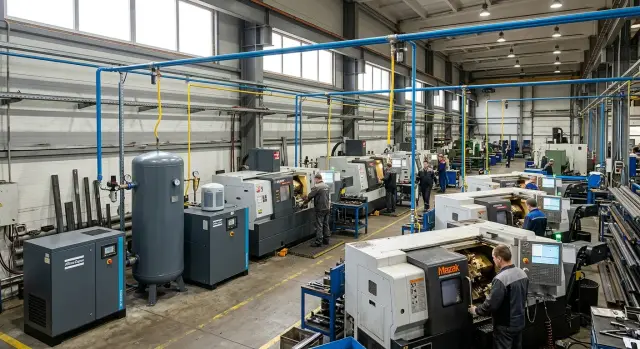
Why the nameplate consumption does not save you
A machine’s datasheet usually shows an average compressed air consumption. For one machine, that is already a rough estimate. For a shop floor with several machines, that number often gets in the way more than it helps.
A machine does not draw air evenly all day. It takes it in short bursts: the chuck clamps, a valve opens, a blow-off starts, the CNC pneumatics switch over. Between those moments, consumption can be almost zero, and then it jumps sharply.
That is why the average figure on paper looks calm, but in the shop floor the short peaks decide everything. If two or three machines blow off at nearly the same time, and one of them is clamping the chuck at that same moment, line pressure drops very fast. The compressor may seem to be “sized correctly,” but in practice it still cannot keep up with those spikes.
On a lathe section, you see this right away. The chuck responds more slowly, the automation reacts with a delay, and the valves start to work unevenly. Sometimes the issue looks like a random machine fault, although the reason is simpler: the system is short of air for a brief moment.
That is why a compressor for multiple machines cannot be chosen by the datasheet’s consumption line alone. You need to understand which parts draw air, how often they switch on, and what can happen at the same time. Average consumption is useful, but it does not answer the main practical question: will the system handle the peak without a pressure drop.
A simple example: you have three machines, and each one uses only a little air according to the datasheet. Together, the figure seems safe. But if all three machines trigger blow-off, the chuck, and the pneumatic valves in the same cycle, the short-term demand will be much higher than the average. That is when the calculation error shows up.
For that reason, you calculate not only total compressed air consumption, but also a reserve for air consumption peaks. Otherwise the compressor runs almost without a break, the air receiver does not have time to recover pressure, and small glitches slowly become the norm.
Where the machine uses air
A machine does not send air to one big unit. It loses it through several small ones. That is why a compressor for multiple machines is often chosen incorrectly: people look at one datasheet value and miss the everyday details.
One common consumption point is the chuck clamp and release. Each cycle takes a small amount of air, but there can be hundreds of such cycles in a shift. If the shop runs short batches and changes parts often, this consumption grows quickly.
The second group is blow-off. Air is sent into the chuck, the spindle area, or directly into the work area to remove chips and coolant residue. The bursts are short, but they often coincide with other machine actions.
Pneumatic cylinders also use a lot of air. Stops, steady rests, bar feeders, and other feed units work fast, but repeat the same stroke again and again. On one machine that may seem minor, but on three machines it already adds up to a noticeable compressed air demand.
Simple automation is another separate item. Solenoid valves, doors, shutters, and similar units do not always use much air in one cycle, but they create a constant background load. If a door opens and closes after every part, the compressor feels it more than it seems from the outside.
There is also manual consumption, which is often forgotten. An operator uses a blow gun, cleans the chuck jaws, blows chips off a fixture, or cleans a part before measurement. Five to ten seconds after every part quickly turn into a noticeable number over a shift.
That is how real CNC pneumatics add up: a little for clamping, a little for blow-off, a little for cylinders and automation, plus manual use at the machine. If you record those points separately, it becomes easier to understand where the steady demand is and where the air consumption peaks appear.
What data to collect before calculating
Trying to size a compressor “from memory” almost always means either overpaying or ending up with a pressure drop. You need not general impressions, but a few concrete numbers from the shop floor. They can be collected in one shift if the supervisor and technician look calmly at how the machines really run.
First, do not count the total number of machines. Count how many are actually working at the same time. On the shop plan there may be five machines, but in a normal hour three are cutting, one is waiting for a blank, and another is in changeover. For calculation, that is a big difference.
Then open each machine’s datasheet and write down two things: compressed air consumption and working pressure. These figures are often generous, but you cannot start without them. If you have CNC lathes on the floor, check not only the machine itself, but also everything connected nearby: the bar feeder, pneumatic cabinet, blow-off, automatic door, and measuring unit.
One datasheet is not enough. CNC pneumatics use air in bursts, not evenly. That is why it helps to note how often per minute or per cycle the chuck, blow-off, part separator, auto-feed, and other automation switch on. If the chuck activates rarely but blow-off runs almost constantly, total consumption changes a lot.
Also check what else is connected to the same main line. Air often goes not only to machines, but also to pneumatic tools, parts washing, marking, workplace blow-off, or packaging. These small users are often what cause unpleasant pressure drops later.
It helps to put the data into a short table:
- machine or device;
- working pressure;
- datasheet consumption;
- how many times per minute the pneumatics switch on;
- whether this consumer runs at the same time as others.
One more question is often remembered too late: will the shop grow. If another machine, a second shift, or more frequent automation use will be added in a few months, it is better to include that now. A small reserve is usually cheaper than replacing the compressor after the first serious load.
If you do not have enough numbers, do not guess. It is better to watch the shop floor for several shifts and write down the real operating modes. For machines and pneumatics used in metalworking, this approach gives much better results than calculating only from the catalog.
How to calculate consumption step by step
You do not start with compressor power, but with a list of all air consumers on each machine. If you miss even a small unit, the error grows fast: a short blow-off in the cycle often uses more air than the steady pneumatics.
- For each machine, list the constant consumers. This may be air support, pneumatic valves, blow-off, door drive, or other automation if it works often. Use the real operating mode, not just the datasheet.
- Calculate the cycle consumption separately. You need the volume of one burst and the number of activations per minute or per hour. If a unit uses 0.5 NL per activation and does 12 activations per minute, it will consume 6 NL/min.
- Divide the machines into groups that often overlap in timing. Two lathes with similar cycle times may clamp the chuck and blow off at the same time. A third machine with a long cycle may barely contribute to that peak.
- Add up the average consumption of all machines and add the most likely peak for the overlapping group. Do not sum every maximum at once if they almost never happen together.
- Add a reserve. A moderate reserve of 15–25% is usually enough. A double reserve without reason almost always leads to unnecessary spending on the compressor, air dryer, and air receiver.
A simple formula is handy: calculated consumption = constant consumption + average cycle consumption + likely group peak + reserve.
A small example. On one machine, constant consumption is 20 NL/min. Blow-off uses 4 NL per cycle, and the cycle runs 6 times per minute. The average blow-off consumption will be 24 NL/min. If two such machines often overlap in blow-off, you should add the peak of simultaneous bursts to the total average instead of the maximum for the whole shop.
That is how you size a compressor for multiple machines without guessing. The same shop can be calculated in different ways, but the logic is the same: look at how often things switch on and what really overlaps in time. Then the number is closer to reality, and the compressor will neither suffocate nor run empty.
How to account for peaks, the receiver, and pressure
When people choose a compressor for multiple machines, they most often get the short peaks wrong, not the average consumption. The machines may draw air moderately for an hour, and then give a sharp spike in one second because of the chuck, blow-off, and pneumatic automation.
What counts as a peak
First check how many pneumatic units can switch on at the same time. If two lathes clamp their chucks almost together and a third one is blowing off, the network sees not the average demand, but the sum of these actions in one second.
It helps to make a simple scenario for each machine: when the chuck activates, how long the blow-off lasts, how often the automation valves switch. Even a rough cycle table gives a more honest picture than a datasheet consumption figure per minute.
The air receiver helps exactly with such short bursts. It releases the reserve air quickly while the compressor comes up to load. But the receiver does not fix a constant lack of capacity. If the compressor cannot replenish consumption all day, a big tank only delays the pressure drop a little.
The usual logic is this:
- first, calculate the average consumption of the shop floor
- then add short simultaneous activations
- then size the receiver for those short peaks
- after that, check whether the compressor can restore pressure between cycles
Where pressure is lost
Do not look only at the gauge on the compressor. For machines, the pressure at the farthest consumer matters more, where air passes through a long line, narrow sections, filters, moisture separators, fittings, and quick couplers. That is usually where the drop appears.
A thin pipe often hurts the calculation more than people expect. On paper the compressor delivers the right volume, but at the far machine the chuck closes sluggishly and the valves start to behave unevenly. This is especially noticeable on a floor where several machines switch on almost at the same time.
So define the minimum pressure below which the automation no longer keeps a stable cycle. For one shop this may be 6 bar at the machine, for another it may be higher. The point is simple: you must calculate from the real minimum working pressure, not from a nice number in the compressor catalog.
If the shop is still in the planning stage, it is better to check the scheme against the worst-case scenario right away. For deliveries and machine selection with CNC, as at EAST CNC, this approach is especially useful during layout planning: later you will not have to fix the problem by replacing hoses, filters, and the receiver piece by piece.
When problems start without an air dryer
Compressed air almost always carries moisture. While the air is hot after the compressor, it is not so noticeable. But then it cools down, and water condenses in the line, the receiver, and the machine pneumatics.
On one machine, that is already a nuisance. On a shop floor with a compressor for multiple machines, the problem grows faster: there is more air, longer pipes, and stronger load swings. In the end, condensate reaches valves, cylinders, and air preparation units.
If water gets into CNC pneumatics, you start seeing small but very stubborn faults. Blow-off works worse, the chuck may react with a delay, and valves begin to stick. At first, it looks random, and then these “random” issues repeat every shift.
Water is especially bad for blow-off. Instead of a dry air stream, you get a mix of air and droplets. It cleans the machining area worse, leaves moisture on parts, and speeds up wear in pneumatic components. Seals age faster, and dirty deposits from water and oil build up inside the line.
If the shop is cold, saving on an air dryer is usually a bad idea. The risk is also higher where it is warm during the day but the temperature drops sharply at night. The air cools, the dew point shifts quickly, and water appears even in places that were dry yesterday.
An air dryer is almost always needed if:
- there are several machines on a shared air network
- there is frequent blow-off, clamping chucks, and pneumatic automation
- the main line is long or passes through cold areas
- noticeable condensate regularly comes out of drains and filters
Do not size the dryer from the catalog “with a rough reserve.” Look at the real compressed air consumption, working pressure, and inlet temperature. If the dryer is designed for one operating mode and the shop runs on another, it will not provide the required dryness even with a normal compressor.
One dryer alone does not solve everything. A filter is needed before the machines to trap water and dirt, and the condensate must be drained from the receiver regularly, ideally on a schedule or through an automatic drain. Otherwise the water will go back into the network, and the whole calculation will remain only on paper.
A simple sign of trouble is this: the pressure seems fine, but the pneumatics work unevenly, especially in the morning or on cold days. In such cases, check the moisture in the system before you check the compressor.
A simple example for a shop with three machines
The shop has two CNC lathes and one more machine where blow-off is used often. In normal operation, the air goes to part clamping, short blow-off of the machining area, and small automation. If you only look at the average hourly consumption, the shop seems “light.” That is what throws the calculation off.
Let’s take simple numbers:
- Lathe N1 changes blanks 20 times per hour and uses 14 liters of air per cycle.
- Lathe N2 changes blanks 15 times per hour and uses the same 14 liters.
- The third machine performs 60 short blow-offs per hour at 5 liters each.
- Working pressure on the machines is 6 bar.
The average compressed air consumption here is small: 20 x 14 + 15 x 14 + 60 x 5 = 790 liters per hour, or about 13 L/min of free air. Based on that number, it is easy to think that a small compressor will be enough. But the machines do not draw air in a flat line.
One clamping cycle and short blow-off on a lathe often fit into 2 seconds. Those same 14 liters in 2 seconds equal about 420 L/min at the moment. If both lathes change blanks almost at the same time, the shop asks for about 840 L/min. If the third machine blows off at the same moment, the peak reaches close to 1000 L/min.
That is why air consumption peaks are often more important than the average number over a shift. A small 100-liter air receiver may survive one such spike, but a series of overlaps quickly causes a pressure drop. Then the chuck clamps more slowly, blow-off weakens, and the CNC pneumatics start to behave unevenly.
For such a shop, one shared compressor is definitely possible, but only if it has enough delivery and receiver capacity. If the calculation shows only a small reserve, do not look only at motor power or the “datasheet consumption.” You need to check the real output at the required pressure, the receiver volume, and how often blank changes on two machines happen almost at the same time. After that calculation, it becomes clear whether one shared compressor is enough or whether the reserve is too small.
Common mistakes when choosing a compressor
The most common mistake is simple: people take the datasheet consumption of each machine, add the numbers, and consider the job done. In practice, machines rarely consume air evenly. One is clamping a part, another is blowing off the zone, and a third is running the pneumatic door or chuck. If you look only at the datasheet, the reserve disappears in the first busy hour.
Another mistake is choosing a compressor by maximum pressure rather than delivery. A number like 10 or 12 bar looks convincing, but the shop floor is usually limited not by pressure, but by liters of air per minute. If the compressor holds the required bars but does not deliver the needed flow, the line pressure still drops. Then the CNC pneumatics work unevenly: clamping is slower, blow-off weakens, and the automation starts making mistakes.
People also often forget the things that are not obvious in the machine datasheet. Every day, air goes to small but constant tasks:
- blow-off of the work area
- a hand air gun at the machine
- leaks in old fittings and hoses
- frequent pneumatic valve operation in the cycle
Individually, that seems minor. Together, it can add a noticeable amount to compressed air consumption.
A separate mistake is installing a small air dryer “for now” when the shop already plans to grow. Today it handles two machines, and in six months a third one arrives, and the reserve is gone. Moisture in the line quickly damages valves, cylinders, and filters. In winter, these problems show up even faster.
Many people also underestimate the main line itself. A long thin pipe, extra bends, a clogged filter, and an old hose create pressure losses that nobody includes in the calculation. In the end, a compressor for multiple machines seems to have been chosen correctly, but the farthest machine no longer gets enough air. That is why the engineer must calculate not only the compressor, but also the line, the receiver, and the drying system.
A good calculation starts not with one catalog number, but with the real picture of the shop floor. You need the average demand, the short air consumption peaks, and a reserve for leaks. Without that, the choice is almost always either too weak or too expensive.
A short checklist before ordering
People often choose a compressor with a rough reserve. Then one of two things happens: either you overpay for unnecessary capacity, or the pressure drops at the worst possible moment. Before ordering, check not the machine’s datasheet, but how the shop runs every day.
- Put all air consumers for each machine into one table. Count not only CNC pneumatics, but also the chuck, blow-off, doors, separators, external cylinders, and any equipment on the same line.
- Write down how often the chuck and blow-off switch on. One burst per hour and a series of short activations in every cycle create very different compressed air consumption.
- Check the minimum pressure at the farthest machine. If the compressor outlet gauge shows normal pressure, that does not mean the same level reaches the end of the line.
- Take into account pipe length, pipe diameter, filters, connections, and receiver volume. Pressure is lost at these points more often than it seems.
- Allow for growth. If another machine is added later or the shop moves to a second shift, the system should not immediately hit its limit.
Even a simple example shows the difference quickly. If two machines run steadily, while a third often switches on blow-off and the pneumatic chuck, the total consumption looks moderate only on paper. In reality, air consumption peaks come in short bursts, and a weak compressor starts chasing the system instead of keeping it stable.
For metalworking shops, that is a common story. That is why, before ordering, it is better to have three numbers: average consumption, peak consumption, and pressure at the farthest point. If even one number is missing, the calculation turns into guessing.
If you are choosing a compressor for multiple machines, pause at this stage and gather the missing data. One hour of measurements is almost always cheaper than replacing the compressor, the receiver, or part of the line after startup.
What to do next on your own shop floor
Start not with the compressor catalog, but with a measurement on the line. Put a pressure gauge at the farthest machine and watch what happens during the peak: during chuck clamping, blow-off, pneumatic valve switching, and simultaneous operation of nearby machines. That is often where the pressure drop shows up, even though the compressor’s main gauge does not show it.
Then compare the datasheet numbers with how the shop actually runs during the shift. A machine may have modest average compressed air consumption but sharp short peaks. If two or three machines do that at nearly the same time, a calculation based on the average value gives too rosy a picture.
A practical way to go about it is this:
- measure the pressure at the peak at the farthest consumer
- record which operations create the highest consumption
- compare datasheet consumption with the real changeover cycle
- check how the air dryer, filters, and condensate drain are working
In practice, problems often hide not in the compressor, but in air preparation. A clogged filter, an air dryer with reduced capacity, or a condensate drain that does not work can ruin the result very quickly. Then the automation starts to fail, the chuck holds worse, and in winter there are extra surprises in the line.
If you are choosing new CNC lathes, discuss the shop’s pneumatic scheme in advance. It is better to understand right away what pressure reserve you need, where to place the receiver, whether the current drying system is enough, and how to separate consumers into different lines. That conversation before purchase saves more than trying to “patch” the system later.
You do not need a complex project for the first step. It is enough to collect measurements over one shift, note the peaks, and check the condition of the air preparation system. After that, it is already clear whether you need a different compressor for multiple machines, an additional air receiver, or simply better line organization.
If you are dealing with new equipment, EAST CNC can help you review the machines’ air requirements, startup conditions, and service details in advance. That is useful before purchase, when you can still adjust the shop layout calmly instead of solving the problem after commissioning.