
Compressed air for a machine: what to check besides air pressure
We explain how pressure, dew point and cleanliness affect clamping, blow-off and automation — and what to check when a machine's air supply malfunctions.
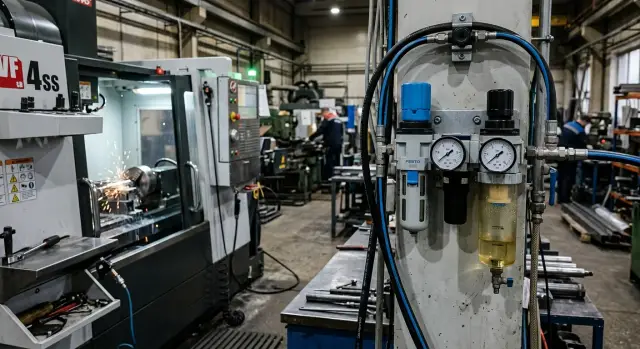
Why one gauge is not enough
A pressure gauge shows only one number at one point. For a machine that is not enough.
Compressed air must have not only the right pressure but also be dry, clean and stable during operation. Problems appear during the moment of operation, not at idle, and those are the cases that are often mistaken for mechanical or electrical faults.
A typical situation looks like this: the line shows 6 bar at the inlet, so everything seems fine. But during clamping, blowing or cylinder action the pressure can dip for a fraction of a second. A simple gauge does not always show that, yet the machine already begins to behave strangely. The chuck clamps with a delay, a door does not reach its end position, and the automation logs random errors.
There is another trap. Moisture and dirt often look like lack of air. Condensate gets into valves and cylinders, oil and dust clog filters, and fine rust hinders spool movement. From the outside the symptoms are almost the same: assemblies move sluggishly, do not actuate on the first try or work intermittently.
The components that react fastest to poor air are the chuck clamp, blow-off, pneumatic valves, door cylinders, safety mechanisms and short automatic cycles. If a fault appears and disappears, first check the pneumatic line. Especially when the problem occurs in the morning, after downtime, in damp weather or on several machines in the shop at once. Mechanical wear usually behaves more consistently.
If the gauge reads normal but a unit works in jerks or does not repeat cycles consistently, check not only pressure but also the compressed air preparation. Dew point and air cleanliness affect operation as much as the number on the dial.
In practice this becomes obvious quickly. The chuck sometimes holds the part normally, sometimes it actuates with delay. The operator suspects hydraulics or mechanics, while the cause turns out to be a wet filter and a dirty valve after the compressor. That is why during diagnostics it is useful to look at the whole air chain, not just the gauge.
Where the machine gets compressed air
A machine uses air in several places. It is needed where a unit must act fast, hold a part or make a short repetitive motion. Therefore, with the same inlet pressure different functions can behave differently.
On CNC lathes air is often used for chuck clamping, collets and other auxiliary units. The operator only sees the result: the part is clamped or not. Inside there are valves, distributors and pneumatic elements that need a stable flow without drops.
Air is also used for blow-off. It cleans the working area, sensors, guards and places where fine chips or dust accumulate. If blow-off is weak, a sensor may read incorrectly and dirt gets where it shouldn't.
Another group of consumers is pneumatic automation: valves, cylinders, interlocks, curtains and locks. Those units rarely fail suddenly. First they start to work slower, with delays or intermittently.
On machining centers air is often involved in tool change as well. The cycle there is short, so the issue does not always show. The machine may run half a day without notes, and a fault appears only when several pneumatic units operate almost simultaneously.
For these reasons you need to check not only the compressor. The whole path of air inside the machine matters – from the inlet to the specific unit.
What to check step by step
If a machine behaves inconsistently, do not start with guesses and parts replacement. First gather simple facts: where pressure drops, whether there is water in the line and at which moment the fault appears. This usually takes 10–15 minutes and is more useful than random repairs.
Follow a sequence:
- Read the pressure at the compressor and at the machine inlet. If the compressor pressure is normal but lower at the machine, the loss is in the main line, a filter or fittings.
- Inspect the air preparation unit. A dirty filter, incorrect regulator setting or a full condensate bowl quickly cause weak clamping, poor blow-off and valve faults.
- Walk the line with eyes and hands. Hoses should not be pinched, fittings should not hiss, quick-connects should not be loose.
- Compare performance at different times. The machine may behave differently in the morning after idle, under load during the day and after a long pause. Condensate and unstable supply often reveal themselves this way.
- Note the exact moment of the fault. Not “machine runs poorly,” but “the error occurs at clamping,” “after the blow-off command,” or “during tool change.”
If in doubt, keep a short log: date, pressure at two points, filter condition, whether there is water in the drain, and which cycle showed the problem. After a few shifts the picture usually becomes clearer.
How to evaluate pressure without mistakes
A single gauge almost always reassures too early. It can show normal pressure while the machine is idle. But air pressure for the machine must be checked under load: during clamping, blow-off, tool change or pneumatic motion.
A common error is simple: an operator sees 6 bar in the compressor room and assumes it's enough. At the machine the pressure at the same time can be 5.2 bar, and during a short peak load it drops even lower. For automation and clamping that difference is noticeable.
Measure pressure at the machine inlet, not only next to the compressor. If a filter-regulator is installed before the machine, check both before and after it. This shows faster where air is lost: in the main line, in a hose, in fittings or inside the preparation block.
The most unpleasant faults are usually not steady losses but short dips. A standard gauge easily misses them. If the chuck clamps while the blow-off fires or another consumer starts nearby, pressure can fall for a moment. The machine may not go to alarm, but the pneumatics act slower, the clamp holds worse and repeatability suffers.
A proper check is simple: measure pressure at the machine at rest, repeat during a work cycle, see what happens when neighboring machines start, and compare readings at the start and end of a shift.
If the difference is noticeable, inspect the air route. A long line, thin hose, extra connections and several consumers on one branch almost always cause losses. In that case do not immediately raise the setpoint. First find where pressure is lost; otherwise air consumption will increase while the cause remains.
Why check the dew point
The dew point shows how much moisture remains in compressed air. Pressure can be normal while the air is already wet. For the machine this is bad: water gets into valves, cylinders, clamping units and blow-off lines.
Moisture appears predictably. The compressor compresses warm air, then it cools in the receiver and piping, and water condenses. If pipes run through a cold part of the shop, the dryer is underperforming or condensate drains have not been checked, water quickly reaches the machine.
The risk is higher after a night stop. During downtime air in the system cools and excess moisture precipitates inside the line. In the morning check not only the gauge but also the dryer: has it reached operating mode, are there errors, is the drain overflowing?
Often the problem is visible without instruments. If there are drops, an emulsion or cloudy deposit in the filter bowl, moist air is already moving through the system. On CNC lathes this shows as familiar symptoms: the clamp works with delay, a valve sometimes actuates and sometimes not, blow-off weakens and small pneumatic units start to stick.
Over time wet air causes costlier consequences. Rust appears inside fittings and valves, seals age faster, and in winter water accumulates in the coldest places of the line. Then technicians look for a fault in a sensor or the machine, while the source is in air preparation.
If the machine runs worse in the morning and symptoms almost disappear after 20–30 minutes, that is a common sign of moist air. In that case checking only pressure is pointless. Inspect the whole compressed-air preparation chain.
How to check air cleanliness
Air cleanliness for CNC is as important as pressure and dryness. If dust, rust or oil are present in the line, symptoms again look familiar: the clamp actuates intermittently, valves click with delay, seals begin to leak. But the sources differ, so check them separately.
Dust usually gets into the system from the shop or old filters. It clogs small channels, settles in solenoids and prevents normal switching. Rust often comes from the receiver, pipes or fittings if there is internal corrosion. It quickly scores valve seats and seal edges.
Oil is a separate story. If the compressor starts to carry oil into the line, a sticky film remains on parts. At first this seems minor, but then dirt adheres to the film and it becomes a hard deposit. Distributors move stiffer and rubber elements age faster.
The check takes little time. Inspect filters and bowls. A dark film, cloudy condensate or oil traces already indicate a problem. Check filter elements by service life and by actual condition. Drain some condensate into a clean cloth or a transparent container — it is easier to tell water, rust and oil apart that way. It is also useful to watch valve exhaust: oil mist, sticky residue or black dust are usually obvious at once.
If oil appears after the filter, the source should be sought closer to the compressor. If the contamination is mainly rusty, inspect the receiver and old sections of the piping. And if the machine runs fine in the morning but after a few hours shows intermittent delays and floating pneumatic errors, do not replace solenoids at random. First check what actually passes through the line.
Mistakes that give false symptoms
One of the most common mistakes is to raise pressure as soon as the clamp weakens or pneumatics start to lag. That can quickly get the machine running again, but only for a short time. If the line has a leak, a clogged filter or a flow deficit, added pressure just masks the problem and stresses valves and seals more.
Another frequent source of faults is a long thin hose before the machine. At idle the gauge looks fine, and it seems the air is OK. But when the chuck clamps, blow-off fires or automation runs, flow rises and pressure on such a hose drops quickly.
Filters with dryers also cause confusion when they are remembered too late. When the cartridge is clogged or the dryer has not been serviced, moisture and dirt pass into the line. Distributors start to stick, blow-off runs unevenly and sensors give strange signals. From the outside this looks like an automation fault, although the cause is much simpler.
The same story repeats with condensate. If drains are emptied irregularly, water accumulates in the receiver and filters and then moves further down the line. In the morning after downtime the machine can be fussy and during the day run almost normally. Because of this the fault appears and disappears and troubleshooting goes in the wrong direction.
One more rule: don't trust a single gauge. The compressor reading shows the system as a whole, but not what actually reaches a particular machine.
An example from the shop
On a lathe cell the same minor but annoying problem repeated each morning: the chuck closed with a noticeable delay and the machine waited longer than usual for clamp confirmation. After lunch the fault almost disappeared. At first the operator only looked at the compressor. The gauge there read normal, so air was not suspected for a long time.
When they checked the line at the machine the picture changed. During clamping and blow-off the inlet pressure dropped noticeably. For the automation that was enough: valves actuated slower, the chuck closed unevenly and the clamp sensor gave a delayed signal.
They opened the filter bowl. Water had already collected. The dryer was nominally working but not holding mode, so moist air reached the machine. In the morning this affected operation more because the cold line condensed moisture faster. As the shop warmed up during the day, the symptom almost disappeared, although the root cause remained.
After draining the condensate, checking the dryer, replacing the filter element and setting the regulator the clamp returned to normal. This case shows a simple point: evaluate machine air by several indicators at once. Not only the numbers on the gauge matter, but also how the line behaves under load, the dew point and air cleanliness.
A quick check before the shift
Before starting don't look only at the gauge. A quick inspection usually takes 2–3 minutes and often prevents false alarms during the shift.
Check a few things:
- pressure at the machine inlet and its behavior during a short cycle;
- the filter bowl — any water, oil film or dark deposit;
- the dryer — is it running without errors and in operating mode;
- hoses and fittings — any hissing, whistling or signs of leaks;
- clamp and blow-off operation — they should actuate immediately without pauses or jerks.
If in doubt, run one idle cycle and stand by the machine. In that moment it is easy to hear where air is leaking and see whether pressure drops under load. For CNC lathes this is especially useful at the start of a cold shift, when moisture and weak leaks show up more clearly.
What to do next
Don't try to find the cause from memory. During one shift collect several simple measurements and note what the machine does at those moments. Even 6–8 short entries are usually more useful than a general impression like “the air seems OK”.
Look not only at the main gauge. It is far more useful to understand what happens at the machine during clamping, blow-off, tool change and pauses between cycles. If pressure only drops under load, the problem is usually supply, filters, drying or line cross-section, not a setting.
For diagnosis it is usually enough to record inlet pressure at the machine at the start, middle and end of a shift, the dip during a working cycle, traces of water or oil in the filter and the exact moment the fault repeats. If possible, add photos of the gauge, filter and dryer. With these notes a service engineer will more quickly separate an air problem from a valve, sensor or cylinder fault.
If you are selecting equipment, clarify air requirements before purchase. Ask in advance about operating pressure, allowable dew point, filtration requirements, air consumption and who is responsible for air preparation during commissioning.
Supplier experience is useful for these checks. EAST CNC supplies CNC lathes and other metalworking equipment and provides commissioning and service. So when starting a new machine or hunting intermittent faults it makes sense to check the whole air chain, not just one gauge.
FAQ
Why does the gauge read normal, but the machine still runs with delays?
Because a pressure gauge often shows the value at rest, not during operation. During clamping, blowing or cylinder travel the air can dip briefly, and the machine already starts to respond with delays. Water and dirt in the line produce a similar picture. From the outside it looks like a mechanical fault, while the root cause is in the air preparation.
Where is the correct place to measure air pressure?
Measure not only at the compressor but also at the machine inlet. If possible, check pressure before and after the filter-regulator. This quickly shows where air is lost: in the main line, in a hose, in fittings or inside the preparation block.
Should air be checked while the machine is running?
Yes — otherwise the check is often misleading. Measure the air at rest and during an operating cycle when the clamp, blow-off or tool change runs. Short dips under load are usually where problems show up, and a static gauge reading can miss them.
Which components react first to poor air?
Most often the chuck clamp, blow-off, pneumatic valves, door cylinders and tool-change units react first. These elements need a steady flow and react quickly to reduced flow, moisture and contamination. If a fault appears and disappears, start by checking the pneumatic line.
Why does pneumatics often misbehave in the morning?
After idle periods the air in the system cools and moisture condenses in the line and filters. If the dryer isn't holding its setpoint or the drain is overflowing, the effect is stronger in the morning. If performance evens out after 20–30 minutes, check for moisture in the air.
How to quickly tell if there is moisture in the line?
Look into the filter bowl. Drops of water, a cloudy deposit or an emulsion indicate that moist air is passing further into the system. Also check the dryer and the condensate drain. When there is water in the line, valves and cylinders often operate unevenly.
How to check for dirt or oil in the air?
Inspect the filter and element, drain some condensate into a clean container and check for an oil film or rust. Dark deposits and sticky residue also indicate a problem. It's useful to watch the valve exhaust: oil mist or black dust is usually obvious right away.
Should I simply raise the pressure if the clamp weakens?
No — that is a poor first step. Raising pressure can temporarily mask a leak, a clogged filter or a weak supply, but the root cause remains. Find where air is being lost before changing the setpoint.
What most often causes a pressure drop at the machine?
Common culprits are a long thin hose, extra fittings, leaks, a clogged filter or multiple consumers on one branch. At idle the gauge can look fine, but when flow increases those sections cause a pressure drop at the machine. If you simply increase the setpoint without finding the bottleneck, air consumption will rise while the problem persists.
What should I record to find the cause faster?
Record the date, pressure at the compressor and at the machine inlet, condition of the filter and dryer, presence of water in the drain and the exact moment the fault occurs. A short note like “error during clamping” is much more useful than “machine runs badly”. With such notes a service engineer can more quickly separate an air issue from a valve, sensor or cylinder fault.