
CNC Axis Acceleration: How to Calculate the Cycle Time of Short Operations
Axis acceleration in CNC machines matters more than it seems: for short cycles, calculate acceleration and deceleration time, or fast feeds will not improve output.
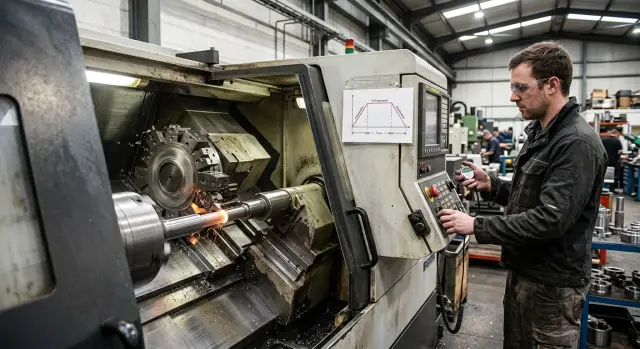
Why fast rapid traverses are not the same as a fast cycle
In a machine’s spec sheet, the rapid traverse figure always looks impressive. It seems that the higher it is, the shorter the cycle. But that only works on long moves, when the axis has time to accelerate to the stated maximum and spend part of the travel at that speed.
On a short move, the picture is different. The axis first accelerates and then almost immediately slows down. If the travel is 20–40 mm, it often never even reaches the catalog maximum. That is why on mass-produced parts with many small moves, what matters is not the record speed in the brochure, but how quickly the axis starts and how confidently it stops.
This is easy to see in simple turning cycles. Tool approach, retract, a short facing pass, moving to the next point — each move is small on its own, but each one needs acceleration and deceleration. In the end, time is spent not so much on the travel itself as on the start and end of the movement.
So the conclusion is simple: rapid traverse speed cannot be judged separately from acceleration. On a long pass, the difference between 24 and 30 m/min may be noticeable. On a short move, what matters much more is how quickly the axis picks up speed and whether the machine hesitates before stopping.
Where the cycle loses time
In short operations, the cycle is usually slowed down by non-cutting moves. This is especially true in production runs, where the tool approaches the machining zone many times, makes a short move, and immediately leaves.
The first source of loss is the tool approach to the cutting point. If the tool travels 10–20 mm each time, a significant part of that distance is spent on acceleration. After the pass, the same thing happens again: a short retract seems trivial, but over a series it adds up to minutes and hours.
Another common loss is transitions between neighboring positions on X and Z. For turning, that is a normal situation: one step, then the next, then a groove, a chamfer, a face. On moves of 8–15 mm, the catalog’s 24 or 30 m/min may not matter at all.
This shows up worst on simple production parts: bushings with several steps, pins with a groove and facing, short shafts with frequent diameter changes. If cutting takes less time than the moves between points, the share of idle time grows quickly.
One loss is barely noticeable. Half a second here, two tenths there, a few more tenths on the next move — and the cycle becomes one or two seconds longer. For a batch, that is already significant. If a machine spends just 2 extra seconds on one part, that is more than half an hour of pure time over 1,000 pieces.
How to calculate acceleration and deceleration time
If the move is short, you cannot use only the formula L / V. That calculation is too neat and almost always underestimates the real time.
First, break the cycle into separate movements. You need to count not only cutting, but also approaches, retracts, transitions between points, and position changes on X and Z. For an estimate, five steps are enough:
- List all short moves in the cycle.
- Note the length of each move in mm and the required speed.
- Take the axis acceleration from the machine spec sheet or from a real test.
- Check whether the axis can reach the target speed over that distance.
- Add up the time for all moves, not just the longest one.
It is best to convert speed into mm/s right away. For example, 15 m/min = 250 mm/s. Do the same with acceleration: if the catalog lists 5000 mm/s², keep working in those units.
When the travel is long enough for acceleration to the required speed and then deceleration, the calculation is:
tразг = V / a
Sразг = V² / (2a)

Если L >= V² / a,
то tобщ = 2(V / a) + (L - V² / a) / V
Here V is the required speed, a is the acceleration, and L is the travel length. The condition L >= V² / a means the axis has time to reach full speed and then slow down.
If the travel is too short, the maximum speed is not reached. Then the motion follows a triangular profile:
Если L < V² / a,
то tобщ = 2 * √(L / a)
A small example quickly shows the difference. Let the move be 8 mm, the set speed 250 mm/s, and the acceleration 5000 mm/s². For full acceleration and braking, V² / a = 12.5 mm is required. The move is only 8 mm, so the axis will not reach 250 mm/s. The real time will be 2 * √(8 / 5000) = 0.08 s.
If you calculate it using the simplified L / V approach, you get 0.032 s. On one move, the error seems tiny. But if there are many such moves in the cycle, the difference adds up quickly.
That is why, when choosing a CNC lathe, you should ask not only about the maximum rapid traverse, but also about axis acceleration. Even better, ask for a short test on a real move.
What to look for in the machine specifications
Speed in m/min is only part of the picture. For short moves, axis dynamics and the machine’s behavior after a sudden move matter much more.
First, compare acceleration on X and Z separately. On a lathe, these axes work differently, and poor dynamics on even one of them can stretch the cycle. Then check how the rapid traverse is stated: for which axis, under what conditions, and with what load.
Stopping after a rapid move is just as important. If the machine reaches position quickly but then spends time stabilizing or correcting, the gain disappears. The same applies to simultaneous movement across multiple axes. The catalog figures for X and Z may look great, but in the actual path the system may limit acceleration to preserve accuracy.
Before comparing models, it helps to ask a few direct questions:
- what acceleration is specified separately for X and for Z;
- is that a peak value or an operating value;
- how does the dynamics change with real tooling;
- is there a cycle measurement on a part similar to yours;
- what happens with short repeated moves, not just one showpiece move.
In practice, the last question is often more important than the table. A couple of 8–15 mm moves tell you more about a machine than a nice line about maximum feed.
Example for a simple production part
Let’s take a simple bushing made in a large batch. The program has no long traverses, but it does have many short approach and retract moves on X and Z: approach the face, retract, shift to the groove, move to the chamfer, return before parting off. The typical length of these moves is 10–15 mm.
Compare two CNC lathes:
- machine A: rapid traverse 30 m/min, axis acceleration 3 m/s²;
- machine B: rapid traverse 32 m/min, axis acceleration 8 m/s².
On paper, the difference in rapid traverse is small. The machines look almost equal. But on a 12 mm move, neither of them reaches its maximum. Almost the entire travel is spent accelerating and then immediately braking.
For a quick estimate, the formula t = 2 x sqrt(S / a) is enough, where S is the travel in meters and a is the acceleration. For 12 mm, it works out roughly like this: machine A takes about 0.13 s per move, machine B about 0.08 s.
The difference is only 0.05 s on one move. That does not sound serious. But if there are 8 such moves in the cycle, machine A will already lose about 0.4 s per part just on short transfers.
Suppose the pure cutting and other actions take 14.6 s. Then the total cycle will be:
- machine A: about 15.4 s per part;
- machine B: about 15.0 s per part.
Over an 8-hour shift, the difference is already noticeable: machine B will produce about 1,920 parts, while machine A will produce about 1,870. Almost the same rapid traverse speed, but different output.
That is why, in short operations, axis acceleration affects results more than maximum speed. It determines how quickly the axis gets moving and how quickly it stops at the point.
Common mistakes when choosing a machine by speed
The most common mistake is simple: look only at the advertising figure of 30 or 36 m/min and assume the cycle will automatically get shorter. For long idle moves, that is sometimes true. For short operations, far from always.
There are other mistakes too. Often the cycle is estimated using one long move, even though the real program has many short and medium moves. Sometimes all movements are blended into one average length, which produces an overly optimistic calculation. Even worse is making a choice without a trial measurement.
Another trap is comparing an “empty” demo machine with one in working configuration. The chuck, jaws, tool, workpiece, and safety restrictions all change how the axes behave. The more mass there is, the harder it is to accelerate and stop the assemblies accurately.
That is why it is useful to check your cycle realistically before buying. Count how many short moves the machine makes per part, which travel range repeats most often, and whether the axis can reach maximum speed over that distance. If not, the rapid traverse figure does not solve much.
What to check before buying
The best approach is not an abstract machining example, but your own regular production cycle. Even a simple table already helps show where time is lost.
Make a map of short moves: approaches, retracts, transfers between positions, changes in X and Z. Note the travel length and the number of repeats per part. If the program has many moves of 10–30 mm, you should take the catalog feed rate with more caution — the axis often simply does not have time to reach it.
After that, ask the supplier not for a promise, but for a calculation or a test. A good option is a cycle measurement on a part similar to yours, with tooling close to the real setup. Then you can immediately see where the cycle saves seconds and where there is no difference.
It is useful to compare at least two similar models using the same scenario. Sometimes a machine with a more modest rapid traverse delivers almost the same output. Sometimes the difference in acceleration really pays off. Without calculation and testing, it is easy to mix those up.
If you need this kind of analysis for a specific part, EAST CNC in Kazakhstan handles selection, supply, commissioning, and service for CNC lathes. In such cases, it makes sense to discuss not only the catalog m/min, but the full cycle on your part, including tooling and repeated short moves.
A good final question before buying is simple: how many parts per shift will this machine produce on my cycle? If the answer is confirmed by calculation and test, the comparison is based on facts, not just the biggest number in the catalog.