
Chip Bin or Deep Coolant Tank: What Matters More
Chip bin or deep coolant tank: comparing two setups for cast and welded workpieces and showing when dirt changes machine maintenance.
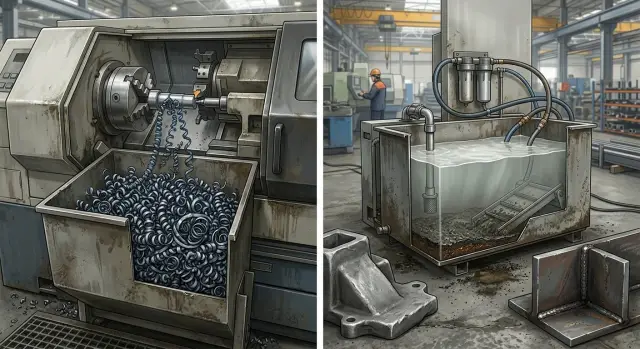
What is the problem with dirty workpieces
On clean bar stock, chips behave quite predictably. With cast and welded workpieces, it is a different story. Along with the metal, sand, scale, fine rust, dust from cleaning, and welding spatter enter the machine.
This dirt does not stay only in the cutting zone. Some of it is washed away by coolant, some settles in the sump, some moves toward the drain, and the finest fraction turns into sludge and spreads through the whole circuit. That is why the problem quickly goes beyond ordinary chip cleanup.
With cast parts, the main trouble is usually molding sand and the hard crust on the surface. Welded parts bring more scale, particles left after cutting and grinding, and uneven flakes of metal. For the machine, the difference is not very big: both pass poorly through the drain and both do not live well in coolant.
Clogging starts early. Sand and scale quickly block screens, pockets, and drain channels. At first, the operator simply reaches for a hook and brush more often. Then the pump starts pulling a dirty mixture, the flow weakens, and the sump, instead of draining properly, begins to hold slush.
Fine sludge is even worse. It does not sit in a neat pile like large chips. It smears across the tank, settles on the bottom, and then returns to circulation. Such coolant turns cloudy faster, cleans the machining zone worse, and makes cleanup much harder. One evening without cleaning, and in the morning the machine greets you not with work, but with a dirty tank to dismantle.
The debate over “chip bin or deep coolant tank” usually starts too late, after downtime has already begun. If you focus only on collecting large chips, fine dirt will go into the tank and start choking maintenance. If you rely only on tank volume, the drain and sump may clog before the dirt has time to settle.
The mistake is rarely visible on the first day. It shows up over shifts: extra cleaning, dirty breaks, a broken rhythm, and lost hours on CNC machine maintenance. For dirty workpieces, that is a common cause of downtime.
How a chip bin works
A chip bin is needed where the machine quickly generates a lot of large chips and they need to be removed from the work area without constant manual cleanup. It takes the main flow of waste right after cutting so chips do not sit under the chuck, by the doors, or near the guides.
The setup is simple: chips slide down a chute or inclined surface and drop into a separate bin. The operator does not have to shovel them out of the sump every hour. After the shift, the bin is pulled out, rolled away, or taken by a forklift if the volume is large.
On dirty workpieces, the benefit is especially clear when the waste is large and heavy. A cast part often produces brittle chips mixed with sand and scale. A welded workpiece can produce long strips, especially if the cutting parameters were chosen for a clean cut. In both cases, the bin quickly removes the bulk waste before it interferes with coolant supply and access to the part.
This setup works best where the chips are long, rigid, or simply heavy. A deep coolant tank does not like it when a lot of curled chips suddenly falls into it. They tangle, block passages, and interfere with fluid return. In that sense, a bin is simpler: it collects mechanical waste separately and does not turn the tank into a catch-all container.
There is also a practical advantage. When the bin is separate, the end of the shift is faster. Staff can see the real amount of waste, unload it quickly, and put the machine back to work without long cleaning of the lower sump.
But the limitation of a chip bin is strict. By itself, it does not clean fine sludge out of the coolant. Sand from cast parts, rust, abrasive dust, and fine metal suspension still enter the liquid. If the dirt on the part turns not into large chips, but into a cloudy suspension, a bin alone will not solve the problem.
So a chip bin is great at one task: quickly removing large, heavy waste from the cutting zone. If you get a full bin of curled or brittle chips every shift, the benefit is obvious right away. If the main enemy is fine sludge in the coolant, you need to look wider.
What a deep coolant tank gives you
A deep coolant tank is useful where the workpiece brings a lot of extra material into the machine: casting sand, scale, sludge, welding spatter, rust. The main advantage is simple: there is more liquid in the system. Dirt is diluted more slowly, and the pump keeps working longer without a sudden drop in flow.
On dirty workpieces, you can see this in the first shift. In a small tank, the mixture quickly darkens, heavy particles rise with the flow, and then go back into the cutting zone. In a deep tank, dirt has more time to settle to the bottom instead of returning to the tool within a few minutes.
This is especially helpful with cast parts. Sand and fine hard dust behave like an abrasive. If they keep circulating, the pump, nozzles, and the tool itself suffer. Tank depth does not remove dirt completely, but it slows the rate at which it returns to work.
With welded workpieces, the picture is a little different. There you usually get scale, rust, and small flakes after seam cleaning. They are larger and settle more easily, so a deep tank gives a good buffer between cleanings. But if long chips enter the system together with the dirt, a tank alone is not enough.
Another benefit is more stable coolant temperature. A larger volume heats up more slowly and cools down more slowly too. Part dimensions shift less during the shift, especially on long passes and in production runs. For precise work, that is very noticeable.
The downsides are also clear. Such a tank takes more space next to the machine, needs more fluid for the initial fill, and takes longer to clean thoroughly. Once sediment has built up, you cannot deal with it quickly: you have to drain it, remove the sludge, and flush areas that are not always easy to reach.
That is why a deep tank is good as a reserve for stability and dirt capacity. But in a shop with very dirty workpieces, it works better when cleaned on schedule, not after an emergency stop.
How to choose the setup step by step
It is better to choose based on the first dirty batch, not on the catalog. With cast and welded parts, it is not only the chip volume that matters. It is just as important where the sand, scale, and sludge go, and who has to clean it afterward.
Start with the workpiece itself. If molding sand, rust, or welding slag is already falling off before the first cut, part of the dirt will go straight into the sump and drains. In that case, good access to the tank and drain channels is often more important than a large chip bin.
Then make one roughing pass and look at the chips. Short, heavy chips fill a bin quickly. Long, gummy chips catch on the chutes and drag dirt with them. If operators have to empty the bin several times per shift, chip removal becomes the top priority.
After that, honestly check the cleanup routine by shift. If the day shift cleans the machine right away, but the night shift puts it off until morning, a deep tank will only delay the problem. The setup has to fit your work rhythm, not an ideal instruction.
Also look at access. Two people with ordinary tools should be able to reach the tank, drains, and bin without struggling. If sludge is hard to get out of the tank, it will stay there. Very quickly.
The last test is the simplest: count real stoppages. If the machine stops more often because the chip bin is full, you need a better chip discharge. If more time is spent draining dirty coolant and cleaning the sump, a deep tank is more useful.
A clear rule of thumb: after a normal shift, see where people lost an extra 20–30 minutes. If they were hauling out full chip carts, look toward the bin. If they were draining cloudy coolant and scooping out sludge, look toward the tank.
How cast and welded parts behave differently
The debate over a chip bin and a deep tank is rarely settled by the machine spec sheet. The part itself decides. Cast and welded workpieces dirty the machine in different ways, so maintenance heads in different directions too.
Castings usually bring sand, dust, and fine abrasive dirt. This mixture is not always obvious, but it quickly enters the coolant, settles at the bottom, and gets pulled into the pump. Over time, it starts acting like grinding paste for the whole system.
That is why with cast parts, a deep tank often brings more benefit than a large chip bin. It gives the dirt room to settle below the pickup zone and keeps the operator from having to get into the tank every couple of hours. If the tank is shallow, the suspension returns to circulation faster, and the machine starts suffering not from chip volume, but from dirty coolant.
With welded parts, the picture is different. There you more often get scale, torn chips, trimmed edges, and long sharp pieces of metal. They pack poorly in the tank, tangle with each other, and quickly create manual work: remove the clumps, clean the screens, untangle everything at the conveyor or in the receiving area.
That is why with welded workpieces, a chip bin is often more useful than a deep tank. It takes large waste before it enters the coolant and starts clogging the system further along the path.
To simplify, the difference looks like this:
- Castings contaminate the coolant and pump section more.
- Welding loads the chip discharge area more heavily.
- Castings usually need more volume and settling space.
- Welding usually needs faster removal of large waste.
The same machine may need a different approach for these two types of parts. If the shop machines cast housings, flanges, or heavy castings, the first things to check are coolant behavior, sediment, and tank cleaning frequency. If the work involves welded frames, brackets, or assembled units after tack welding and cutting, the first things to check are how fast the discharge area clogs and how much time chip cleanup takes.
A real shift example
In the morning, the shop loads a cast hub. The part looks ordinary, but from the first passes the machine collects everything left from casting: sand, scale, fine chips, and short brittle chips. The coolant darkens quickly, deposits appear on the screens, and heavy dirt builds up in the sump.
In this job, the chip bin is rarely the first problem. Short chips do not form large balls and do not block unloading right away. The problem goes deeper, into the tank. If it is shallow, the dirt quickly returns to coolant flow, the pump keeps circulating the suspension, and by mid-shift the operator is cleaning screens and the settling area more often than watching the part size.
After lunch, a welded bracket is loaded. The picture changes almost at once. There may be less dirt in the coolant, but long gummy chips appear. They come off in strips, catch on the chuck, stick near the cutter, and quickly fill the chip bin.
Now the tank no longer sets the pace of the shift. If the bin is small or hard to unload, the operator has to stop the machine often, remove the tangles, and haul out the chips. Even a clean tank will not save the situation: long chips still interfere with work every hour.
One shift makes it clear why this choice cannot be made from a catalog. With the cast hub, dirty coolant consumes the time. With the welded bracket, the chips do.
Where people most often make mistakes
The first mistake is choosing based on the machine spec sheet and barely looking at the workpiece type. Power, travel, and part size matter, but for dirty parts that is not enough. Cast crust, sand, scale, and welding residue can start causing trouble before any other limits show up.
The second mistake is choosing a deep tank simply because “the volume is bigger.” A large tank really does give you a coolant reserve and handles peaks of dirt more calmly. But if access is awkward and there is no proper drain, cleaning hatch, or room to remove sediment, maintenance quickly gets postponed. After a couple of weeks the tank no longer helps; it gets in the way. Dirt sits on the bottom, the pump pulls sludge, and the operator loses time.
The opposite extreme is also common. People install a chip bin and think the issue is solved. For long, dry chips, that sometimes works. But on cast parts, the bin does not protect the coolant from fine abrasive dirt. If filtration is weak, the dirt still keeps circulating: tank, pump, cutting zone.
Another mistake has nothing to do with hardware and everything to do with how the shop works. Management plans cleanup as if every shift always has extra hands and time. Then the night shift starts, there are fewer people, the machine runs without breaks, and nobody has time to empty the bin or remove sediment from the tank. The setup that looked convenient on paper starts failing in real work.
People also confuse two kinds of maintenance. A rare deep clean does not replace daily routine. If the bin needs to be emptied every day, and the tank needs checks of level, screens, and sludge every shift, one big monthly cleanup will not save you.
A good sign of a sensible choice is simple: you can clearly say who cleans the bin, when it is done, who removes the sediment, how often filter elements are washed, and how many minutes it takes. If there is no answer, the problem is no longer the bin or the tank. The problem is that the setup was chosen without a real maintenance schedule.
A quick check before you decide
Before buying or reconfiguring a machine, it is useful to take one real workpiece, run the first operations, and see exactly what gets into the cutting zone and the coolant. Often that is enough to make the choice obvious in just one shift.
First, check the part before startup. On cast parts, sand, dust, and molding compound residues often come in with the metal. On welded parts, scale, rust, welding spatter, and fine debris from tack welds and cleaning are more common. If dirt is already on your hands, the table, and the chuck before the first cut, the discharge system has to handle not only chips, but also heavy suspension.
Then look at the chips from the first passes. Short and heavy chips behave differently from long ribbon chips. If the sump after roughing is full of dirt, crumbs, and sticky chips, the standard setup will clog quickly, even if it worked fine on clean bar stock.
After that, it helps to answer a few simple questions:
- How much dirt comes with the part before machining.
- What remains after the first passes: wet sludge, heavy sediment, or ordinary chips.
- Is there enough room for the needed tank depth without rebuilding the foundation and drains.
- Can access for cleaning be opened in 10–15 minutes, or does half the machine have to be dismantled.
- Who in the shift is responsible for draining, filters, and chip removal.
The last point often decides everything. If the responsibility belongs to no one, even a good setup will quickly become a problem. A deep tank tolerates more dirt, but it still has to be cleaned on time. A chip bin is easier to empty quickly, but it handles a mix of heavy sediment and wet chips poorly.
What to do next
After the debate over the chip bin and the deep coolant tank, do not make the decision by eye. First, collect signs from a real shift. Dirty workpieces quickly break neat theory, especially when you are machining cast parts with sand or welded parts with scale and spatter.
It helps to record three things: the workpieces before machining, the chips by the machine at the end of the shift, and what settles in the coolant area. Photos in the morning and evening on the same operation quickly show not only the amount of waste, but also its character: heavy sand, fine dust, sticky sludge, or long chips.
Then count not only the price of the component, but also the hours people spend on cleanup. If the operator empties the chip bin twice per shift, and the setup technician spends a long time getting into the tank once a week, you need to compare all the time together. Otherwise, the cheaper solution on paper will cost you an extra 30–40 minutes of downtime almost every day.
If the task is still unclear, it makes sense to discuss not only the machine, but also maintenance in real work: access to the tank, drains, hatches, and places where heavy dirt collects. Sometimes it is the ease of cleaning that decides more than the layout itself.
For this kind of review, it helps to talk to the people who select equipment and later handle startup and service. At EAST CNC, these cases can be reviewed using real parts, photos of contamination, and the shift pattern. That helps you understand at the selection and commissioning stage where a deep tank matters more, and where a convenient chip discharge and quick maintenance access are more important.
FAQ
What matters more for cast parts?
For castings, a deep coolant tank is usually more important. Sand, dust, and fine sludge quickly get into the coolant, and a larger volume gives the dirt time to settle instead of being pulled right back to the pump. But the tank alone does not solve the problem. If it is rarely cleaned, sediment builds up at the bottom and coolant flow drops again.
What matters more for welded parts?
For welded parts, a chip bin is often more useful. Scale, torn chips, and long strips of metal clog the discharge area faster than the tank itself. If the operator has to remove chip balls often and clean the passages, an easy way to discharge large waste will bring more benefit than extra coolant volume.
When is a chip bin better than a deep coolant tank?
The chip bin wins where a lot of large, heavy chips build up during the shift. It quickly removes waste from the work area and keeps it from sitting by the chuck, doors, and guides. This is especially noticeable when the machine stops more often because the discharge area is full, not because the coolant is dirty.
When does a deep coolant tank bring more benefit?
A deep coolant tank is more useful when the part brings in sand, rust, scale, and fine suspended particles. In a larger coolant volume, dirt spreads more slowly through the circuit, and heavier particles have time to settle. Another plus is a steadier coolant temperature during long runs. For serial work, that often shows up in better size stability.
Does a chip bin solve the problem of sand and fine sludge?
No, it does not. The chip bin takes out large chips, but sand, fine rust, and sludge still go into the coolant. If your coolant turns cloudy quickly, the screens clog, and the pump suffers, one chip bin is not enough.
Does a deep coolant tank help if the chips are long and stringy?
Not always. A large tank helps with fine dirt and gives you more volume, but long chips still catch on the trays, screens, and drain passages. If the machine stops every hour or two because of chip balls, deal with chip removal first, not just the tank size.
Can you tell which option to choose in one shift?
Yes, often one shift is enough. Take a real dirty workpiece, run the first roughing passes, and see what causes more trouble: a full chip bin or cloudy coolant with sludge in the sump. Photos at the start and end of the shift usually show the picture without arguments.
Do you need both a chip bin and a deep coolant tank?
Often yes. For dirty workpieces, one setup rarely covers everything at once: the chip bin removes large waste, while the deep tank gives you more coolant capacity and better settling. That option makes sense if you have both long chips and a lot of sand or scale. But only if cleaning access is good.
Should the workpiece be cleaned before machining?
Yes, if that is realistically possible without extra hassle. Simple pre-cleaning removes part of the sand, scale, and dust before the first cut. Even rough cleaning before the machine often reduces the load on the drain, tank, and pump more than it seems.
How do you know the setup was chosen poorly?
Watch the extra 20–30 minutes after a normal shift. If people are hauling out piles of chips and constantly reaching into the discharge area, the priority is the chip bin. If they are draining dirty coolant, cleaning screens, and scooping out sediment, you need a deeper tank. The worst sign is when nobody can quickly say who services it and when.