
C-axis torque reserve: why steel cuts differently
C-axis torque reserve helps explain why two turning centers with the same C axis in the spec sheet behave differently when milling steel.
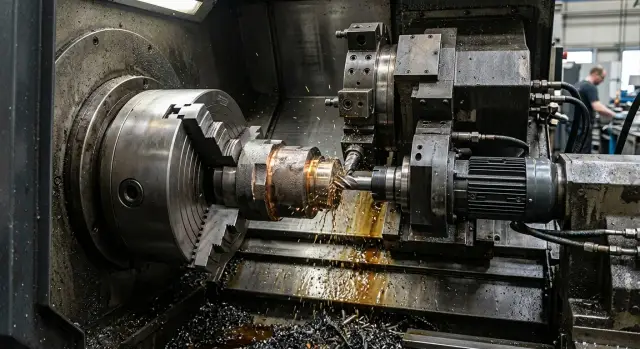
What goes wrong when milling steel
With steel, problems show up fast. The cut starts smoothly, then a hum appears, the tool starts to chatter, and the surface turns rough. If you need to mill a slot, a flat, or an off-center hole, the size often drifts on the first few passes.
The picture is usually the same: vibration increases, the cutting sound changes, waves and scratches appear on the surface, and the cutting edge heats up and dulls sooner than expected. Sometimes it feels like the spindle holds position with a slight delay or tiny jerks. That is a typical operation breakdown. The tool is no longer cutting properly and is partly rubbing the metal.
From the outside, the problem looks random, but in practice it often repeats on the same steel, with the same tool overhang and the same program. The cause is usually not one setting, but how the machine holds angle under load.
This shows up more often in steel because steel is less forgiving of weak points in the system. Cutting forces are higher, the load on the driven tool is greater, and any lack of rigidity or torque shows up quickly. The same turning center may give an acceptable result on aluminum. On steel, it starts making noise, leaving marks, and drifting off size.
Because of that, it is easy to draw the wrong conclusion and blame the whole machine. But in milling operations on a turning center, the problem often comes down to a specific unit, not the machine's overall accuracy. The turning side may work calmly: diameter is held, finishing turning is smooth, and repeatability is fine. The trouble starts when the C axis and the driven tool come into play.
That is why C-axis torque reserve should not be confused with the machine's overall accuracy. A machine may turn steel confidently and still hold angular position poorly under milling load. For a shop, this is the most frustrating scenario: the C axis exists on paper, but in real work you have to reduce cutting parameters, lower feed, and make extra passes.
The first warning sign is simple: everything is still acceptable on soft materials, but on steel, noise, marks, and unstable size begin to appear. That usually means the issue is not the name of the function, but how much torque reserve the C axis really has under load.
Why the same C axis gives different results
The phrase "C axis" in a machine spec sheet is often misleading. On one turning center, it is good only for precise spindle indexing, while on another it can handle steel milling with circular interpolation without trouble. The label is the same, but the behavior is different because it is not the name that does the work, but the whole unit.
When the C axis works as an indexing axis, the spindle turns the part to the required angle and locks it. That is enough for holes on a circle, slots at fixed positions, and stop-and-go operations. With interpolation, the C axis must move continuously with X and Z, hold the angle during cutting, and not break into micro-oscillations. For steel, that is a different mode.
Gear ratio matters a lot. If the drive is tuned for speed, the spindle turns more readily but holds torque worse at low speeds. If the unit has more reduction, the C axis handles a heavy part more confidently and holds load more calmly, but may lose some positioning speed. That is why two machines with the same line in the catalog start behaving differently on the very first slot.
The chuck and the part itself also consume part of the reserve. A heavy large-diameter workpiece acts like a flywheel. The farther the mass is from the center, the harder it is for the spindle to accelerate, brake, and hold angle accurately. A large chuck adds inertia, and a weak clamping force allows tiny shifts right when the driven tool enters steel.
Another separate issue is how the unit holds angle under load. Here, mechanical clamping, spindle braking, and overall locking rigidity are important. If the brake is weak, the cutter slowly pulls the part off angle. On a soft material, this can sometimes go almost unnoticed. On steel, vibration rises quickly, size drifts, and the tool wears out sooner.
On the shop floor it looks simple: two machines both claim a C axis and a driven tool, but one confidently machines a steel slot while the other is only suitable for indexing and drilling. The reason is usually not the program. The difference comes from the sum of the factors: gear ratio, chuck-and-part inertia, and how the spindle holds angle during cutting.
Which units decide the outcome
The same "C axis" label in the catalog tells you very little by itself. When milling steel, the result depends on the set of units that hold the spindle under load and keep the part from shifting off angle.
The first unit is the C-axis servo drive. Do not look at a nice peak number; look at torque in the working speed range. During steel machining, a machine rarely lives in ideal conditions. The cutter enters the metal, the load rises in pulses, and if the motor only holds torque on a short peak, the spindle starts to drift. You see it immediately on the part: the size moves, the edge tears, and vibration appears.
There is often a reducer between the motor and the spindle. It can genuinely help. A reducer increases spindle torque and makes angle holding calmer, especially on heavy cuts. But there is a trade-off: response becomes slower. For a rough estimate, that is a fair exchange if the goal is to mill steel confidently, not just index the axis quickly.
The spindle brake or mechanical locking matters just as much. When the machine cuts steel, the servo alone is sometimes not enough. The brake holds the angle more firmly and takes some load off the drive. Mechanical locking is even more reliable in heavy modes, where any tiny movement immediately ruins the slot or the flat.
Then there is the spindle's own mechanics. If the body, shaft, and bearings are not rigid enough, a good C-axis torque reserve will not save the situation. The unit can flex slightly under load, and then the cutter starts knocking against the metal instead of making a clean cut. That is why you need to look at the whole spindle unit, not only the motor in the catalog.
People often confuse three different things here: C-axis torque, which holds and positions the spindle; driven-tool torque, which spins the cutter itself; and locking rigidity, which keeps the spindle from turning under cutting load. If the driven tool is strong but the C axis is weak, the cutter will spin properly, but the workpiece will start drifting off angle. If the C axis holds well but the driven tool is weak, the spindle stays in place, but the cut will be sluggish. Steel needs both.
What to check in the specs and during the demo
A single "C axis" line in the catalog does not promise much. For steel, you need to understand how this axis behaves during cutting, not only when the spindle is turned to a set angle.
First, separate the two modes: positioning and contour work. If the machine can place the spindle accurately, that is good for holes on a circle or simple flats. But for continuous steel milling, that is not enough. Here, the C axis must hold angle in motion, without jerks and without a noticeable loss of feed.
The torque number can also be misleading. Peak torque looks nice in a table, but in real work it may last only briefly. Look at the torque at the speeds where the machine will actually cut steel. If the reserve in that zone is small, the cutter will start rubbing instead of cutting.
Do not ignore workpiece limits. Large diameter and extra mass change the behavior of the C axis a lot. A heavy part adds inertia, and it becomes harder for the spindle to hold angle accurately under load. So you should check not only the maximum turning diameter, but also what mass and diameter the machine can really handle in milling mode.
Also check the driven tool separately. Even a strong C axis will not help if the driven unit has too little torque or only delivers it at high speeds that are not suitable for steel. Ask two things: how much torque is available at the required speed, and what cutter diameter the unit normally handles without overload.
At the demo, do not ask them to "cut something." Ask for a test similar to your real task. You need a steel blank close to your own part in diameter and mass, not a light piece of aluminum and a short demo pass. During the demo, check a few simple things: does the operation run in contour, not stop-and-go; are torque and load stable at working speeds; does the angle drift after several identical passes; what does the surface look like; do noise and vibration increase by the end of the cut.
If the seller only shows a small part, soft material, or one short pass with no repeats, there is not enough data. For steel, that test proves very little.
How to check torque reserve step by step
You can only understand the C-axis torque reserve on an operation that resembles your own. The catalog number alone says little: when making a slot in steel, milling a flat, and threading, the load on the units is different.
First, define the conditions without vague wording. "Steel" is not enough. You need the grade and the actual hardness of the part, because even a small increase in hardness quickly eats up torque reserve and changes the cutting sound.
For a proper check, a few input data points are usually enough:
- the part material and hardness, if known;
- the exact operation: slot, flat, hole, thread, depth, and pass length;
- the tool and settings: cutter diameter, number of teeth, depth of cut, feed, and speed;
- the torque the machine holds in that specific C-axis and driven-tool operating mode;
- a trial cut on steel close to your part in grade and hardness.
After that, do not look only at the finished part. A good "first pass" result proves nothing if the machine was running almost at the limit. It is much more useful to compare the cutting load during the pass. If one machine shows 40–50% and the other 80–90%, their reserve is different even if the slot looks the same. It is even better to ask what happens as the tool wears, feed increases, or the metal batch is slightly harder. That is where the real reserve shows itself.
A simple rule of thumb: if a 6 mm slot in steel runs calmly, without chatter, without a long "tuning by ear," and with a clear load margin, that mode is easier to repeat in production. When the supplier is ready to show the cut on a similar material and display the actual load on the screen, that is more useful than any polished line in the specification.
A simple shop-floor example
A steel bushing made of grade 45 steel with a diameter of about 80 mm is taken. A longitudinal slot 8 mm wide needs to be cut on the outer diameter with a driven milling cutter. It is a common operation, but it quickly shows how ready the machine is for this kind of work.
Two turning centers of the same class are compared. Both descriptions mention a C axis and a driven tool. At first glance, there is almost no difference: similar size, similar layout, similar program settings.
The first machine runs smoothly. The operator sets the feed, makes a test pass, and barely changes anything. The spindle holds angle without jerks, the cutting sound is calm, and the slot comes out clean. The second and third parts look the same: the walls are straight, and the bottom of the slot has no visible marks from correction passes.
With the second machine, things start the same way, but only until the cutter enters the metal. After that, the C axis works harder: small twitches appear in the middle of the pass, the sound changes, and waves remain on the part. The operator has to lower feed by 20–30% and reduce cutting depth to avoid ruining the surface.
The reason is not the phrase "C axis" itself. What matters is the real torque reserve, the rigidity of the spindle lock, and the mass of what has to be rotated and held. On the first machine, torque is higher, locking is tighter, and the chuck and the whole rotating system are easier to handle in this task.
On the second machine, torque is lower, locking is weaker, and the heavy chuck adds inertia. When the cutter enters steel, the spindle must do more than just turn the part to the required angle. It must hold it without micro-shifts at the moment when cutting starts to slow the system down. If the reserve is too small, the machine loses smoothness and leaves marks on the metal.
From a shop-floor point of view, the difference is simple: the first machine holds the cycle, the second one asks for concessions. On aluminum, this sometimes goes almost unnoticed. On steel, the difference quickly shows up in cycle time, tool wear, and surface quality.
Where people most often make mistakes
The first mistake is simple: the machine is chosen because it has a checkbox that says "C axis." On paper, that seems enough. In real work, something else becomes clear quickly. The C axis may be there, but under load it holds the part differently from machine to machine: one machine cuts a slot calmly, while another starts to chatter, lose accuracy, or drift off size.
People often look only at spindle power and barely look at torque. For steel, that is a bad habit. Power alone does not show how the unit will behave at low speeds, when the cutter enters the metal and the load arrives in pulses. If you need C-axis torque reserve, compare not only the kW figure, but how the drive behaves in real operating conditions.
Another common mistake is testing on aluminum and concluding that "it will work on steel too." Usually it will not, or it will behave very differently. Aluminum forgives weak locking, small vibration, and a less-than-ideal cutting mode. Steel shows these issues immediately. What looks clean and fast on a soft material can become squeal, edge chipping, and extra minutes per part on steel.
Many people underestimate chuck weight and workpiece diameter. That is not a minor detail. The heavier the chuck and the farther the part mass is from the center, the harder it is for the C axis to hold position without a torque drop. A machine may look confident on a small demo part and then behave differently on the real workpiece.
There is one more trap: choosing a large cutter for one operation in order to go faster. In practice, that often overloads the unit, especially if the settings were chosen without reserve. It is often better to remove metal in two calmer passes than to get chatter, surface marks, and a cycle stop.
Before buying, it helps to ask a few direct questions: what steel and cutter were used in the demo; what was the part diameter and weight in the chuck; what happens if the cutting depth is a little higher than the demo; is there a test on the exact operation you need? This kind of conversation quickly separates real suitability from a pretty description.
A quick checklist before choosing a machine
Five minutes with the right questions can save months of frustration in the shop. If you need steel machining, do not look only at whether the machine has a C axis. Two machines can have the same label, but very different torque reserve and cutting behavior.
The most practical approach is simple: ask not for general promises, but for a short test on your own task or on a part close to it in material and diameter. With steel, small details show up quickly. Feed drops, the surface gets wavy, the tool starts to sing, and the slot or flat goes off size.
What is worth checking first:
- does the C axis work in contour mode during cutting, or does it only position the spindle at the right angle;
- what torque is available at the speeds where you will actually work;
- what the driven tool delivers on steel, not on a soft material;
- how the part diameter and weight affect the stability of the operation;
- whether you are shown a finished surface without an artificially eased mode.
A good sign is when the machine holds size and leaves a smooth surface at normal feed, without nervous readjustment after every pass. A bad sign is when the conversation keeps going back to the catalog instead of the actual steel cut.
If you are choosing a CNC turning center for steel parts, keep your focus on three things: torque at the required speed, rigidity of the units, and honest trial machining. That combination quickly shows whether the C axis will work in production, not just in the spec sheet.
What to do next
If you are selecting a machine for steel, do not build a general request. Make a one-page list of the real operations. You need the modes the machine will run every day: slotting, flat milling, off-center drilling, and threading with a driven tool. That makes it much easier to see whether the C-axis torque reserve is sufficient or whether the paper picture looks better than the shop-floor reality.
It is better to describe not the "part as a whole," but each difficult operation separately. If one part has a short steel-45 pocket and a cross-drilled hole near the chuck, that is already a good test. These are the operations that most often show how the C axis and driven tool behave under load.
A task sheet usually needs five items: material and, if known, hardness; part diameter and machining location; tool type and diameter; depth or width of machining; and target cycle time.
Then give that sheet to the supplier and ask for a direct comparison of models, not general talk. Have them show where the C-axis torque is higher, how the locking is designed, how firmly the spindle holds position, and at which settings the drop-off begins. If the comparison is honest, the difference between machines that look similar in the catalog becomes clear very quickly.
If possible, ask for a test on steel, not on a soft material. A short test on your own operation often gives more value than a long presentation. Even a simple part with one flat and one hole can immediately show where the machine cuts calmly and where vibration starts to rise and the cycle begins to stretch.
In this kind of check, a conversation with a supplier who works not only from the catalog but also from real operations is useful. At EAST CNC, you can discuss selecting a model for a specific task, and the east-cnc.kz blog has materials about equipment and practical metalworking tips. That is more convenient when you need to evaluate not an abstract "C axis," but a clear result on your steel part.
FAQ
How can I tell the problem is in the C axis and not the whole machine?
Look at turning and milling separately. If diameter stays consistent during turning, but slotting or flat milling brings humming, waves, and angular error, the issue is usually in the combination of the C axis, spindle locking, and driven tool.
Why is everything fine on aluminum, but on steel the noise and marks appear?
Steel creates a higher load and exposes weak points faster. On aluminum the machine may still work acceptably, but on steel the spindle holds the angle worse, the tool starts rubbing instead of cutting, and the size drifts.
What is the difference between an indexing C axis and a C axis for interpolation?
An indexing C axis simply turns the spindle to the required angle and holds position for stop-and-go operations. For interpolation, the C axis must move together with the other axes directly during cutting and keep the angle under load.
What should I look at in the specs: power or torque?
For this kind of work, do not look only at kW. Torque at working speeds shows whether the spindle can hold the part in steel without jerks or drop-off, while power alone does not tell you that.
How do the chuck and part weight affect the result?
A heavy chuck and a large workpiece add inertia. Because of that, the C axis has a harder time accelerating, braking, and holding angle, so a machine can look solid on a small part and start vibrating on your actual part.
Why does the spindle need a brake or mechanical locking?
The brake and mechanical locking help the spindle hold angle when the cutter presses on the part. If locking is weak, the spindle gets tiny shifts, and you see waves on the surface and faster tool wear.
What kind of test should I ask for during the machine demo?
Ask for a cut in steel that is close to your material in grade, hardness, diameter, and weight. Let the supplier show not a single short pass, but a repeated operation with real load on the screen and the surface condition after several parts.
Will lowering feed and cutting depth help?
Reducing feed and depth often helps you get the job done, but only as a temporary measure. The cycle gets longer, tool life gets shorter, and the machine still does not gain extra reserve, so this approach usually causes trouble in series production.
What data should I give the supplier before selecting a machine?
Prepare the steel grade, hardness, part diameter, weight, type of operation, slot or flat size, cutter diameter, and target cycle time. With that set of data, the supplier can compare models based on the job, not just the catalog.
Can a machine with a C axis still mill steel poorly?
Yes, if the C-axis torque is low, locking is weak, or the chuck is too heavy for the task. On paper the function exists, but in the shop you will have to reduce cutting parameters, make extra passes, and accept unstable surface quality.