
BT, CAT or HSK: what changes in real milling
BT, CAT or HSK: we explain how clamping, repeatability, vibration and tooling choices change for roughing, finishing and high-speed milling.
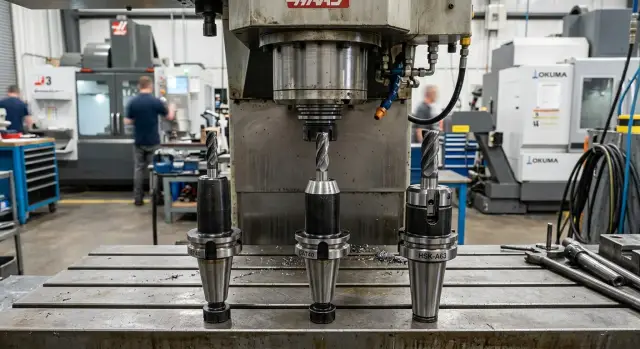
Why the spindle taper changes the outcome
The spindle taper affects more than which holder fits the machine. It determines how the tool sits in the spindle, how strongly it’s held and how precisely it returns to the same position after a change. That influences part size, tool runout and surface marks.
When the fit is stiff and stable, the cutter cuts more evenly. If the connection allows micro-slip or centering is poor, edges load unevenly. Size starts to “wander”, walls get streaks, and pockets show circular marks at the bottom. Operators often first suspect the cutting parameters, while the actual issue is how the holder sits in the spindle.
The difference is visible not only at extreme speeds. Even during ordinary steel machining, without chasing record feedrates, one taper may run calmer while another produces more vibration at the same overhang. With a long cutter this appears faster. The larger the overhang, the more any weak point in clamping affects surface finish and tool life.
The part material also changes the picture. On aluminum the machine often forgives small clamping flaws: cutting is gentler, loads are lower and marks aren’t always obvious. On stainless, heat-resistant alloys and dense steels mistakes show up quickly. Shuddering appears, edge wear grows, and size drifts after just a few tool changes.
So the question “BT, CAT or HSK” shouldn’t be decided by habit. There’s no single best option for every shop, every machine and every part. Requirements for heavy, short, stiff tooling differ from those for fine finishing, frequent tool changes or long, small-diameter endmills.
It’s better to evaluate the spindle taper together with the task: what you cut, which tools you use, the overhang and how often you change tooling. Then the choice affects daily results: sizes hold, surfaces are cleaner and the operator doesn’t spend shifts chasing the cause of rejects.
How BT, CAT and HSK hold the tool
BT and CAT work on a similar principle. They have a steep 7/24 taper: the holder goes into the spindle, a drawbar pulls it in, and the taper centers the tool. The flange isn’t only for tool change. Through keys and slots it transmits torque when the cutter cuts under load.
In fit BT and CAT are close. In both the main support is along the taper, and the flange face usually doesn’t serve as a precise datum. So in practice they often behave similarly: if the spindle is clean, the taper isn’t worn and the drawbar provides the right force, the tool sits stably. Differences show more in flange design: BT’s flange is symmetric, which helps balancing and automatic changing; CAT’s flange is asymmetric, though the clamping principle is the same.
HSK is different. It’s a short hollow taper clamped from the inside. The spindle mechanism engages the inner part of the holder and pulls it so that contact is made both on the taper and on the face. That gives two supports at once. Because of this, the holder shifts less after a change, especially when accurate tool length and low runout matter.
At high speeds the difference becomes more noticeable. BT and CAT depend more on taper condition, drawbar force and the balance of the assembly. HSK often runs calmer because the short hollow holder and face contact better preserve the geometry of the connection. Put simply: in high-speed finishing HSK usually maintains repeatability better after tool change and the spindle picks up less unwanted vibration.
That doesn’t mean everyone needs HSK. For many ordinary milling modes BT and CAT give acceptable results, especially when price, tooling availability and familiar maintenance matter. But where a shop runs high speeds, frequent changes and tight tolerances, the clamping method quickly shows its effect. You’ll see it on the part surface, in cutter life and in how often the operator has to re-establish size.
What happens in different milling modes
You should judge BT, CAT and HSK not by a catalogue but by how the machine holds size after hours of work. The same tool may run calmly on a roughing pass and start to “sing” at high speeds if the taper and clamping don’t suit the mode.
Roughing
When the cutter removes large volumes, the spindle and holder see strong side loads. In such work stiffness, reliable clamping and calm behavior under impact are important. BT and CAT often feel confident here, especially at medium speeds and with large-diameter cutters.
Between BT and CAT the difference in actual metal removal isn’t always large if holder, drawbar and spindle are in good shape. But CAT usually handles rising speeds worse due to less convenient balancing. BT is steadier in that sense and can produce less vibration on the same machine.
HSK also performs well in roughing, but its strength isn’t seen only in heavy cuts. It often wins where modes change during a shift and a forceful cut is followed by a more precise operation.
Simplified: BT and CAT tend to vibrate more when the taper is worn or the holder is poorly balanced. HSK typically maintains contact better as speeds increase. Yet any taper quickly loses stability if the tool is too long and overhang is chosen without stiffness margin.
High speeds and finishing
Finishing demands different things. Here large removal isn’t needed; runout, heat and repeatability after tool change become visible. If the part needs a clean surface, sharp edges and stable size, HSK often runs calmer. The short hollow taper and dual contact help the tool seat more precisely and shift less at high RPM.
BT can also achieve good finishing, especially with a short tool and proper balancing. But as speeds rise it more often loses to HSK in heat and size stability. CAT is usually the most demanding of the three in these modes, particularly for long runs at high RPM.
A short tool helps any taper because it reduces lever arm. But even with a short holder differences remain: HSK often yields less vibration and more predictable size, while BT looks like a reasonable compromise. If a shop does a lot of aluminum finishing, thin walls or complex 5-axis parts, you’ll notice the effect quickly.
When repeatability becomes the priority
Repeatability matters where the machine changes tools many times in a shift. It’s not about a one-time spec accuracy but whether the cutter returns to the same length and runout after each change. If it doesn’t, the operator measures again, adjusts offsets and runs a test piece.
Think in minutes and scrap, not just microns. A shift of a few microns is often invisible in roughing but becomes a problem on a finished wall, a fit hole or pocket depth. The smaller the tolerance and the longer the series, the more expensive every inaccurate re-seat becomes.
When choosing between BT, CAT and HSK this often matters more than catalogue numbers. In a serial part the machine may alternate a rougher, a finisher, a drill and a reamer every few minutes. If a worn tool is removed and a new identical one installed but size shifts, the cycle stops. The operator runs a check cut, applies correction and only then returns the part to flow.
Imagine a batch of 300 housings with a tool changer cycling four positions each cycle. During a shift the operator changes the finishing cutter twice and a drill once. If each change costs 5–7 minutes for measurement and adjustment, you lose up to 20 minutes of productive time per shift. Over a week that’s hours.
Automatic tool change alone doesn’t solve it. A fast changer only helps when the spindle taper, chuck and tool clamp each seat the same way every time. Otherwise a quick exchange turns into a quick stop for verification.
HSK is often chosen where there are many changes, high speeds and tight finishing tolerances. BT and CAT are usually sufficient for standard serial work if the spindle is good, holders are clean and drawbars and seating surfaces aren’t worn. Repeatability depends not only on taper type but on the condition of the whole tool-change chain.
How to choose the taper for your task
Choose BT, CAT or HSK based on real machine work, not a catalogue. Start by looking at the part: material, batch size, daily tolerance and how deep the cuts go.
If you make single items with wide tolerances, the requirements differ from a series with frequent tool changes and tight size control. The same taper may be fine for roughing yet annoying for finishing.
Where to start
Begin with four simple questions. Which material do you cut most often: aluminum, steel, stainless or heat-resistant alloys? What speeds and feeds are actually used: RPM, feed, depth and width of cut? What overhang is typical in ordinary operations, not on a test part? And what is the cost of a stoppage: a scrapped part, extra setup time or spindle downtime?
Then it’s easier to see what each option gives. For heavy milling and coarse removal stiffness of the whole chain matters: spindle, holder, tool and overhang. For high speeds and accurate tool re-installation HSK often looks more attractive. BT and CAT are chosen where there’s already a park of holders, straightforward service and a familiar workflow.
Also check compatibility. Verify spindle taper, drawbar type, available holders, spare tooling costs and lead times. Sometimes a taper fits the task but the shop loses time because the needed holder or collet chuck is hard to get quickly.
A simple calculation helps. If a tooling error ruins one housing per month, that’s money. If re-setup costs 15–20 minutes per shift, that’s also money. Sometimes more expensive tooling pays off simply because the operator spends less time chasing runout and restoring size.
Talk about choice by parts and modes. EAST CNC prefers this approach rather than debating which standard is “better” on paper. It’s logical: compare results on your operations, not letters in a designation.
Common mistakes in selection and operation
The most frequent mistake is simple: choosing a taper out of habit. If the shop has run BT for years, the next machine is ordered with BT. But if the work changed from heavy steel roughing to frequent finishing and tool changes, that habit may be wrong.
A second mistake relates to holders rather than taper. Too much overhang and poor balancing ruin results fast. A short, stiff holder cuts calmly; a long one brings vibration, noise and surface defects. This is especially visible with small cutters, deep pockets and high RPM.
Another error is expecting an expensive holder to solve everything. It won’t. If the spindle is worn the seating no longer holds the tool properly. Then repeatability after a change suffers and runout grows even with good tooling.
People often forget seating cleanliness. Fine chips, oil or damage on contact surfaces are enough to cause a shift that is later blamed on cutting parameters, tooling or the workpiece material.
One more common oversight: evaluating taper type separately from service and tooling availability. On paper a choice looks good, but in practice the shop waits weeks for a chuck, adapter or drawbar. For production this matters far more than nice numbers in a spec.
A simple shop example
In one shift a vertical center makes three parts from the same batch: a housing, a cover and a long slot. First the operator removes a large allowance on the housing with a face mill, then machines the cover with a cleaner finish, and finally cuts a narrow slot with a small endmill.
On the first operation the difference between BT, CAT and HSK is often smaller than expected. If the machine runs normal modes without very high RPM and without strict finish requirements, BT and CAT usually cover the task. Clamping is reliable, holders are affordable and the shop avoids paying for tooling that won’t pay off on roughing.
BT is often more convenient where they want to keep good balance at higher speeds. CAT also runs without surprises when a tooling park exists for it. If the housing only needs stable metal removal rather than perfect finish on the first pass, paying extra for HSK may not yield noticeable benefit.
The picture changes on the cover and the slot. There the tool diameter is smaller, RPM higher and tolerances tighter. After several tool changes the operator cares not about the change itself but how much time is spent re-adjusting. If the spindle taper holds repeatability poorly, size starts to “wander” and the operator adjusts offsets more often.
In that scenario HSK often helps. It feels more confident in finishing and high-speed work, where runout, stable seating and identical overhang after a change matter. On paper the difference per tool change may look small, but in practice there are fewer pauses for checks and fewer trial passes.
If the shift is mostly roughing, BT or CAT typically give acceptable results without extra cost. If the same shift includes much finishing, frequent tool changes and high RPM, HSK often saves not seconds on a spec sheet but 10–20 minutes of real operator time.
Quick checks before buying
A machine spec only gives part of the answer. Before buying, look at how the machine will run in your shop every day, not just letters BT, CAT or HSK.
If you have many tool changes, finishing work and tight tolerances, your taper needs differ from a shop mostly engaged in heavy roughing. Before the deal check: which spindle type the machine has and which holders are actually available; which operations take most machining time; the condition of the spindle, draw mechanism, drawbars and chucks; and who will provide service, tooling supply and commissioning. Also see whether you can run a test on your part or at least on a close regime.
People often err on the first point. On paper you can buy a machine with the right taper, and then spend weeks sourcing holders, collets or adapters. This is especially critical for Kazakhstan and neighboring countries: downtime due to one missing holder quickly eats the purchase benefit.
Then look at real operations. If 60–70% of time is spent on face milling steel, clamping and stiffness needs differ from serial aluminum finishing with frequent short cutters. A seller needs your list of operations, materials and typical tools, not a generic question.
You can’t skip checking the clamping assembly. A worn spindle or weak draw mechanism can spoil the impression even of a good taper. Measure runout, inspect seating wear, contact surfaces and chucks. For used machines this is mandatory.
Discuss service before purchase. Who handles commissioning, who is responsible for setup, how long to wait for consumables and tooling, and is there post-launch support? When the supplier covers selection, supply, commissioning and service, fewer gray zones remain. For companies that value delivery, start-up and ongoing support, this approach is usually more practical.
The most useful check is a trial part. One run in your regime shows more than a long presentation: how size holds, how the tool behaves and whether surprises appear after changing holders.
What to do next
Don’t start from a catalog of holders. First list your real operations. The choice between BT, CAT and HSK is rarely set by one value on a spec sheet. It’s defined by part material, tool length, frequency of changes and the tolerance you must hold in series.
Write down 3–5 typical parts and note for each the material, tolerance, tool, RPM and number of tool changes per shift. After that it usually becomes clear what matters most for you: stiffness in roughing, calm behavior at high speeds, or repeatability after each change.
Then separate must-have requirements from nice-to-have options. The must-haves typically include stable tool clamping, sufficient stiffness, repeatability after tool change, tooling availability and clear service. Everything else is secondary.
Look not only at current workload but at the next year or two. Today a shop may mostly machine aluminum small batches, and in six months move to steel and longer series. In that case check how the chosen taper will behave on future orders.
If you need a selection based on real parts and modes, EAST CNC can help choose a machine and tooling for your tasks. They provide supply, commissioning and service, so the conversation can be concrete — by part, material and shop loading — not abstract.
FAQ
What’s the simple difference between BT, CAT and HSK?
In short: BT and CAT use a similar clamping principle, while HSK works differently and usually returns the tool more precisely after a change. For ordinary roughing the difference between BT and CAT is often small; at high speeds and finishing HSK usually behaves more calmly.
What should I choose for roughing steel?
For roughing steel, BT or CAT are usually enough if the spindle, holder and drawbar are in good condition. BT can be preferable when speeds rise because it often gives fewer balancing issues.
Which taper suits finishing and high speeds?
For finishing and high speeds, HSK is often chosen. It typically produces less vibration, holds tool length more stably after a change, and helps keep the surface cleaner.
Do I need HSK if the machine runs in normal modes?
Not always. If most work is roughing, at normal speeds and with wide tolerances, BT or CAT can solve the job without extra cost. HSK pays off where there are many tool changes, tight sizes and sensitive surfaces.
Why does size shift after a tool change?
Start with the seating and cleanliness. Size often shifts not because of cutting mode but because of dirt on the taper, spindle wear, weak drawbar or poor re-seating of the holder.
Is BT enough for series production?
Yes — in many shops BT gives acceptable day-to-day results. It’s a reasonable choice when tooling is familiar, service is straightforward and there’s no constant work at extreme speeds.
What else affects the result besides taper type?
Look beyond the taper. Overhang, balancing, spindle condition, drawbar and chuck state, and contact surface cleanliness all strongly affect results. A good taper won’t save a poorly assembled chain.
Why is tool overhang so important when choosing a taper?
Large overhang magnifies any weakness in the clamping. The longer the tool, the faster vibration, runout and surface marks grow. For long, thin endmills the demands on seating and repeatability increase immediately.
What should I check before buying a machine with BT, CAT or HSK?
Check which holders and chucks are actually available, who will do commissioning and service, and whether you can run a test part or a close simulation. Also assess the spindle and clamping unit condition, especially for used machines.
When is CAT still worth considering?
CAT still makes sense if you already have a park of tooling for it and your operations stay conventional in speed and tolerance. If you face a lot of finishing, frequent tool changes and high speed, compare it with BT and HSK on your real operations, not by habit.