
Bottlenecks After Buying a Second Center: What Slows Output
Bottlenecks after buying a second center are often hidden not in the machine itself, but in tooling, inspection, and material feeding. Let’s look at where output is lost.
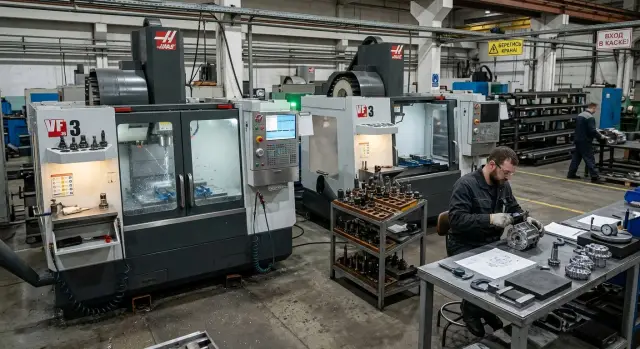
Why a second center does not double output
A second machining center looks like an easy answer to lack of capacity. On paper, it all seems logical: there was one workstation, now there are two, so output should rise almost twofold. In the shop, that rarely happens.
A machine adds cutting minutes. It does not remove the pauses around the cycle. The operator removes the part, carries it for inspection, waits for the next blank, adjusts the tool, records the dimension, calls for the crane or forklift. While all this is happening, the spindle is silent.
Most of the time the shop loses time not in the machining cycle itself, but between cycles. These stops are short, so they are easy to miss in utilization reports. But this is exactly what makes up a lost shift.
After buying a second center, old weak points become visible right away. One machine could still tolerate a delay in inspection or material feeding. Once there are two machines, the same measuring station, the same operator, or the same tool stock starts slowing the entire flow.
Losses are usually hidden in familiar things: waiting too long for the first part after a setup change, measuring every piece by hand, delivering blanks too late, changing tools at the wrong moment, and not recording small stoppages. Individually, it seems minor. Over a shift, it adds up to something very real.
That is why a second center often brings not a twofold increase, but a 20–40 percent gain. The reason is simple: a shop floor works like a chain. If one link is weaker than the others, the whole flow moves at its speed. Suppose each center makes a part in 4 minutes, but inspection of one part takes 6 minutes. The second machine will not double output. It will double the queue at the measuring table.
The same logic applies to tooling and material feeding. If the setup technician cannot prepare fixtures for two machines, one of them will wait. If material arrives late, both centers can sit idle even with a good plan. Output growth starts not with the number of machines, but with checking the entire part route — from the first blank to acceptance of the finished batch.
Where the bottleneck usually appears
After expansion, the shop rarely slows down in the spindle itself. Much more often, the flow breaks around the machine: at tooling, inspection, material feeding, and the operator’s work between the two machines.
The most common hidden slowdown is unprepared tooling. The machine finished the previous batch, but the new one does not start because someone has to look for a holder, change an insert, fetch a tool holder from the rack, or set lengths again. On paper, the stop looks short. Over a shift, it easily turns into an hour.
Inspection also quickly becomes a bottleneck. If a part is machined in 6 minutes and post-setup inspection takes 12, the pace is no longer set by the machine but by the person doing the measuring. This is especially noticeable with precise parts, when the operator carries the part to a separate table, waits for a free micrometer, and only then returns to the machine.
Material feeding is even simpler. One center is ready for the next part, but the bin is empty. Fifteen minutes later, material is delivered to both machines at once, and the operator starts loading them in bursts. The flow becomes uneven: idle time, then rush.
If one person services two machines, the rhythm also breaks quickly. The operator removes a part from the first machine, runs to the second, then goes back for a measuring tool, then fetches fixtures. If the needed items are stored in different corners of the shop, the person walks hundreds of extra meters over the shift instead of keeping output moving.
A simple rule of thumb: see who waits most often — the machine, the operator, the inspector, or the blank. Wherever waiting repeats several times per shift, that is where the real bottleneck sits.
How to find the bottleneck in one shift
You do not need a complicated report to understand what is holding back output. You need an honest picture of how one normal part moves through the shop.
First, take a regular part and follow it from storage to the next stage. Write down not a polished diagram, but the real route: who brought the blank, who loaded it into the machine, who removed the part, who carried it to inspection, and where it waited. The route as it really happens is almost always more interesting than the procedure.
Then make a few simple measurements:
- How many minutes the machine is actually cutting.
- How much time goes into loading, unloading, air blow-off, and transfer.
- How long the part waits for a blank, a tool, or inspection.
- How long setup and tool changes take.
After that, separate machine time from manual work. This step quickly brings everyone back to reality. For example, the center cuts for 7 minutes, and the operator spends 4 minutes on loading, gauging, and recording the result. If the same person services two machines, part of the downtime is already built into the layout.
Next, do not look at the noisiest area — look at the longest queue. If 20 parts are sitting in front of inspection, the problem is not the machine. If the second center waits 10 minutes for blanks to arrive, the problem is not the machining cycle. The queue almost always shows where the flow is narrowing.
Another useful approach is to watch the stop live. At the moment of downtime, do not guess — just note who is doing what. The operator may be looking for an insert, the inspector may be checking the previous batch, the storekeeper may only bring material once an hour. One shift of observation is usually enough to see the stage that is holding the whole shop.
When you find that point, do not rush to buy another machine. First remove the queue where it already exists.
Tooling: a quiet cause of downtime
When a second center appears in the shop, tooling quickly reveals weak points in how the work is organized. The machine is ready, the program is there, the blank is nearby — but the start is still delayed. The reason is simple: there is no assembled kit, some items are in sharpening, and the needed holder is on another machine.
In practice, one complete kit per machine is rarely enough. You need a working set, a set for the next operation, and a reserve for breakage, regrinding, or sudden wear. Without that, the shop starts losing time in 5–10 minute pieces. Each stop is almost invisible on its own. Over a shift, it becomes a large number.
The problem is usually not the tool change itself, but what happens around it. The operator looks for the right cutter, checks the overhang, waits for a reground drill, re-enters offsets. If storage has no compartments, no labels, and no clear stock status, the plan quickly starts to wobble even when orders are stable.
Regrinding and scrapping also often disrupt output. On paper, the CNC tooling is there, but in reality part of it has gone for sharpening and part of it can no longer be used because of wear. As a result, the shop switches modes on the fly, adds an extra pass, or stops the machine until the replacement arrives.
Ready-made kits should be assembled in advance if a batch repeats for several shifts or if the setup follows a familiar pattern. A simple example: the shop has two similar orders, but the kit for the second order starts being assembled only after the machine stops. At that moment, the spindle is silent, even though all preparation could have been waiting in a labeled tray before the shift began.
This is especially noticeable on CNC lathes and machining centers, where the cycle itself is already tuned and the losses hide around it. If you measure the time spent searching, assembling, replacing, and entering offsets separately, the hidden slowdown usually becomes visible immediately.
Inspection: when measurement sets the pace
After a second center is installed, the shop often hits a limit not in cutting, but in measuring. The machines are ready to run, but parts are waiting for the operator, the inspector, or a free spot at the measuring table. Even a few extra minutes per batch quickly eat up the expected gain.
A common mistake is measuring too much and too often. After a proper setup, many dimensions change rarely: overall length, simple outside diameters, chamfers, and other parameters where the process is already stable. If the tool has not been changed, the settings are untouched, and the previous parts are coming out consistently, there is no reason to check every piece with the same frequency.
At the machine, it is better to keep only what helps make an immediate decision. The first part after setup, a dimension at risk of drifting because of tool wear, or a base diameter after changing the blank or fixture — that is work for the operator on site. Complex geometry, roughness, and final batch acceptance are better moved to a separate station. Otherwise, the machine turns into a waiting point.
The inspection queue usually looks very familiar. Two machines are waiting for one micrometer or one measuring station. The operator carries parts to the inspector after every short run. The inspector rechecks what was already checked at the machine. The supervisor asks for another measurement just in case. When this repeats all day, the second center does not add output — it creates a second queue.
Repeated measurements also create confusion. One person gets 39.98, another 40.01, and a third measures again, so the argument is no longer about the part but about whose result is correct. Usually the cause is different tools, different part temperature, or simply a different measuring sequence. One clear standard helps: what is measured with what, who measures it, when it is measured, and which result counts as final.
Recording results also often gets bloated. If the operator rewrites the same data into several forms every time, the shop loses time for no benefit. It is easier to keep a short batch record: part number, inspection time, a few dimensions with tolerance, and a note about correction if one was made.
Material feeding and part movement
After the second center starts running, one simple thing often becomes clear: the machines are ready to work, but the shop is not ready to deliver, collect, and sort parts quickly. One operator is waiting for the crane, another is looking for a cart, and the storekeeper is busy with another order. The machine datasheet shows a good cycle time, but the shift includes long pauses between cycles.
This can happen even in a solid, well-organized shop. If the blank is heavy or awkward, one crane quickly becomes the common slowdown for two machines. The same is true for a cart, a forklift, or the person issuing material from storage. Capacity has increased, but the internal logistics have stayed the same.
Batch size also changes the picture. Too large, and a batch sits at one machine while the other waits its turn. Too small, and there is constant bustle: people move bins more often, count parts again, and mix up statuses. In practice, it often works better to have a transport batch that covers 30–60 minutes of work. While the machine is cutting that part, the next one is already being prepared nearby.
Semi-finished parts and scrap often pile up not where it is convenient, but where there is space left. That could be a walkway, the inspector’s table, or the floor next to the machine. Then parts have to be moved again, and sometimes counted again. If scrap is kept near good parts, the risk of mistakes rises very quickly.
Even ordinary bins do more than they seem to. When a bin has a fixed place, a standard size, and simple labeling, people ask each other fewer questions and are less likely to take the wrong batch. A label usually only needs the order number, operation, quantity, and status — raw, after operation 1, scrap, finished.
A good sign is simple: the operator does not have to look for the next blank after the cycle ends. The next batch is already nearby, scrap is stored separately, and finished parts move out without debates or searching. That is when the second machine starts producing output not on paper, but in the real shift.
A shop-floor example
One shop bought a second center for a recurring part. The part was simple: a housing blank, a few holes, and finish machining of a seat. The first machine had been running steadily for a long time, the operator knew the settings, the tooling was in its place, and inspection followed a familiar routine.
Management expected almost a twofold increase. The math looked right: if one center produces 80 parts per shift, two should produce around 160. But already in the first week it became clear that the second machine was often sitting idle.
The problem was not the center itself. At the start of the shift, the operator was looking for holders, inserts, and drills, and part of the tooling was taken from the first machine. That took 25–40 minutes. Then came a second pause: after each batch, the inspector took the part for measurement, and while the part was being checked at the far end of the shop, the next start was delayed.
As a result, the first machine kept running steadily, while the second was always trying to catch up. Over a shift, it could be idle for more than an hour in small 5–10 minute pieces. That is what a problem after expansion usually looks like: the equipment is there, but the flow is not assembled.
The shop did not do anything dramatic. Inspection was moved closer to the machines so checking took minutes, not half the shift in total. Tooling started being prepared in advance: kits for both machines were assembled before the shift began instead of being searched for at startup. Fixtures were separated so the second center would not wait for the first one to free a holder or chuck.
The result came quickly. Output did not double, but it rose at once: instead of 95–100 parts, the shop started producing about 140 per shift. A good example of how material feeding, part inspection, and tooling affect results much more than it seems at the moment a new machine is purchased.
Mistakes after expanding the shop floor
Buying a second center rarely brings growth by itself. More often, it simply makes old problems visible — problems that used to hide behind one machine.
The first mistake is to install a second machine without changing the part flow. Blanks are still stored in one place, finished parts are stacked there too, the operator takes extra steps, and the cart arrives only after downtime has already started. In the end, two centers are waiting for the same delivery instead of cutting metal.
The second mistake is to look only at machine time. If one center has a 7-minute cycle, it is easy to assume the second will almost double output. But a real shift is more than cutting. It also includes loading the blank, unloading the part, air blow-off, measuring, correction, waiting for tooling, and small stops that often do not show up in the report.
The third mistake is to keep all inspection with one person. With one center, that is still manageable. With two, that setup starts slowing the shop down within the first few days.
The fourth mistake is to change tools only after the operator complains or after the dimension drifts out. Planned replacement may look like a waste of time, but emergency replacement is almost always longer. It also often leads to repeat inspection and extra parts in quarantine.
And there is another typical situation: one operator is moved between tasks without a clear priority. He is loading blanks, then measuring a part, then looking for tooling, then answering the setup technician. On the surface, the person is always busy, but the machines are still standing. People being busy and output are not the same thing.
If inspection, material feeding, and tooling work are not separated after expansion, the second center will add not output, but a new queue.
What to do next
If the second center is idle, do not rush to solve the problem with another purchase. First remove the longest recurring downtime. Usually it is hidden not in cutting, but nearby: in waiting for setup, measurements, tooling, or blanks.
Start with facts from one normal shift. How many minutes does the machine actually cut metal, how long does it wait for the operator, how long does it sit because of the first-part inspection, and how much time goes into delivering the batch. Even a simple log often shows the problem more clearly than discussions at the machine.
Then the logic is simple. First remove the one longest downtime that repeats every day. Then level out material feeding so the machine does not wait for the next batch. After that, reorganize inspection so it does not stop the whole shop. Only then recalculate the real capacity and decide whether you need a new machine, different tooling, or another person on the shift.
Looking only at the cycle of a new center is a common mistake. You need to count the entire route of the part: who prepares the tooling, who feeds the blanks, where the inter-operation stock sits, and who measures the dimension and when. If one link lags behind, the second center simply runs into someone else’s bottleneck faster.
If you are planning to expand the shop floor, it helps to discuss not only the machine model, but the whole launch. At EAST CNC, that comes naturally: the company helps with selection, delivery, commissioning, and service, so the conversation can focus not on the datasheet, but on how the shop will actually run in a real shift.
A good result at this stage looks simple: the machines cut steadily, blanks arrive on time, inspection does not break the rhythm, and capacity calculations match the shift output. If that is not the case, the next gain should be sought where the center is waiting — not where it is already working.
FAQ
Why does a second center not double output?
Because a machine adds cutting time, but it does not remove the pauses around the cycle. If the operator is waiting for inspection, looking for tools, or not getting material on time, the second center simply creates a second queue.
Where does the bottleneck usually appear after expanding the shop floor?
Most often the flow is slowed by inspection, tooling, material feeding, and the operator’s work between two machines. The spindle itself is often ready to run, while the shop loses time right next to the machine.
How can I quickly understand what is slowing output?
Take one regular part and follow it through the whole shift, from the blank to the next stage. Measure cutting, loading, unloading, gauging, tool changes, and waiting separately — then the bottleneck becomes obvious without complex reports.
Should every part be measured after starting a second center?
No, not always. If the process is stable after setup, it is better to check at the machine only the dimensions that can realistically drift, and move complex inspection to a separate station. Otherwise, measurement starts setting the pace for the whole shop floor.
What should be done with tooling so machines do not wait?
Prepare tool kits in advance instead of when the machine stops. When holders, inserts, drills, and offsets are arranged by order, the shop does not lose 5–10 minutes many times per shift.
Can one operator normally service two centers?
It can, if there is little manual work between cycles and everything needed is close by. If the operator spends a lot of time on gauging, records, searching for fixtures, and moving parts, one of the machines will start waiting in almost every cycle.
How should material feeding be organized for two machines?
Keep enough material nearby for at least 30–60 minutes of work and do not move material in bursts. The operator should not have to look for bins, wait for a crane, or run for the next batch after every cycle.
How do I know the bottleneck is inspection?
Watch the queue and repeated waiting. If parts pile up at the measuring table and the machines stop after the first part or after a short series, the shop has already hit the inspection limit.
Should I buy another machine if the second one often sits idle?
First redesign the flow, then count the cost of a new purchase. If you have not removed the waiting at inspection, tooling, and feeding, another machine will add expenses, not output.
What output growth is realistic after buying a second center?
In many shops, a second center does not double output, but adds about 20–40 percent until the shop removes the old bottlenecks. That is normal if inspection, fixtures, and internal logistics stay the same.