
Boring Head or Reamer: Which to Choose for Holes
Boring head or reamer: compare tolerance, setup and batch time to choose the best way to finish a hole for your material and volume.
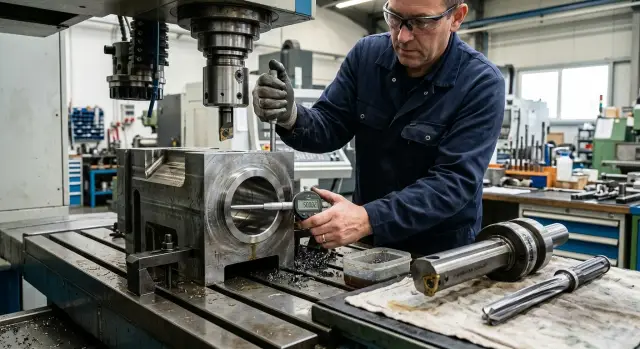
The problem of an accurate hole
After drilling, a hole almost never matches the drawing exactly. The diameter can be slightly over or under, the axis may shift, and marks remain on the wall that later interfere with assembly. On paper this looks minor. In the shop it leads to extra passes, scrap and arguments around the machine.
The issue isn’t a single number. A part often requires several conditions at once: size within tolerance, correct form, straight cylindricity and a clean surface. If the hole becomes oval or the axis shifts, assembly is already difficult even when the caliper shows nearly the right size.
An error of a few hundredths quickly becomes expensive. For a loose fit that might pass. For a bushing, bearing or guide pin — it won’t. The part either goes together with too much interference or develops play. In both cases the assembly performs worse and wears out sooner.
That’s why the question “boring head or reamer” isn’t just curiosity. You need the method that will give not only the right size but a stable result across the batch. One method is easier to adjust to the actual size. The other runs faster in series when allowance and cutting modes are chosen correctly.
Batch size also strongly affects the choice. For a small run setup time matters more. If there are ten parts, few people want to spend a long time dialing in a tool for a few seconds saved per piece. For large batches the logic shifts: it’s more important that the tolerance holds from the first to the hundredth part without constant readjustment.
The worst part is that the error often hides until the end. The drill went through fine, the hole looks neat, but on finishing you find the allowance was small, the axis shifted or the size varies. So you can’t pick the finishing method by habit. First you look at the tolerance, geometry, material and the actual stability of the blanks.
How the two methods differ
Both tools bring the hole to the final size, but they do it differently. A boring head reaches size by adjustment. A reamer follows the prepared hole and removes a small allowance.
When these methods are compared people usually mix two questions: which holds size better and which runs faster per batch. The answer depends not only on the tool but on the material, the quality of prior operations and the order volume.
With a boring head the diameter is changed by the cutter overhang. The operator brings the diameter to the required value, makes a trial pass, measures the result and corrects the setting if needed. This is convenient when you must tune size precisely, when the hole has shifted after roughing, or when the blank behaves inconsistently.
A reamer works differently. It does not chase size with adjustments but repeats the existing hole and removes a small finishing allowance after drilling or rough boring. In a series it’s usually faster: the tool is chosen, the mode checked, and the process runs smoothly. But if the initial hole is off-center, tapered or already out of size, a reamer will fix almost nothing.
On a single part the difference might seem small. On a batch of 100–200 it becomes noticeable. Boring often requires more setup, control measurements and sometimes two trial parts. Reaming performs better where the process is already stable and the allowance does not vary.
Material also changes the picture. In aluminum a reamer can produce a clean surface, but with poor chip evacuation the metal can stick and the size drifts. In stainless steel the tool heats and dulls faster. For a boring head another weak point appears: with a long overhang and hard material it’s easier to catch vibration.
If you need to flexibly hit an exact size and tweak it by sight, a boring head is usually more convenient. If the hole is already prepared correctly and parts run in series, a reamer often saves time and gives a predictable, repeatable result.
When the boring head wins
A boring head works better where the size varies after drilling. The drill wears, material cuts unevenly, or the part clamping changes behavior. In that situation a reamer usually only repeats the existing axis and shape, and there’s little room for correction.
If the operator sees the hole off by a few hundredths, the boring head has a clear advantage: you can shift the cutter and reach the size without new tooling. This is especially useful for nonstandard diameters. For sizes like 23.7 mm or 41.35 mm you would need a special reamer, while a boring head can be set directly on the machine.
Another common case is axis drift. It happens in cast blanks, on parts with uneven wall thickness and with weak clamping. A reamer hardly corrects such deviation because it follows the existing hole. Boring gives a chance to correct axis and shape with a few light passes.
A boring head usually wins when the size after drilling fluctuates between parts, a rare diameter is needed, you must slightly correct the hole axis, or the batch is too small to justify buying a dedicated reamer for one size.
For a small batch the time calculation changes. If you need to make 6–10 parts, a five–ten minute setup on a boring head often costs less than buying a reamer for one size and risking scrap on the first part.
A good example: a housing with a bushing bore of 38.42 mm. After drilling one part is 38.34 mm, another 38.37 mm, and on a third the axis shifted slightly. A reamer offers little control here. With a boring head the operator can tune the size, check the actual result and finish the hole calmly.
If the size is nonstandard, the hole behaves variably and the batch is small, boring usually gives more control and fewer unpleasant surprises.
When a reamer is more convenient
A reamer is more convenient where the size is well known and hardly changes. If the hole is a standard size, for example 10, 12 or 20 mm, and it repeats from batch to batch, fine adjustment before each series is usually unnecessary. Put the tool in, check the mode, and run.
This approach suits dozens or hundreds of identical parts. On a repeatable run a reamer often wins on time because the operator doesn’t spend shifts tuning the diameter. This is especially noticeable when you need to start the job quickly and keep a steady cycle from part to part.
But reaming requires order. After drilling or rough boring there must remain an even and predictable allowance. If the blank holds dimension stably, the tool removes a thin layer and gives a clean surface without long trials. If the allowance fluctuates, the hole drifts and the time advantage vanishes.
A reamer is most useful in four situations: the diameter is standard and stable for a long time; the blank after drilling behaves predictably; the batch is large enough to value every saved cycle; and a fast start without repeated corrections is required.
In practice it looks simple. There’s a batch of 80 bushings with a 12H7 hole. The drill and previous pass leave a stable allowance. In that work a reamer often gives a shorter cycle than a boring head because it doesn’t require lengthy tuning for the first part.
Another plus: the process depends less on fine manual adjustment at startup. A boring head makes it easier to reach a nonstandard size precisely, but setup demands time and care. A reamer is simpler where the procedure is already tuned and the task is just to quickly and evenly finish the hole across the batch.
If the size is nonstandard, the allowance fluctuates or the part moves after roughing, the convenience of reaming stops quickly. But on a stable run it’s often the calmest and fastest option.
What tolerance, setup and time decide
The same nominal size on the drawing does not mean the same machining method. If after drilling or rough boring the hole varies, a reamer often performs worse than expected. It needs an even, predictable allowance rather than trying to correct a noticeable error from a previous operation.
First look not at the nice nominal number but at the scatter of blanks. If one blank comes with 0.15 mm allowance and another with 0.35 mm, a reamer may give different results in size and surface finish. A boring head in that situation is calmer: the operator adjusts size by setting rather than hoping the tool will remove the excess.
Rigidity also changes the choice. A weak holder, a long overhang or a worn machine give vibration, and a precise hole departs from calculation. For a boring head this is especially noticeable, because it is sensitive to play and deflection. For a reamer the problem is different: if the tool enters off-angle, the size may come out tighter and the surface rougher.
Allowance under a reamer is often chosen incorrectly. Too little allowance prevents normal cutting. Too much overheats the tool, spoils the surface and speeds wear. In practice a reamer is good where the previous operation already holds shape and axis, and it only needs to remove a small even layer.
Many people count only cutting seconds and draw the wrong conclusion. A boring head almost always requires a one-time setup: a trial part, measurement, small correction. For a small batch this can take longer than the machining itself. For a large batch that same setup spreads out over many parts and no longer seems expensive.
With a reamer the picture is reversed. Setup is usually simpler, but the cost of an error in preparation is higher. If you leave a bad allowance or don’t keep coaxiality, the batch quickly goes to scrap.
It’s useful to separate the time to the first good part, the cycle time per piece, the batch size and the cost of changing setup after tool change. Then the choice becomes much fairer.
If the run is one-off and holes are almost the right size, a reamer often gives the shortest route. If the batch is large, tolerance tight and scatter after the previous operation noticeable, choose based on the real process stability. That usually determines how many good parts you’ll have by the end of the shift.
How to choose step by step
When choosing between a boring head and a reamer people often look only at the finishing pass. In reality the whole chain decides — from the allowance after drilling to the time to the first good part.
First open the drawing. For finishing holes you need more than the diameter: the tolerance zone, roughness requirement and hole length. A short hole with a tight tolerance often behaves differently than a long one, even for the same nominal size.
Then look at what’s left after drilling. If the allowance varies, the axis shifts or the material pushes the tool, reaming often surprises. If the allowance is even and small, reaming usually runs faster. For ductile steels, cast iron and non-ferrous alloys the picture differs, so don’t choose by habit.
A practical approach works like this. First fix the size, tolerance zone and required surface finish. Then check hole length, part material and the real allowance after drilling. After that assess the current batch specifically, not the monthly average, make one trial part and measure diameter at several points. Finally sum all the time: setup, cutting, measurement, adjustment and the possible risk of scrap.
Batch size changes the choice more than it seems. If you need 6 parts, an extra 10 minutes of setup is already noticeable. If the batch is 300 pieces, a successful setup can pay off a longer startup within the first hour.
A trial part is almost always needed. It quickly shows whether you hold size across the length, whether there is taper and how the tool behaves after warming up. One measurement at the hole entrance usually tells little.
Consider total time for the batch. Sometimes a reamer cuts faster on each part but you lose time on finding the right mode and get more scrap. Sometimes the boring head is slower but easier to hit the size without extra stops.
If the trial part shows stable size and even allowance, choose the method that requires fewer manual corrections during the shift. Most often that is the most cost-effective option.
Example for a typical batch
Imagine a housing with a bearing bore. The batch is small — 30 pieces. After roughing the size varies a bit: one blank leaves an even allowance, another has a misbehaving wall and the hole is off by a few hundredths from the start.
In that batch a reamer looks attractive. It usually gives a shorter cycle: insert the tool, finish the hole, get a clean surface. If the previous operation holds allowance steadily, it’s really convenient. On 30 parts you can save noticeable time.
But the weak point is obvious. A reamer likes predictable blanks. If the incoming size fluctuates, the axis shifts slightly or allowance is uneven, the final diameter will scatter across the batch. The first parts pass well, then wear appears and the last ones require extra checks. For a bearing fit this is unpleasant: one part fits perfectly, another is close to the tolerance limit.
A boring head in the same case is slower but steadier. The operator spends more time on setup and checking the first parts. But size is easier to tune. If the hole is off by 0.01–0.02 mm, the tool can be corrected and the process returned to tolerance without changing the whole scheme.
For such a batch the conclusion is simple. If the blanks and pre-hole are stable, a reamer is faster. If part-to-part size fluctuates, boring is more reliable. If the bearing fit is tight and scrap is costly, a boring head is usually safer.
When the batch grows to several hundred pieces the decision shifts. Then even fractional minutes per cycle give a big gain. If prior operations are aligned, allowance holds and tool wear is controlled, reaming begins to win on batch time. If there is no stability, fast cycles don’t save you: losses on inspection, sorting and rework eat that advantage.
Where mistakes are most often made
Scrap on a precision hole often starts before the finishing pass. The foreman takes a habitual tool, leaves about the usual allowance and hopes to finish the size at the end. That small oversight later ruins the batch.
The most common mistake is incorrect allowance. If there is too little metal after drilling, a reamer won’t cut properly and will rub the surface. Size drifts and finish worsens. If the allowance is too large, the reamer is overloaded, the surface is damaged and the tool wears faster. With a boring head the same problem arises: too large a finishing cut makes it hard to hit hundredths.
Another frequent error is confusing startup speed with overall speed. A reamer seems quicker: put the tool in, run the mode, quickly get the first good part. But on a series that isn’t always the fastest route. If scatter after drilling is large, the operator later spends time on inspection, rework and tool changes.
People also misjudge reamer wear. First parts run well and control relaxes. Then the last 15–20 pieces start to go out of tolerance. This is especially noticeable on long runs with non-homogeneous material or poor chip evacuation.
Boring heads have their trap too. The operator sets the size but doesn’t secure the adjustment well. Even a small shift during tightening changes diameter by hundredths. Then they look for problems in cutting mode when the cause was loose locking. A simple rule helps: after changing a setting, lock it, make a control pass and measure again.
Measurement mistakes are common as well. People use an inside mic right after cutting while the part is still warm or there is a thin layer of chips or coolant inside. That reading easily lies. Better to clean the hole, let the part cool a bit and only then measure.
In practice the winner is not the one who started faster but the one who keeps size to the last part. For that you need a correct allowance before finishing, regular control not only on the first pieces, a rigidly locked boring head and measuring after cleaning the hole.
If the batch is running, compare the first, middle and last part. That simple snapshot quickly shows where size is lost: in allowance, wear or setup.
Quick checks before startup
Before a run it’s worth spending 10 minutes on checks rather than later disassembling the whole batch over a few hundredths. Choosing the method is only part of the job. You need to confirm the process can deliver repeatable results.
Start with the drawing. You need not only the nominal size but a clear tolerance: how far diameter can stray, whether there are requirements for ovality, taper and surface finish. Without those data the choice between boring and reaming is almost blind.
Then assess the blank after drilling. The allowance should remain even along the hole length. Reaming is especially sensitive: if the hole wanders or the allowance varies, the size will drift immediately. A boring head tolerates more, but it doesn’t like a crooked pre-hole either.
Check the tool mounting separately. The holder, arbor, chuck, the head or the reamer itself must sit rigidly without play. Even small runout quickly destroys tolerance. On a CNC machine this may not be visible at once, but it will show on the first part.
Before start it’s useful to compare form requirements, measure the actual allowance after drilling, check mounting rigidity and runout, prepare the inspection method and plan one trial part with possible adjustment. This short check often saves the whole series.
Measurement tools should be ready before the first cut, not after the fifth part. If the operator looks for a free inside mic or gauge around the shop, batch time immediately increases. It is much calmer when the first part can be checked right away, corrections made and only then the run started.
The same applies to time calculation. Pure machine time almost always looks attractive, but the real run includes a trial pass, measurement, possible adjustment and recheck. This is especially visible in small batches. If you account for these steps in advance, the choice between the two methods becomes much fairer.
What to do next
After comparing on paper the decision often remains disputed. One part values size more, another values throughput. It’s more useful to collect a short set of facts for the specific order than argue about the method in general.
Summarize requirements in a simple table. It’s enough to list material, hole diameter and depth, required tolerance, surface finish and batch size. Add two columns: how long a setup takes and what scrap risk you can accept.
Then discuss this table with the process engineer. In practice the choice is usually decided by a combination of parameters. If the hole is single and tolerance tight, boring gives more freedom to tune. If the batch repeats and the size already holds confidently, reaming often saves time.
A good quick way to resolve the debate is to make two trial parts using both methods, measure size, form and surface finish, record full cycle time including setup and compare not only the best result but the scatter. That test takes little time and quickly shows what’s more profitable for your batch.
If the question involves not only the tool but the machine or fixtures, look at the task more broadly. EAST CNC, the official representative of Taizhou Eastern CNC Technology Co., Ltd. in Kazakhstan, provides not only CNC machines but also selection, commissioning and service. So such issues can be discussed with reference to the real cycle, setup and batch stability.
After startup don’t rely on the operator’s memory. Record successful modes, tools, corrections, actual size after the first parts and cycle time. Next time this will save hours and reduce the risk of having to hunt the precise hole from scratch.
If you must decide today, start with the table and two trial parts. Usually that’s enough to choose the method without unnecessary loss of time or scrap.
FAQ
When is a boring head the better choice?
If the diameter and axis vary after drilling, choose a boring head. It allows you to tune the diameter on the machine and correct the hole without looking for a dedicated tool for each size.
When is a reamer more advantageous?
A reamer is more convenient for a stable series where the previous operation leaves an even allowance. In that case it usually gives a shorter cycle and fewer manual adjustments between parts.
Will a reamer correct an offset axis?
No — it almost won’t fix axis deviation. A reamer follows the existing hole, so it mostly repeats its axis and shape.
Which matters more for the choice: tolerance or allowance?
Look not only at the nominal size but at the spread after drilling. If the allowance varies between parts, a boring head usually holds the result more steadily because the operator adjusts size by setup rather than relying on the tool to remove variable stock.
What to choose for a small batch?
For small batches, boring often wins — especially if the diameter is nonstandard or the blank behaves inconsistently. For large runs a reamer can save time, but only when the process is already stable.
Is a boring head suitable for nonstandard diameters?
Yes — that’s one of its strengths. If you need unusual sizes like 23.7 or 38.42 mm, it’s easier to set a boring head on the machine than to find or order a dedicated reamer.
How does the workpiece material change the outcome?
In aluminum a reamer can give a clean wall, but chips may stick and shift the size. In stainless steel the reamer heats up more, while a boring head on hard material with large overhang is more prone to vibration.
Why does a wrong allowance so often cause scrap?
Too little allowance prevents a reamer from cutting properly and it ends up rubbing rather than cutting. Too much allowance overloads the tool, worsens the surface and speeds up wear.
How to measure a precise hole correctly after machining?
Don’t measure immediately after the cut. First clean the hole from chips and coolant, let the part cool slightly, then check the diameter at several points along the length.
How to quickly decide which method is better for my batch?
Start with a single trial part and count not only machining time but the full cycle: setup, measurement, adjustment and scrap risk. If the size is stable after the trial, choose the method that needs fewer corrections during the shift.