
Belt vs Direct Spindle Drive: How to Choose for Your Tasks
Belt or direct spindle drive affects RPM, torque, noise and service. We explain the differences in simple terms and give a quick checklist to choose.
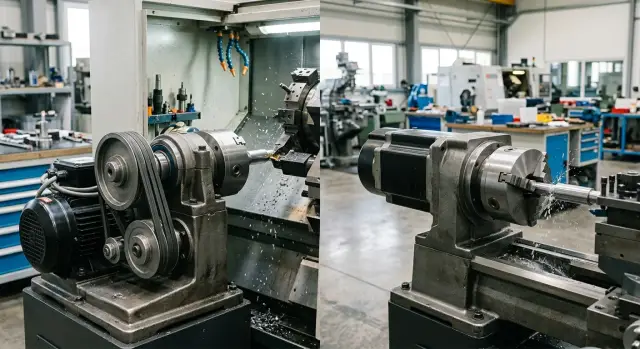
Why the drive type affects results
The same power on paper doesn't mean the same behavior on the shop floor. Two machines with similar specs can cut very differently. The reason is often how the spindle is driven and how the whole unit handles load in real production.
When choosing between belt and direct drive people usually look at price and maximum RPM. That's not enough. Much more important is how quickly the spindle accelerates, whether it holds RPM under load, how noisy it is and how it copes with long shifts without overheating.
On thin workpieces the difference is visible right away. If the workpiece is long, thin-walled, or needs a finishing pass, extra vibration shows quickly: ripples appear on the surface, dimensions start to vary, the operator reduces feed and loses time. Noise also tells a lot — it often goes with oscillations that later show up on the part.
For heavy cuts different factors matter: torque at low and mid RPM, spindle unit heating and the reserve capacity for load. If a machine often works in tough cutting, its weak point will reveal itself quickly. RPMs drop, tools wear faster and cycle time increases from batch to batch.
A wrong choice rarely stays only a technical problem. It brings rejects, downtime, extra tooling costs and rework. On the shop floor it looks simple: the machine is new, but you constantly have to avoid the desired mode.
For companies taking machines for varied orders this mistake is especially expensive. Today you need quiet, clean finishing of a small part; tomorrow — a large rough cut on another batch. If the drive doesn't match the main work, you'll compromise every day.
How a belt drive works
In this scheme the motor isn't directly connected to the spindle. It turns a pulley, a belt transfers torque to a second pulley, and that turns the spindle. The design is old, straightforward and still widespread, especially where simple servicing is valued.
A practical advantage of a belt drive is that the motor can be positioned slightly away from the cutting zone. Because of this, heat and some vibrations don't go directly into the spindle. For common turning work this is often convenient: the unit is less fussy and easier for a mechanic to handle.
Another point: when the tool suddenly hits a harder section, the belt can slightly cushion the impact. It won't save you from wrong cutting conditions, but it can absorb part of the sharp impulse.
At high RPMs downsides become noticeable. The belt heats up, noise increases and some power is lost in transmission. If the machine runs for long in the top range this is felt more: the sound gets harsher and the unit behaves less tightly.
Maintenance is usually simple. You typically check obvious things: tension, cracks and wear, any squeal during acceleration, and whether pulleys or the cover are heating. Replacing a belt is in most cases easier and cheaper than repairing a more complex spindle unit.
So for a shop where the machine runs in normal regimes and quick return to operation matters, a belt drive often turns out to be a calm and sensible choice.
How a direct drive works
In a direct drive the motor is connected to the spindle directly. There are no belts, pulleys or intermediate transmissions. The spindle receives torque with almost no loss and responds faster to program commands.
This is especially noticeable where speeds change often. If the machine processes short series and constantly accelerates and decelerates, direct drive saves time on nearly every cycle. The difference per pass is small, but it accumulates over a shift.
Another advantage is RPM stability. It's easier to hold a set value, especially during finishing and at high speeds. Surface quality often improves when the spindle unit is precisely assembled and properly cooled.
But this layout also has a weakness. The motor's heat is close to the spindle. If the manufacturer skimped on cooling, balancing, bearings or assembly, errors will grow faster. The concept is good, but it depends more on build quality.
Direct drive can handle heavy cutting confidently, but only if the machine has margin in torque and stiffness. The absence of a belt doesn't automatically make a machine stronger. You need to look at the whole unit, not only the drive type.
Service for direct drive is usually more complex. With a belt drive you often change consumables and get the machine running faster. Direct drive repairs may involve the motor, sensors, cooling and bearings. So when comparing drives look beyond rated RPM to who and how will service the spindle.
What shows up at high RPM
The catalog RPM quickly loses meaning if the spindle accelerates slowly, gets noisy and heats up after an hour. For finishing this is often more important than maximum RPM. A machine may promise 4,000 or 6,000 rpm, but if it reaches the speed with noticeable delay the cycle stretches.
You should judge the range where you actually work every day, not the top limit. If your parts run at 2,500–3,500 rpm, evaluate machine behavior in that band rather than a short unloaded acceleration.
A simple check: fit the tooling you actually use and run the machine for a while. An empty test without chuck, collet or tool shows too little.
During the check pay attention to:
- how long it takes to accelerate to working speed;
- whether noise changes after a long series;
- whether spindle area temperature rises;
- whether vibration appears in the usual working range.
These things show up quickly on thin parts. In finishing a long sleeve extra vibration creates ripples even when the tool is new and the mode seems correct. On paper the machine fits, but in practice it leaves marks you then remove by extra passes.
Long-run stability is also important. The first 10 minutes may cut cleanly, but after an hour sound changes, the housing heats more and dimensions drift. So ask for a longer test, not just a short demo.
If after such a test the machine keeps a steady sound, moderate heating and clean surfaces, its high RPMs make sense both on paper and in the shop.
What matters in heavy cutting
In roughing the machine is loaded by actual torque at low RPM, not by rating alone. So the debate about drive type is often decided by how the spindle holds the cut when feeds are high and the workpiece is hard and sticky.
A belt drive has a clear plus: the belt can partly soften shock loads, and the transmission ratio can sometimes help get more confident low-end pull. In roughing this is useful, especially when removing large allowances from steel or cast iron.
Direct drive responds more precisely to commands and loses less power between motor and spindle. But in heavy cuts this only works when the unit is designed for it: enough torque, stiffness, cooling and bearing margin. Otherwise the specs look better than the machine performs.
Check by simple signs:
- how the spindle handles a sudden tool entry;
- whether vibration increases at deep cuts;
- whether the cut leaves a steady trace after a heavy pass;
- whether the machine sustains the same load by the end of the shift.
If a heavy pass leaves waves, torn traces or changing dimensions, the problem is often the unit's inability to sustain long load. The spindle heats, stability drops and torque sags.
A good example is machining a massive part for construction equipment. The first parts cut confidently, but after a few hours the noise rises and the operator must reduce feed. For roughing that’s a bad sign.
If you need a machine specifically for heavy cutting, ask not only for motor power but also a torque-vs-RPM curve, permitted continuous load and a real cutting example on similar material.
How to assess service and downtime
Repair cost rarely hits production as hard as downtime. While the machine stands idle a batch is delayed, the operator waits and delivery dates get tight. So when choosing a drive consider not only specs but how long routine checks and minor repairs take.
Ask the seller a simple question: what parts of this unit are replaced most often and how many hours does each job take. You need a concrete scenario: diagnosis, disassembly, replacement, setting and test run.
Usually clarify four things:
- how they check belt tension, spindle runout and unit temperature;
- whether these checks can be done without long disassembly;
- how much consumables cost and how fast they can be supplied;
- who does the work: your mechanic, the supplier's service or an external crew.
Small details matter in spindle service. If it's hard to get to belts, fasteners or check points, a one-hour job can stretch to half a day. On a busy machine that's felt immediately.
A good sign is when the service engineer calmly explains step by step where they measure runout and how they monitor heating after start-up. With that service it's easier later on. If you're considering EAST CNC equipment, discuss not only equipment but also commissioning, maintenance and the post-delivery workflow. For the company this is part of the full cycle, and such details are best clarified before purchase.
Count not only repair cost. If the machine produces 200 parts per shift, even a cheap part with long lead time can cost more than the repair. So a unit that is easier to service and quicker to return to operation is often more economical, even if the machine itself costs a little more.
How to choose for your work
Start from your parts, not from the machine passport. Compare drive types only after you collect simple data about the actual shop load.
First write down what you turn most often: part diameter, material and typical batch length. One thing is single stainless jobs, another is hundreds of identical shafts in 45 steel.
Then split operations into two groups. For some parts surface finish and dimensional stability matter most. For others removing more metal per pass and saving cycle time matters more.
After that compare RPMs not by the pretty catalogue number but by your tooling. If you use small tools on aluminum a high spindle range can help. If your shop mainly runs large diameters and tough steel turning, the RPM ceiling may hardly affect output.
A quick assessment needs four questions:
- Which parts provide the main machine load?
- Where are finishing passes more common and where is roughing?
- What RPMs and feeds do your tools require for those parts?
- Who will service the machine and how much downtime can you accept?
The last point is often underestimated. If you have your own mechanic and scheduled service, one drive type won't be a problem. If the machine must run almost non-stop, serviceability and repair speed should be discussed in advance.
Before purchase ask for a demo on your part. Show the drawing, material, required finish and tolerance. Then the conversation is about real cycles, loads and service, not abstract pros and cons.
Example from a typical shop
One shop had two sections. In the first they turn thin stainless sleeves in small series. The part is light, thin-walled and batches may change after lunch. The operator needs quick spindle acceleration, calm high-speed operation and a surface without fine ripples.
For this job direct drive often gives a better result. The spindle reaches speed faster, the machine reacts more lively to mode changes and it's easier to hold an even surface in finishing. This is clear on a long sleeve that doesn't tolerate extra vibration.
The second section is different. There they remove large allowances from shafts every day. The workpiece is heavy, cuts are deep and the shift runs almost without pauses. Here they look not at how fast the spindle reaches max RPM but at how it pulls under load, how it handles heating and how long service takes.
In that regime a belt drive is often more convenient. It handles shock loads calmly and maintenance is straightforward for the shop: belt, tension and pulleys. If the unit needs attention it's easier to return it to work without long downtime. For a section that turns shafts every day this can be more important than saving a few seconds of acceleration.
So you can't decide with one general phrase. The first section could lose surface quality and time with a drive that has too much inertia. The second could lack pulling power and endurance if you choose a model only for high RPM.
If both scenarios exist in one shop, honestly determine which operation loads the machine most of the shift and choose for that. Otherwise the compromise will be too costly.
Common selection mistakes
The most common mistake is buying by a number that looks good in the catalogue — usually maximum RPM. But in practice the important thing is the range where the spindle cuts every day without excess noise, heating or torque loss.
If your parts run at 1,800–3,500 rpm, a margin to 12,000 rpm may remain only on paper. You pay for it up front without real benefit.
A second mistake is focusing only on motor power. Two machines with similar kilowatts can cut very differently if their torque in low and mid RPM differs. In heavy cutting this becomes obvious fast: one machine sustains the cut, the other starts to sag.
A third mistake is leaving service discussions until later. That’s costly. Ask in advance how spindle service is organised, what a typical repair costs, whether consumables are available and how many days downtime to expect. If the machine stands for a week, losses often exceed the price difference between two options.
A short demo is also misleading. At an exhibition or in a video a machine usually cuts a convenient part in a soft mode. Much more honest is a test on your blank with your material, tooling and tolerance. Then you immediately see RPM stability, vibration and behavior under load.
Before buying check:
- the RPMs where the machine will operate most of the shift;
- whether you need high torque in your specific feeds and cut depths;
- who will service the unit in a year and what it will cost;
- whether the supplier will show the machine working on your part, not just a generic demo.
Often shops buy a machine with extra speed margin and then rarely leave the mid range. Money goes to a parameter that doesn't help real work. Better pay for what gives a stable result on your parts every day.
Pre-purchase checks
Don't argue about which drive is better in general. What matters is your operating mode on a real part.
A common error: buying a machine for a rare scenario instead of the usual shift. Later the machine can do much on paper but each day it works where the result is needed.
Before ordering check five things.
- The RPM band the spindle will live in most of the shift. If you constantly run at high range, look beyond the maximum and check stability, noise and heating in a long series.
- The metal removal per pass. For heavy work you need torque, stiffness and behavior under load, not a pretty maximum RPM.
- Whether quiet operation matters. Short batches tolerate noise; long series tire the operator and make it harder to hear abnormal sounds.
- Who will do maintenance. Ask directly: who arrives, which tasks they perform on site, how long parts take to arrive and how many days the machine may stand.
- Whether the supplier can discuss processing your specific part before purchase. This is the most honest way to remove guesses.
Give the supplier not only a drawing but the task: diameter, cut depth, tolerance, surface finish and series length. Then the conversation becomes concrete.
If you choose a machine for series work, listen to spindle noise during testing and check temperature after continuous loading. For power machining watch how it behaves in cut, not at idle.
If the supplier handles the full cycle, clarify commissioning, setup and service in advance. With EAST CNC this is especially logical: the company does selection, delivery and ongoing service, so organizational questions can be closed early, not after startup.
If after discussions you get only general promises, pause and wait for specifics about your task. Buying a machine tolerates few guesses.
What to do next
Don't choose a drive by a catalogue or by someone else's habit. Decide on your parts.
Start by collecting 3–4 typical items the shop runs most often and note material, diameter, cut depth, feed and required RPM. Then mark what is critical and what is negotiable: tolerance, acceptable surface finish and batch size.
Next compare both drives only on the same blank and similar cutting modes. Look beyond numbers. Listen to how the spindle behaves at working RPMs, check heating after a series and measure dimensional stability after heavy cuts.
Summarize results in a short table:
- cycle time per part;
- dimension deviation after several consecutive parts;
- surface quality without extra tuning;
- what needs servicing and how often your shop can do it.
One more point: drive type matters, but it doesn't solve everything. Chuck, motor power, turret, cooling, commissioning and service affect results as much. The weak spot is often next to the spindle, not in it.
If you select a machine for mixed loading, discuss the whole working scenario with the supplier. EAST CNC has a clear format for this: consultation, selection, delivery, commissioning and maintenance. With a list of real parts and clear requirements the choice between belt and direct drive becomes much easier.
FAQ
Which is better overall: belt or direct spindle drive?
There is no universally better option. Direct drive often wins for finishing, frequent speed changes and high RPMs, while belt drive is often more convenient where straightforward servicing and steady operation in common regimes matter. Choose based on the parts that load the machine most of the shift, not the catalogue.
When is a direct drive truly justified?
It pays off when the machine frequently changes speeds and works on finishing passes. The spindle reaches the target speed faster and holds it more steadily, so cycles shorten and surface quality improves. This benefit appears only if the whole unit is well made and cooled.
In which tasks is a belt drive more convenient?
Belt drives are often chosen for everyday turning and heavy shifts where easy servicing is valued. The belt can soften impact when the tool enters the material, and pulleys and belts are straightforward to inspect and replace. For a shop this means lower risk of long downtime from a minor failure.
How do I know the machine can't hold high RPMs?
Look at the machine after a long run, not at an empty-speed test. If noise increases, the spindle heats up, vibration appears, or dimensions start drifting, the top RPM figure exists only on paper. A fair test uses your tooling and a real part.
What matters more in heavy cutting: power or torque?
For rough cutting, torque in the working range usually matters more than an attractive power rating. If the spindle drops torque at low or mid RPM, the machine will struggle even if the kilowatts on the spec sheet look solid. Ask for a torque curve and watch a cut in material similar to yours.
Does drive type affect surface finish?
Yes — the difference shows up quickly on long, thin-walled parts. Extra vibration creates ripples, and unstable RPMs spoil finishing passes. Direct drive can deliver a smoother surface, but only when the entire spindle unit has no weak points.
Which drive is easier to service?
Belt drives are usually easier and cheaper to service. Routine checks focus on tension, wear and heating, and replacing a belt is often simpler than repairing a direct-drive unit with motor, sensors and cooling. If every hour of downtime costs you, this is a critical point.
What should I check during a demo before buying?
Ask for a demonstration on your part or a very similar one. Watch how fast the spindle reaches operating speed, whether noise changes after an hour, if dimensions hold and if spindle temperature rises. A supplier who immediately discusses commissioning and service is a good sign.
How to choose if the shop does both finishing and roughing?
Decide honestly which operation loads the machine most. If the shift is mostly finishing and short runs, direct drive is a better fit. If the machine mostly removes large allowances and must be returned to service quickly after maintenance, a belt drive is often more practical.
What mistakes are most common when choosing a drive?
Common mistakes are buying by the maximum RPM in the catalogue or judging from a single short demo. Another frequent error is postponing service discussions. Bring a drawing, material, tolerance, finish requirement and batch size, then compare machines by real results.