
Bearing Seats in Production Runs: What Causes Size Drift
Bearing seats in production runs do not drift only because of insert wear. We’ll look at how clamping, part heating, and the order of turning passes change the size.
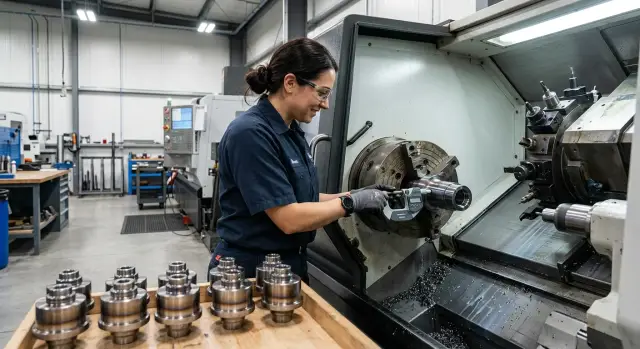
Why the fit drifts from part to part
A bearing seat can drift even with a brand-new insert, and that often causes confusion. The first parts are within tolerance, then the size slowly creeps away, even though the tool is still cutting cleanly and shows no obvious wear.
In a production run, this is a common story. The operator sees the deviation and first blames the insert or the tool offset. But with bearing seats in series production, the size is often thrown off not by the cutting tool, but by the machining setup itself.
Most often, the problem hides in three places:
- the workpiece clamping on the lathe changes from cycle to cycle
- the part temperature and size stop matching after long running without pauses
- the order of turning passes causes different material removal and different stress relief
Clamping has a bigger effect than it seems. If the jaws tighten a little harder, a thin section under the seat can deform slightly during machining. After unclamping, the part "relaxes," and the diameter is no longer the same as the one measured right on the machine.
Temperature also creates a quiet but noticeable shift. As the run goes on, the chuck, the part, and even the air around the work area get warmer. On a hot part, the size looks one way, and after cooling it turns out different. Because of this, the first parts and the parts in the middle of the batch can behave differently, even with the same program.
The route matters too. If you remove more material from one side first and leave the finishing pass until the end without a pause, the part can distort. Then seat stability does not fall apart right away, but gradually, and that is especially frustrating: the scrap starts not with the first part, but with the sixth or the tenth.
Worst of all, these causes are easy to confuse with insert wear. That is why the source should be searched more broadly. If the size shifts, look not only at the cutting edge, but also at clamping force, part heating, and the order in which the machine performs the operations. That is where the real cause is most often found.
What exactly to track in a run
If you only check the scrap at the end of the batch, you usually find the cause too late. For a bearing seat, it is not just one size on one part that matters, but how the size behaves across the whole run.
The first thing to do is measure the diameter at two moments: right after cutting and after cooling. Sometimes a part comes off the machine "in size" while hot, but 15-20 minutes later it shifts by several microns. For a tight fit, that is already enough for the bearing to seat differently than intended.
It helps to keep a simple control rhythm for the batch. Not only the first part after setup, but also the middle of the run and the last parts often show a different picture. If the first part reads 50.000 mm, the middle 49.992 mm, and the last 49.987 mm, the problem is already visible even without complex statistics: the size is drifting in one direction.
It is important to record not only whether the part goes out of tolerance, but also the direction of the drift. When the size consistently moves into the minus or the plus, that almost always points to a system-level cause. Random scatter and a gradual shift are not the same thing, and they have to be searched for differently.
One measurement can also be misleading. A seat may hold diameter at one point but still have ovality or slight taper. That is why, in a run, it is better to check at least several cross-sections and several positions around the circumference. Otherwise the part looks good on paper, but during assembly the interference shows up where nobody expected it.
It is useful to track four things:
- size right after machining;
- size after cooling;
- data for the first, middle, and last part;
- the shape of the bore or journal, not just one diameter.
This kind of log does not need to be complicated. A simple batch table is already enough to show where seat stability breaks down. For the topic of bearing seats in production runs, that is much more useful than checking only the parts that have already failed inspection.
If the size starts to drift slowly, it is better to react to the trend right away instead of waiting for obvious scrap. A couple of extra measurements at the start of the shift often save an entire batch of parts.
How clamping changes the diameter
Even with a new insert, the size can wander if the part sits in the chuck a little differently every time. In the topic of bearing seats in production runs, this is one of the most common causes: the machine cuts the same way, but the part changes shape by a few hundredths after removal.
A strong clamp is especially noticeable on thin walls. A bushing, ring, or hub under the force of the jaws deforms slightly, and the tool is machining a geometry that will not be the same after unclamping. In the chuck, the size looks normal, but after removal both the diameter and roundness shift.
Soft jaws can also create scatter very easily. If they have not been re-bored to the actual clamping diameter, they press the part unevenly. One blank sits deeper, another a little higher, a third touches only part of the surface. The result is the same: different force, the part axis shifts slightly, and the fit wanders.
The part overhang changes rigidity more than it seems. At a 30 mm overhang, the blank stays calm, but at 50 mm it starts to spring under the tool. The cutting mode is the same, the tool is the same, but the diameter turns out different. If the operator changes the overhang from part to part in a series, there will be no stable result.
Reclamping after roughing adds another problem. After rough machining, the part may already have released internal stress or distorted slightly. If it is then clamped again by a new surface without a clear datum, the finishing pass starts from a different axis position and a different circumferential allowance.
In practice, four simple rules usually help:
- keep the clamping force as low as possible without allowing the part to slip;
- re-bore soft jaws to the current size and the same overhang;
- use a stop so the overhang does not change during the run;
- do not reclamp before the finishing pass unless you have a rigid, repeatable datum.
If the first part in the chuck gives the right size, but after removal and recheck it shifts by 0.01-0.03 mm, look at clamping first. Very often the cause is there, not in the insert.
How part temperature shifts the size
For bearing seats in production runs, temperature often matters just as much as insert wear. The same part can show a different size right after the pass and five minutes later. Metal expands when it heats up, and that changes what the measurement shows.
There is a simple rule. If you are turning an outer diameter for a bearing, a hot part will usually read slightly larger, and after cooling it will move down. If you are boring a hole, the picture is the opposite: on a hot part the hole looks larger, and on a cold one it becomes smaller.
A long run heats not only the part itself. The chuck, the jaws, the cutting zone, and sometimes even the air around the machine heat up too. Because of this, the first parts after startup, the parts in the middle of the batch, and the last parts of the shift can behave differently, even if the program has not changed.
A pause between parts also breaks the usual logic. The machine stops, the chuck cools, the coolant flow is interrupted, the blank reaches shop temperature - and the next part is cut under different conditions. That is why, after lunch, after an insert change, or after a setup stop, it is wise not to trust the first part without checking it.
Often the issue looks like this: the operator measures the part immediately after removal and sees a good result. Ten minutes later it cools down, and the fit becomes tighter than it should be. In a run, that is especially unpleasant because part of the batch may look "good" only when measured hot.
To keep part temperature and size from working against each other, keep one rule for the whole batch:
- measure parts after the same amount of time following machining
- check the first parts separately after any pause
- do not change coolant flow or spray direction during the run
- watch whether chuck and cutting-zone heating increases toward the middle of the batch
For bearing seats in production runs, that is often enough to remove the strange scatter that first gets blamed on the insert or the material. If the size is "floating" without a clear reason, first compare a hot and a cold measurement of the same part. That test quickly shows where the error is: in cutting or in temperature.
Why the order of passes matters
When a seat starts drifting in a run, many people first look at the insert and the offset. But the order of passes affects the size just as much. If one pass removes more than another, the part behaves differently: the load changes, heat rises, and the finish size starts to wander.
The first problem is uneven roughing allowance. If after roughing one part has 0.3 mm per side left and another has 0.1 mm, the finishing tool is working under different conditions. On one blank it cuts smoothly; on another it starts rubbing more than cutting. As a result, bearing seats in production runs come out different, even with the same program.
An extra finishing pass often ruins the result too. It seems like one more light pass should only help. In reality, it often just heats the part. The size right after machining may look fine, but a few minutes later the part cools and the diameter drops into the minus. This is especially noticeable on long shafts and thin sections.
There is also a quieter cause - changing the feed direction. If one size is finished from right to left and the next from left to right, the tool mark on the surface changes. The cutting force at the end of the pass changes too. On a bearing seat, that can sometimes create a small but annoying difference that is enough for scrap or the wrong interference fit.
Usually it is better to keep one and the same order:
- first establish and check the datum surfaces
- then remove the roughing allowance evenly
- leave the same allowance for the finishing pass
- finish the seat with a single final pass
If the datum has not settled yet, it is too early to finish the precise diameter. First the part has to take its position in the clamp, and the geometry after roughing has to become predictable. Only then does it make sense to obtain the final size.
A simple example: in a batch of shafts, the operator first finished the seat and then faced the adjacent shoulder. After facing, the stress in the part changed, and the size on the seat was no longer the same. If the order is changed so the datum and nearby surfaces are stabilized first, the series usually runs more smoothly and inspection shows less scatter.
How to find the cause step by step
When the size is drifting, the worst thing is to change everything at once. After that, it is hard to understand what actually disturbed the fit. For bearing seats in production runs, it is better to take the short and boring route: one setting, one series, the same conditions.
Check order
First, take a small sample in a row, with no pauses and no setup changes. Usually 5-10 parts are enough.
- Keep the same program, tool, and part position.
- Record the clamping force, cycle time, and part temperature at the moment of inspection for each part.
- Measure the size right after machining and repeat the measurement after a short wait, for example after 5-10 minutes.
- Change only one parameter and then run the same series again.
- Compare the scatter and the average size before and after the change.
This order quickly separates guesses from the real cause. If the part gives one size right off the machine and then consistently shifts after a few minutes, the problem is often heat. If the size changes with clamping force, and after loosening the clamp the roundness and diameter become more even, look toward deformation during setup.
The same logic applies to the order of passes. Do not rearrange roughing, finishing, and shoulder facing all at once. Change only one step in the route. For example, move the finishing pass closer to the end of the cycle and check a new series. If the scatter was 0.018 mm and then becomes 0.006 mm, the cause is already visible without arguments.
It helps to keep a simple table: part number, time, temperature, clamping force, size right away, size after waiting. On 8 parts, the pattern usually appears faster than after long discussions at the machine.
A small example. In a shaft batch, the first measurements looked normal, but after 7 minutes the diameter dropped by 0.01 mm. At first, they wanted to change the insert, even though it was cutting cleanly. They checked the part temperature and repeated the measurement after a wait. It became clear that heat, not the tool, was shifting the size.
If nothing changes after one correction, do not draw a conclusion from a single part. Take another 5-10 in a row. A series shows the truth better than a lucky one-off measurement.
Mistakes that most often ruin a series
Bearing seats in production runs most often drift because of ordinary working habits, not because of a rare machine failure. The trouble is that these mistakes seem "logical" and at first even feel reassuring. After 10-20 parts, they already create scatter.
Where the series usually breaks down
The first trap is looking only at the first part after a setup tweak. It may land within size, but that does not mean the process is stable. If you do not check at least a few following parts in a row, you can miss a drift that starts after the part, chuck, or tool warms up.
The second mistake is adding a pass or an offset by feel and not writing anything down. An hour later it is hard to remember why the operator added two hundredths and then took one back. That is how a chain of random adjustments starts, and the size begins to live separately from the setup sheet.
Clamping causes the same kind of trouble. When the size drifts, the hand naturally wants to tighten the chuck harder. It feels safer. In reality, the part may deform slightly in the clamp and then show a different diameter after removal. This is especially common on thin-walled blanks and long parts.
Another frequent confusion is mixing hot parts and already cooled parts in one measurement log. The operator measures one part right after machining, the second after ten minutes, the third after a break, and then tries to find a common cause. There is none. The measurement conditions are simply different, so the numbers cannot be compared directly.
It is also very harmful to replace two things at once. If you install a different tool and at the same moment change the feed or speed, it becomes almost impossible to find the source of the deviation. Did the size shift because of insert geometry, the cutting mode, or heat? The answer gets lost.
A simple rule usually helps: change only one factor at a time and immediately note what was changed, on which part, and what size was obtained. That discipline may seem boring, but it quickly reveals the real cause instead of leaving the shop floor in guesswork mode.
A good sign of a healthy series is simple: parts are measured in the same condition, the clamp is not "tightened a little more just to be safe," and every correction can be opened in the record and checked by part number. Then the fit stays noticeably more stable.
An example from a normal batch
In a batch of bushings for bearings, a 62 mm bore first behaved calmly. The first three parts came out in the middle of tolerance, and the operator decided the series was running smoothly. By the fifth part, the bore had grown by 0.006 mm, and by the eighth it was almost at the upper limit.
At first, suspicion fell on the insert. That is a normal reaction: if the size is creeping, the edge must no longer be cutting properly. The operator installed a new insert and made two more parts. Nothing changed. The scatter remained, and one bushing came out almost nominal while the next shifted positive again.
Then they checked not only the tool, but the whole work sequence. They quickly found several causes at once.
- On some blanks, the chuck clamped harder than at the start of the batch.
- The bore was measured almost immediately after machining, while the part was still noticeably hot.
- The route included an extra finishing pass on the bore "just in case."
Individually, these seem like small things. Together, they can easily shift the size. Strong clamping slightly changed the shape of the thin-walled bushing during machining. After the clamp was released, the metal relaxed differently, and the geometry no longer repeated from part to part. The heated part added a few more microns, so the bore looked larger. And the second finishing pass did not improve the surface; it removed an inconsistent остаток because the cutting conditions had already changed.
The fix took less time than replacing the tool. The clamp force was returned to one value and no longer changed during the shift. Only one finishing pass was kept, with a constant feed. The inspection was moved so the part cooled first and was measured afterward.
After that, the series settled down. The size stopped slowly creeping upward, and the scatter narrowed noticeably. In bearing seats in production runs, this kind of case is common: the insert is not always to blame. Much more often, the size is thrown off by workpiece clamping on the lathe, part temperature, and the order of turning passes.
Short pre-start checklist
Before a run, it is better to remove some of the risk before the first good part. The size often drifts not because of one big mistake, but because of small things in setup, measurement, and cutting conditions.
If bearing seats in production runs need to stay steady, do not look only at insert wear and offset. First check the things that most often create scatter right at the start of the batch.
- Re-bore the jaws for the current setup and the actual clamping diameter. Jaws from a previous part can easily create misalignment, and then the diameter may seem fine while the fit becomes unstable.
- Leave the same allowance after roughing. When one part has 0.2 mm left and another 0.5 mm, the finishing pass cuts differently.
- Keep the same time between the last pass and measurement. A hot part and a cooled part often show different sizes.
- Do not change coolant flow during the batch. If cooling becomes stronger or weaker, the part temperature changes, and the size goes with it.
- Check not one part, but at least three in a row. One good part proves nothing.
There is a simple working trick: measure the first three parts using the same rule. The same operator, the same tool, the same measuring point, and the same pause after cutting. That makes it easier to see whether the problem is in the machine, the workpiece clamping on the lathe, or the process itself.
If the size is already drifting in one direction on the first three parts, do not rush to adjust the correction. First remove the differences in clamping, allowance, cooling time, and coolant flow. Otherwise you will tune one part, and the next will drift again.
This short check takes only a few minutes, but it often saves the whole batch from rework and extra measurements.
What to do next so the series holds the fit
If bearing seats in production runs start to "float," it is not worth blaming the insert or the material right away. More often, a one-time correction is not enough; what helps is a short working standard that the operator and setup tech use every time the machine starts.
First, build a simple measurement map for the first ten parts. Record not only the diameter, but also the part number, machining time, pocket or position number, clamping force if it changed, and the part temperature at the moment of inspection. Even on these ten parts, it is often clear whether the size is drifting smoothly, in steps, or repeating after the same operation.
After that, lock in one order of passes in the operation sheet. If today the operator does the finishing pass after one pause and tomorrow after another, there will be no stability. The same allowance, the same sequence, and the same measurement moment help more than extra adjustments during the batch.
Also write down how to measure hot and cold parts. That sounds minor, but in practice one part gives one value right after machining and a different one after 15 minutes on the table. If the shop measures without a shared rule, people end up arguing about different states of the part, not about size.
A useful minimum for the sheet is:
- measurement of parts 1, 5, and 10 with temperature recorded
- a fixed sequence of passes, with no "as needed"
- one clamping rule for the whole batch
- a separate note for when the part was measured hot and when it was measured cold
If the scatter repeats even after this discipline, the problem is often broader than one operation. Then it makes sense to discuss the task with EAST CNC engineers: which machine is best for that fit, which fixture deforms the part less, and how to set up service so the machine does not change behavior from batch to batch.
A good series does not depend on one lucky setup. It depends on a repeatable process that you can open, check, and calmly repeat tomorrow.