
Base map for turning and milling operations without disputes
A base map for turning and milling defines setup logic in advance, removes disputed choices between sections and reduces rejects.
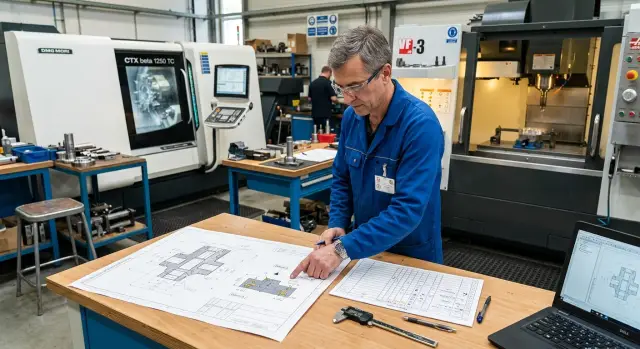
Why disputes start without a shared base map
Disputes between sections usually aren’t about people. The reason is simpler: the lathe section treats the already-machined diameter as the base, while the mill takes the face or a raw surface after clamping. Each acts by its own logic, but there is no common reference. As a result the same part ends up with two different coordinate systems.
This is especially clear when a part moves from a lathe to a milling center. On the lathe the operator measures from the rotation axis and the cut face. On the mill the operator chooses fixturing that is faster and easier to clamp. If the process engineer didn’t link these setups in advance, misalignment is almost inevitable.
Typical consequences follow: a dimension "drifts", a slot or hole is shifted, and the sections argue about where the error came from. The problem is not one wrong action, but that no one set a single scheme for everyone in advance.
What the engineer records in a base map
If turning and milling sections read the drawing differently, the dispute starts immediately. One operator takes the axis after the first cut as the base, another uses the finished face. The engineer must remove this doubt ahead of time and write down a single logic for everyone.
First, they select the part's primary base. It’s not chosen by clamping convenience, but by how the part functions in the assembly. For a shaft this is often the rotation axis and a reference face. For a housing it’s a datum plane and two holes that set position. If important dimensions later reference different bases, cumulative error appears and each section starts correcting the part in its own way.
A good map answers one question clearly: from which surface is each dimension taken at every stage. That’s why the primary base is usually shown alongside which surfaces are considered primary and which are needed only for a specific setup.
Next the engineer lists setups in order. Vague phrases are not helpful here. You need short clear notes: setup number and machine, how and where the part is clamped, which base is active in this setup, which surfaces are produced or finished, and what is checked before passing the part on.
Such notes remove unnecessary questions. For example: S1 — clamp by rough diameter, face trimming and obtaining base A; S2 — fixturing by face A and axis B, finishing shafts; S3 — transfer to milling, fixturing by A and B, machining slots and holes. When recorded, the operator no longer changes the base "because it’s more convenient".
Where to mark the transfer between sections
The transfer from turning to milling should be highlighted separately. The map must state the condition of the part leaving the lathe, which bases are already ready, and which must not be lost at the next clamping. It should also list checks before handover: runout, length from face A, diameter of the base journal, condition of the support plane.
If this line is missing, the mill operator often accepts the part "as is" and rebuilds the fixturing. Then the dispute is not about the drawing but about who first chose the wrong base.
The engineer also ties dimensions and tolerances to each base — not all dimensions, only those produced or checked in that setup. If a slot must be located relative to axis B and face A, record it explicitly. If holes reference plane A rather than the outer contour, fix that in the map. A good note is short: the dimension, which base it references, the tolerance, and the inspection method.
When the lathe and the mill look at the same scheme, they discuss a specific deviation and where it arose, not competing interpretations.
How to set setup logic in advance
You design setup logic from the finished part. First the engineer reviews dimensions, tolerances and surfaces that must keep their mutual position at the end of the process. Only then do they decide which operations are turning, which are milling, and how the part is easiest to clamp. If you start from the machine rather than the part, the route often becomes convenient for one section and inconvenient for another.
The map works only if it clearly shows which bases are rough and which are finished. A rough base is for removing stock and producing initial even surfaces. A finished base holds accuracy later. If you mix those roles, one operator will treat a base as temporary and another as primary. That’s where disputes begin.
A simple rule helps: once you have a surface or axis from which precise dimensions will be taken, mark it as finished and don’t change it without reason. For rotating bodies this is often the axis, outer diameter or face. For housings it’s a plane and two clear locators, e.g. a hole and a side face.
Also mark surfaces that must not be lost during the route. These are not every processed area but only supports without which the dimensional referencing collapses. If after turning the part cannot be confidently located by the same axis or face on the mill, fixturing logic failed already in process preparation.
Before launch, check four things: which base yields the first precise size, which base carries to the next setup without re-referencing, which surfaces must not be touched during re-clamping, and what will serve as support if the part is flipped or sent to another section.
Each new setup should continue the previous one, not undo it. If after the second setup the operator must "find the part again," the engineer failed to chain the operations. Proper logic preserves the same geometry throughout the route: the lathe creates a base and the mill uses it instead of inventing a new one.
Therefore the map should record not only the base itself but the purpose of the setup: what we reference, how we clamp, what we obtain after the operation, and which surfaces stay untouched. Then both sections share the same picture.
How to link turning and milling with one scheme
Operators often read the same drawing in different ways. The lathe keeps the outer diameter and a face, while the mill later mounts the part on another plane and sets its own zero at the clamp. From this comes the argument: who introduced the shift, who misunderstood the setup, and why the dimension changed after transfer.
To avoid this, the engineer sets one scheme for both sections. The idea is simple: before starting they select surfaces both sides accept as references and record which base remains primary after turning.
Usually you start from the part’s geometry rather than clamping convenience. If after turning there is a finished face and a seating diameter with the required accuracy, those often become the common pair of bases. Then the lathe does not just pass a semi-finished part, it hands over a part with a clear reference position.
A good map must state which surfaces are common supports for both sections, which base the lathe must maintain and pass on, what the mill accepts as the initial position at first clamping, and how to check displacement after handover.
If this is not explicit, each section invents its own way. On paper everything looks logical, but on the machine the same part lives in two coordinate systems.
A working scheme typically says: the lathe forms reference face A and diameter B, and the map records that the milling section positions the part by A and B in the fixture. Not "if possible" or "by location", but strictly by those surfaces. If another surface is more convenient for clamping, treat it as auxiliary support, not a new base — and record that too.
Also specify post-transfer checks. The simplest is a control dimension from face A to the first milled plane and a runout or concentricity check by diameter B before machining begins. That check takes a few minutes but immediately shows whether the part shifted during re-clamping or the problem occurred earlier.
This approach significantly reduces disputes. Each section follows a common logic instead of having its own version of fixturing.
A simple example on one part
Take a flanged bushing: an outer seating diameter and a slot plus several holes on the flange face. Disputes start quickly on such parts. The lathe focuses on accurately producing the axis and diameters. The mill looks at the slot and flange holes and sometimes proposes its own setup.
If you make a base map in advance, the dispute usually disappears. The engineer sets the rule once: which surfaces are primary and secondary and from which references dimensions come in both sections.
In this example the logic is simple. On the lathe they first machine outer surfaces, the seating diameter and the reference face. After that the part has two working bases: the part axis from the machined diameter and the flange face. That is enough to transfer the part without reinterpreting it.
On the mill the slot and holes are made not by clamping convenience but from the same bases. The part is centered by the axis, supported on the same face, and only then the slot and drilling are referenced. The mill does not create a new logic; it continues the one set by the engineer at the turning stage.
A good sign of a correct scheme is simple: if you change the operator, the result should not change. The same slot must remain at the correct angle and the holes at the same distance from the axis and face even across different shifts.
QC after each operation checks only what maintains that scheme, not everything. After turning they check the base diameter, seating surfaces and face runout relative to the axis. Then they confirm the flange face is suitable as a support for the next setup. After milling they measure the slot position relative to the axis, and after drilling — the hole coordinates on the flange and their reference to the same face. In the end they verify that all features are tied to the same bases, not to different setups.
This saves a lot of time. If the slot shifted, the section immediately knows where to look: the turning base, the milling clamp, or a referencing mistake. When bases aren’t fixed, each section defends its own version and the investigation takes longer than the machining itself.
Where errors most often occur
Errors usually start before the machine, when a section reads the documents its own way. If the map isn’t complete, everyone takes what seems logical. Then one operator is sure they did everything right while another receives a part that is hard to place.
The most common slip is simple: the operator chooses a base different from the engineer’s, one that’s easier to clamp. On turning this may pass without obvious issues. On milling the shift immediately shows in holes, slots or planes and people blame the machine accuracy, though the cause is fixturing.
A second mistake comes from documentation. The engineer indicated a base but didn’t note it was temporary for the first operation only. The next section treats it as permanent. As a result they build from a surface that is later removed or finished, causing extra re-clamps and unnecessary stock allowances.
Inconsistent labels also cause trouble. The drawing uses base A, but the routing sheet points to a different surface for the same name. If someone didn’t take part in process preparation, they read the papers literally. The error isn’t inattentiveness but conflicting documents.
Another problem is leftover stock after the first operation. The lathe may assume enough allowance remains for milling, while the mill sees no stock after re-clamping. This appears often on blanks with uneven outer surfaces. If allowance isn’t tied to bases, everyone estimates it differently.
Inspection also sometimes measures from the wrong surface. Production reports a dimension within tolerance while QC gets another number and rejects the batch. Both sides rely on real measurements but from different reference points.
A simple sign of trouble: the lathe, the mill and QC cannot name the base identically without pausing. That means the map doesn’t cover all questions. It should fix in advance which base is used at each operation, which base remains for the next setup, and from which surface control measures afterwards.
A short check before launch
Spend 10 minutes checking before the first part rather than arguing at the machine about why a dimension changed after transfer. Usually the problem isn’t people but that everyone reads fixturing differently.
If the map is well made, this check is quick. If any point triggers a long discussion, the document is still raw and you should delay launch.
First look at the part as a whole. It should have one primary base that builds the common setup logic. That doesn’t mean every transition uses only it — it means the lathe, mill and engineer share one reference point rather than three different versions.
Then check how the base is named in each setup. The operator shouldn’t have to guess which surface is primary there. The map must state how the part is supported, how it’s clamped, and from which surface the dimension is taken. If on the lathe the base is listed by a face and on the mill the same face suddenly becomes auxiliary without explanation, a dispute is almost guaranteed.
Before launch go through a short list: is there one common base for the whole part, are the bases named the same in the drawing, routing sheet and setup sketch, is it clear at each setup which base is working and which is only an auxiliary clamp, is there a quick way to check displacement after re-clamping, and do both sections understand the condition the part is handed over in.
The displacement check is often underestimated — mistakenly. You need a simple control: an indicator on the diameter, a face check, or a control dimension between an already machined plane and the new base. The check should take minutes, not a full re-measurement.
At transfer the lathe must hand over not a semi-finished blank but a part in a defined condition: which surfaces are finished, which still have stock, and from which base the mill should continue. Otherwise one side treats a surface as finished and the other as rough, and the dimensional chain breaks.
A simple example: after turning a stepped shaft the mill must pick a slot. If the engineer already specified that milling fixturing uses the finished outer diameter and trimmed face A, the operator places the part the same way every time. If not, one operator will reference the diameter and another will stop on the chuck step, and the slot will shift.
If any checklist item sounds unclear, it will be even less clear during work. Then the map must be corrected before launch, not after the first rejected batch.
What to do after agreeing the map
After agreement, don’t just send the map to the floor. Gather the engineer, a lathe operator, a mill operator and a QC person for 15–20 minutes and step through the route. The team will immediately see where the first setup starts, when re-clamping is acceptable, and which surfaces inspection measures after each operation.
This meeting is not a formality. Small but costly mistakes usually surface: the wrong base number on a sketch, an unclear note for a transfer, or different understandings of allowance after turning. Catching these before launch resolves the dispute on paper rather than at the machine.
Make corrections before the first batch, not after rejects. One vague arrow on a sketch or one phrase without explanation easily gives two interpretations across shifts. Later each operator is sure they did everything right, but the dimensional chain still fails.
After approval set a few simple rules: keep a single current copy for all shifts, remove old printouts from the floor, record who changed the document and when, and notify not only the foreman but also operators and QC about any update.
The approved map must be the one reference for everyone. If the engineer has a file, the foreman a printout, and the night shift a photo of an old version, confusion is likely. It’s much calmer when one version number and one clear sketch are used.
Another sensible step is to revisit the map after the first 2–3 parts and check how it works in practice. Sometimes the on-paper logic is correct but inconvenient for the operator or inspection adds ten extra minutes. Fix such issues immediately while the route is not yet habitual.
If the company is still selecting equipment for the common route, compare the base map with machine capabilities. For this topic, materials from the EAST CNC blog at east-cnc.kz may be useful. The company works with CNC lathes, machining centers, commissioning and service, so the issue of transferring bases between operations is practical, not theoretical.
FAQ
What is a base map in simple terms?
It’s a short diagram where the process engineer records which surfaces are used to place the part at each setup and from which points dimensions are taken. It links turning and milling into a single logic. When there is no such scheme, each section takes its own reference and the part quickly ends up with two different zero points.
Why make a single base map for turning and milling?
One map removes guesswork. The lathe operator and the mill operator see the same bases, so disputes are rarer and it’s easier to find where the size shifted. Without a common scheme, the lathe hands over the part with its own logic and the mill builds a new one. That results in shifted slots, holes and faces.
How to choose the main base of the part?
Start by looking not at the clamp, but at how the part functions in the assembly. For a shaft, the main base is often the axis and a reference face. For a housing, it’s a datum plane and holes that define position. If critical dimensions in the finished part are referenced from those surfaces, they should remain the main bases throughout the route.
What must be specified for every setup?
For each setup, note the machine, how the part is clamped, which base is active, what is produced by the operation, and what is checked before passing the part forward. That prevents operators from inventing the scheme on the spot. The shorter and clearer the note, the lower the chance someone will change the base for convenience.
Where is the base most often lost during transfer between sections?
Most often the base is lost during re-clamping between sections. After turning the part has an axis and a face, but on the milling side the operator sometimes places it by another plane because that’s easier to fix. To prevent this, the engineer must record the part’s outgoing condition and which surfaces the mill operator must keep as supports.
How to tell a rough base from a finished base?
A rough base is used to remove stock and get the first even surfaces. A finished base is used to hold accurate dimensions in later operations. As soon as you obtain a surface or axis from which precise sizes follow, mark it as finished and don’t change it without reason.
What to check before running the first part?
Before the first part, the team should check one thing: does everyone understand the main base and the working base at each setup the same way? If the lathe, mill and QC name different surfaces, stop and fix the map. It’s also useful to prepare a quick check for displacement after re-clamping. This saves time already on the first part.
What control is needed after transferring a part from turning to milling?
A short check of the surfaces that connect the operations is enough. Usually they measure runout on the base diameter, the length from the reference face, and confirm the support plane wasn’t lost after re-clamping. Such control takes little time and immediately shows where to look: the turning base, the new clamp, or the tool reference.
What if the operator finds it more convenient to clamp the part by a different surface?
Let the operator use another surface only as an auxiliary support, not as a new base. You must not change the main logic if dimensions are already tied to an axis, face or another chosen surface. If another clamp is truly necessary, the engineer should revise the setup and record the new solution for everyone, not leave the choice to the shift.
When should the base map be revised?
Make corrections as soon as the team notices different understanding of a base, extra re-clamping or inconvenient inspection. Don’t wait for the first batch of rejects. After the first 2–3 parts it’s useful to revisit the map and compare it with real shop practice. If the on-paper scheme hinders the operator or inspection takes too long, correct it while the route is not yet routine.