
Barrel Milling Cutter in 5-Axis Machining: Where It Saves Time
A barrel milling cutter in 5-axis machining speeds up finishing on gentle, smooth surfaces. We explain where you can increase the step-over without leaving a rough mark.
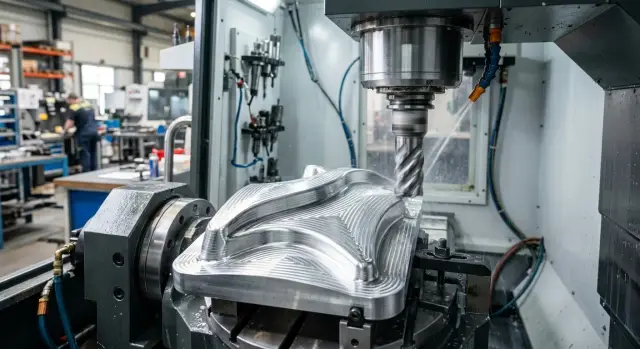
Why finishing often stretches the cycle
Roughing removes the bulk of the metal quickly. The tool takes a large allowance, the toolpath step-over is bigger, and the machine does not waste time on a dense grid of passes. Finishing is different: the allowance is small, but the demands on shape and surface mark are much stricter.
That is exactly where cycle time often grows more than expected at the start. Set the step-over too small, and the machine makes not tens, but hundreds of extra passes over the same surface. Each pass is short, but together they can easily add hours.
On a complex 3D shape, that kind of caution is understandable. It is better to reduce the step-over than to see a wave, a scratch, or a visible tool mark on the finished part. This is especially true for molds, blades, smooth transitions, and radiused areas where any defect stands out right away, and fixing it takes a lot of time.
The problem is that after a certain point, reducing the step-over hardly improves the surface anymore. At first, the result really does get better. Then the difference becomes hard to notice both by eye and by measurement, while machine time keeps going up. The machine runs longer, but the part looks almost the same.
Usually the cycle gets stretched by four things: too tight a step-over on large smooth surfaces, the same cautious mode for the entire part, fear of leaving a mark on transitions and edges, and trying to “fix” the finish with extra passes instead of checking the result properly.
A simple example shows this well. On a housing part, there may be a long convex surface. Roughing removes the material in 25 minutes, and finishing with a ball-nose cutter and a very fine step-over takes an hour and a half, even though the visible improvement after a certain point almost disappears.
Because of that, 5-axis finishing often becomes the longest stage of the program. Not because the metal is hard to cut, but because the machine spends time on a path that is too dense. That is why barrel milling cutters attract interest: if you can increase the step-over without leaving a noticeable mark, the cycle can be reduced very significantly.
How a barrel cutter differs from a ball-nose cutter
A ball-nose cutter touches the part almost at the tip. The working radius at that point is small, so when you increase the step-over between neighboring passes, a visible scallop appears quickly. That is why finishing often runs slowly.
With a barrel cutter, the contact moves higher up, onto the side profile. There the working radius is much larger. For machining, that is an important difference: at the same step-over, the mark is lower, and at the same surface quality, the step-over can be increased.
That is why a barrel cutter often outperforms a ball-nose cutter in finishing passes. Five axes make it possible to set the needed tool tilt so that the cut happens not at the tip, but along a larger arc on the side of the tool.
On smooth geometry, this is visible right away. If the part has a gentle transition, a large radius, or a long convex area, the surface after the passes looks more even. The lines are less visible to the eye, and the cycle gets shorter because the machine makes fewer neighboring passes.
But the advantage is not unlimited. As soon as the surface turns into a sharp break, a small blending radius, or a narrow groove, the large working arc almost stops helping. The contact zone becomes narrow, the allowed tool tilt drops, and the benefit quickly disappears.
That is why ball-nose cutters are still needed. They move through difficult areas more easily: sharp transitions, tight corners, local pockets, and places where access at the tip matters. A barrel cutter should be seen not as a replacement for everything, but as a strong option for specific surfaces.
Put simply, a ball-nose cutter handles complex geometry better, while a barrel cutter closes calm finishing surfaces faster and without extra marks.
Where a large step-over does not hurt the surface
A large toolpath step-over works well where the surface changes smoothly and the cutter contact patch stays predictable. A barrel cutter has a large effective radius, so the scallop between neighboring passes is lower than with a ball-nose cutter at the same step-over.
This works best on shallow convex and concave surfaces with a large radius. If the area looks like a long arc rather than a series of small breaks, the tool leaves an even mark even with fewer passes. On such areas, the step-over is often increased two or three times while still keeping the required finish.
Long, smooth transitions without sharp edges are also good candidates. This is exactly where 5-axis finishing often spends a lot of time because of the dense toolpath grid. If the surface runs smoothly without a sudden change in curvature, a barrel cutter can noticeably reduce machine time.
It is also worth looking at walls and channels where the tool keeps a stable tilt. When the angle does not jump from pass to pass, the cutter cuts more evenly, and the mark stays more uniform along the full length. This is especially useful on deep but not narrow shapes, where you want to remove extra passes without the risk of streaks.
The biggest gains usually appear on mold and die surfaces, streamlined areas of housings, large radius transitions between planes, and wide channels with a smooth profile. There, the large area itself makes even a small step-over increase matter a lot in time.
If the area has no small corners, short broken transitions, or sudden changes in curvature, a large step-over is usually justified. On such surfaces, the savings are real, not just theoretical in CAM.
Where this cutter helps very little
A barrel cutter does not bring the same benefit everywhere. Its strength is a large effective radius and the ability to work with a bigger step-over on calm surfaces. If the geometry breaks that pattern, the gain quickly fades, and in some cases the cycle even gets longer.
The first weak zone is narrow pockets and deep cavities with poor access. There, the tool often works at a long overhang, the tilt angle is heavily limited, and chip evacuation is worse. In those areas, the machinist almost always reduces feed, lowers the step-over, and moves the axes more carefully. In the end, the cutter loses its main advantage.
A similar story happens with small internal radii and sharp surface joints. If the area needs a small contact patch, a large effective radius no longer helps. It is easier to take a smaller ball-nose cutter and clean up the difficult corner properly than to try to force one universal finishing pass.
The risk is even higher near edges. It is easy to gouge the part if the tool tilt changes too abruptly or the control program recalculates the orientation in a bad way. The step-over may look fine on screen, but on the part the mark will show right away. This is especially unpleasant on thin walls and open edges, where the defect is visible at first glance.
There are also surfaces with very frequent changes in curvature. On a smooth shape, a large step-over works well, but on wavy geometry the tool mark starts to wander. One area looks clean, while the next one already shows stripes. Then the path has to be tightened again, and machine time goes back to almost the same level as with a ball-nose cutter.
One more case is a machine that does not handle smooth 5-axis motion well. If the axes move in jerks, lag behind, or the control cuts feed at every small turn, there will be no beautiful finishing. The tool is not the problem here. The limit comes from the machine kinematics and the quality of the postprocessor.
In practice, those zones are better separated from the calm surfaces right away and estimated separately. Then the time expectations will be closer to reality, and the first test will not lead to the false conclusion that the method does not work at all.
How to choose a section for a trial pass
A trial pass is better done not on the whole part, but on one clear section about 80–150 mm long. That is enough to see the tool mark, understand the machine’s behavior, and avoid wasting extra machine time on a bad test.
First, divide the model into two groups: smooth areas and difficult spots. The first group usually includes long convex or concave surfaces without sharp breaks. The second includes sharp transitions, narrow areas, zones near edges, small radii, and sections where the tool often changes tilt.
For the first test, it is better to choose not the most difficult section, but a long and calm one. There, it is easier to understand where the barrel cutter really helps. If you start with a corner, a ledge, or a tight area, the result will almost always be blurred: the mark depends not only on step-over, but also on constant changes in motion.
There is a simple rule: compare only one variable at a time. Keep the same allowance, the same base strategy, and the same material. Then make two passes on the same section: first with a ball-nose cutter, then with a barrel cutter. If you change the tool, step-over, tilt, and feed all at once, you will not get a fair comparison.
After the test, do not look only at the stopwatch. You need four things: the surface mark, actual cutting time, spindle load behavior, and the stability of the machine motion. If there are jumps, vibration, or extra noise, the mode cannot be considered successful, even if it is formally faster.
It also helps to choose a section that can later be checked quickly with the same tool, but with a different step-over. That makes it easier to see the point after which the cycle is still getting shorter, but the surface starts to lose its appearance. Usually that point shows up right away: one step-over still keeps the finish, and the next one already leaves a wave.
Only after such a test does it make sense to transfer the mode to the whole part. And even then, not to everything at once, but only to zones with a similar shape. If a long smooth surface worked well, that does not mean the same mode will suit pockets, transitions near a wall, or small-radius areas.
A real part example
Imagine a mold half with a deep concave wall and a smooth transition into a radius. The main area is long, without sharp breaks, and this is exactly the kind of place where finishing usually stretches the cycle. The part itself does not look complicated, but the area is large, so even a small toolpath step-over has a direct effect on total machine time.
If a ball-nose cutter is used, the programmer almost always reduces the step-over to avoid a noticeable scallop. On the screen, the toolpath looks neat, but the machine makes too many passes. On a wall 200–250 mm long, that quickly turns into extra tens of minutes.
Now the same area is machined with a barrel cutter. Because of the large effective radius at the contact point, the step-over can be increased while the tool mark stays clean. For example, if the ball-nose cutter used a 0.3 mm step-over, after the change it may be raised to 1.0–1.2 mm. The surface still looks even, and the number of passes drops several times.
On a long concave wall, the difference is obvious right away. If the ball-nose cutter took 40 minutes, the barrel cutter often finishes in 15–20 minutes at the same required finish. The exact number depends on the material, tolerance, and strategy, but the principle is simple: the smoother and longer the area, the more the increased step-over pays off.
But the savings are not uniform across the whole part. As soon as the path reaches corners, narrow spots, or areas with a sharp change in curvature, the step-over has to be reduced again. Sometimes you have to return to a more cautious strategy, and sometimes even to another tool. In those sections, the gain almost disappears.
That is why a barrel cutter works best not “everywhere,” but on specific surfaces. If the part gives you a long smooth wall, a large radius, or a wide concave area, the cycle drops without losing quality. If the surface is broken up and full of corners, there will be no miracles.
Mistakes that eat up the savings
Most often, time is lost not in choosing the cutter itself, but in how it is used. If you set a large step-over everywhere possible, you really will speed up the wide smooth areas, but on transitions, near edges, and in small-radius zones you will get a visible mark.
One common mistake is simple: a good step-over from one surface is copied to the entire model. That should not be done. A part almost always consists of different zones. A convex wall, a shallow radius, and a narrow internal corner behave differently, even if the material is the same.
Another typical problem is the wrong tool tilt. A large step-over by itself does not save the cycle. If the tilt is not stable, stripes appear quickly on the surface, and sometimes the gloss becomes uneven. After that, time goes back up: the operator reduces feed, adds a pass, or redoes the finishing altogether.
There is also another mistake: using a cutter that is too large on parts with small radii. On the screen, the path may look fine, but in actual machining the tool either does not match the shape properly or leaves unmachined areas. Then a second tool is needed, and the problem zones have to be machined again. All the savings disappear.
It is dangerous to look only at cycle time. If a new pass shortens the program by 18 minutes but leaves a mark that has to be hand-polished later, there is no gain. You need to compare not only the minutes on the machine, but also the surface itself: gloss uniformity, scallop height, and what happens at path transitions.
The worst scenario is trying to cover both wide finishing surfaces and tight corners with one tool. For open surfaces, that sometimes works. For pockets, transition radii, and tight spots, it usually does not.
A better approach is much simpler: divide the part into zones by geometry, set the step-over and tilt separately for each zone, check the mark on a control section, and keep a second tool ready for corners and small radii. That way, the result is more honest, and the difficult areas do not ruin the whole part.
Quick check before starting
Before the first finishing pass, do not touch the whole part at once. Take a short section where the shape repeats for at least 30–50 mm and test it separately. That makes it faster to see whether the barrel cutter really saves time or whether the large step-over only adds risk.
Do not look only at the calculated time in CAM. On screen, the path may look calm, but on the machine you may find that the tool tilt is wandering, the holder is vibrating, and a wall sits too close by. Then the mark gets worse, and the cycle has to be redone.
Before starting, it helps to run through a few simple questions. The surface in the test area should be smooth, without sharp changes in curvature. The tool should keep a stable tilt along the full pass, without frequent reorientation. The cutter body and holder should not come too close to adjacent walls and ribs. For a fair comparison, you need the same allowance, the same feed, and similar conditions. And finally, the machine together with the holder and tool overhang must handle the pass without noticeable vibration.
If you have doubts on at least two points, it is better to shrink the test area or return to a more cautious step-over. A fast pass only makes sense where the geometry itself helps keep steady tool contact with the surface.
A good sign is a wide and calm surface, such as a smooth mold area, a body contour, or a large transition zone. A bad sign is a narrow groove next to a wall, a sharp exit to an edge, or a place where the machine axes constantly reorient. In those areas, machine time sometimes even grows, because the machine spends it on extra motion rather than cutting.
Check the result honestly. Compare two short passes on the exact same area: one with a ball-nose cutter, the other with a barrel cutter. Then assess the mark at the same allowance and look not only at roughness, but also at sound, heat, and the overall machine behavior. If the surface is clean and the cycle is shorter by at least 15–20%, the area is suitable for expanding the test.
What to do after the first test
Do not change the whole finishing strategy right away. Take one section with clear geometry, run it with two routes—the old version and the barrel-cutter pass—and save both results. Then the discussion is based on facts, not impressions.
Record three things right away: the toolpath step-over, cycle time, and the look of the surface mark. If the step-over increased noticeably but time dropped only slightly, the cause is often not the cutting parameters themselves, but extra axis movement, cautious feed, or long lead-ins. If the mark improved but the cycle barely changed, then the bottleneck is not the tool, but the toolpath or the machine behavior.
Even a simple table helps more than operator memory. It is enough to note the part section and material, tool and overhang, tilt angle, toolpath step-over, feed, spindle speed, actual cycle time, and a photo of the surface. After that, it becomes clear where the barrel cutter is really useful and where the effect only looks good in CAM.
Do not switch the whole part to the new tool right away. Keep the ball-nose cutter for corners, small radii, tight transitions, and poor-access areas. There, the barrel cutter often loses its purpose: the step-over has to be reduced again, and the risk of hitting the neighboring wall grows.
A good practice is to expand use step by step. First, test another similar surface on the same part. Then try a different part with a similar shape. That makes it easier to understand where you are really reducing machine time and where you are just swapping one compromise for another.
On a real part, the difference is usually visible quickly. A smooth outer housing surface may finish in 17 minutes instead of 28, if the mark stays within tolerance. But nearby, in a small-radius area, the same tool will already lose to a ball-nose cutter. That is why the decision is made by zones, not by fashion.
If you are choosing equipment for this kind of work, it is useful to discuss not only the machine specs, but also the parts you plan to make. At EAST CNC, this is especially relevant: the company supplies 5-axis machining centers and helps with selection, commissioning, and service, so the results of such tests are easier to tie to real shop work instead of leaving them at the level of theory.
FAQ
When is a barrel milling cutter really faster than a ball-nose cutter?
It usually speeds up finishing on long, smooth areas where you can noticeably increase the toolpath step-over without leaving a visible scallop. These are convex and concave surfaces with a large radius, wide channels, and gentle transitions. If the geometry is broken up, with corners and small radii, the advantage disappears quickly. Then the machine again needs a fine step-over and a cautious tilt.
On which surfaces does it have the biggest effect?
It works best on large, smooth surfaces without sharp changes in curvature. In those areas, the tool contact stays steady, and the marks from neighboring passes are less visible even with a larger step-over. Good results usually come from mold surfaces, streamlined body panels, and long radius transitions.
Can a barrel milling cutter replace a ball-nose cutter on the whole part?
No, it cannot fully replace a ball-nose cutter. A ball-nose enters tight corners, small internal radii, local pockets, and places where access is needed at the tip much more easily. It is better to split the part into zones. Use the barrel cutter on calm surfaces and keep the ball-nose for the difficult areas.
Why does finishing so often stretch the cycle?
Finishing removes little material, but it requires a dense toolpath and a clean surface. If the step-over is too small everywhere, the machine makes hundreds of extra passes, and minutes quickly turn into hours. After a certain point, the surface hardly improves at all, while the time keeps growing. That is where the extra cycle time comes from.
How do you choose a section for the first test?
For the first run, choose a clear section about 80–150 mm long. It is best to pick a long, calm surface without sharp edges, narrow spots, or frequent axis reorientation. If you start with a tight corner or an edge, you will not know whether the tool itself is helping. In those areas, access, tilt, and machine behavior all affect the result right away.
What should be compared in the test besides cycle time?
Do not look only at the stopwatch. Check the surface mark, actual cutting time, spindle load, and how the machine keeps moving without jumps, vibration, or extra noise. If the pass is faster but the machine shakes or the surface sheen is uneven, that mode will cost time later in rework.
How do you know the step-over is too large?
If the surface starts showing waves, stripes, or a noticeable change in gloss after you increase the step-over, you have already crossed the limit. Another sign is that the machine begins to move nervously even though the toolpath in CAM looks smooth. It is safer to test two neighboring step-over values on the same area. Usually one still keeps the surface clean, while the next one already harms the finish.
What mistakes usually destroy the savings?
Usually three things eat up the savings: using the same step-over for the whole model, poor tool tilt, and trying to finish both wide surfaces and tight corners with one tool. After that, the operator slows the feed, adds passes, or switches tools after the fact. Another common mistake is using a tool that is too large for parts with small radii. Then the problem areas have to be cleaned separately, and the time savings disappear.
Can the machine reduce the benefit of a barrel cutter to almost zero?
Sometimes the tool is not the problem at all, but the machine and the postprocessor are. If the axes move in jerks, lag behind, or the system cuts feed at every small change in direction, finishing will not give a smooth surface even with the right cutter. Before starting, check the smoothness of the 5-axis motion, the tool overhang, and the holder rigidity. Without that, a fair comparison is impossible.
What should you do after a successful first test?
Do not rush to apply the new mode to the whole part. Save the test settings, compare the old and new passes on a similar area, and only then expand the use step by step. Keep the ball-nose cutter for corners, small radii, tight spaces, and poor-access areas. This approach gives real savings without surprises on difficult sections.