
Bar Feeder or Robot Loading: What to Choose
Bar feeder or robot loading — we compare which option is better depending on blank type, run length, work tempo and shop space.
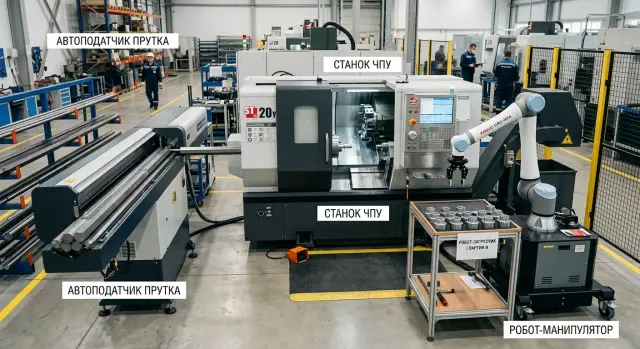
Where to start
The choice doesn’t begin with the machine or with the trend to automate. Usually it’s obvious in the pause between cycles. If an operator keeps bringing blanks, aligning them, opening the door and repeating the same actions, the cell loses output even on a simple part.
At the start most people compare two options: a bar feeder and robot loading. Both remove manual feeding but work differently and suit different tasks. There’s no universal answer. The deciding factors are the blank type, run length, changeover frequency and the available space around the machine.
A bar feeder works well where parts are turned from bar stock. It feeds material into the spindle with almost no gaps and is especially convenient for long repetitive runs. A robot is chosen more often where separate blanks are used: cut pieces, forgings, castings or complex-shaped parts that can’t simply be pushed through the spindle.
The most common mistake at the beginning is the same: looking only at purchase price. It’s far more useful to first find where the cell is losing minutes. Sometimes feeding isn’t the real problem. Batches may change several times per shift, blanks may differ a lot in shape, and changeovers eat up the benefits of almost any automation.
Start by answering three simple questions: what exactly do you feed into the machine, how long are your runs, and how much space is available beside the equipment for feeding and operator access.
A simple example illustrates this well. If the cell turns many identical bushings from bar stock, a bar feeder usually gives the most straightforward result. If today the blanks are short pieces of one type and tomorrow they’re a different shape and size, a robot often proves more convenient.
In practice the layout of the cell matters too. In a tight line where carts move and pallets stand nearby, an extra meter beside the machine can decide everything. That’s why suppliers of CNC machines, including EAST CNC, usually consider not only the machine spec but the real workshop layout: where material is delivered from, where the operator approaches the machine and how much time changeovers take.
In short, automation pays off where it fits the real part flow. So start not with the solution’s name but with the question: what do you feed into the machine every day and how often does it change?
What blanks will you feed
Blank type quickly tells you which option is closer to the mark. If you use a long bar that passes through the spindle and is cut off by the cycle, a bar feeder usually provides the simplest workflow.
For round and hex bar stock this is often the best choice. Material feeds evenly, the machine runs without constant operator involvement, and repeatability is stable if bar diameter and quality don’t vary between batches.
When a bar feeder is convenient
A bar feeder is needed where the blank suits feeding through the spindle. This is typical for series parts made from bar stock when long unattended operation is important.
It’s especially suitable if you have a standard round or hex bar, parts are turned directly from it without separate blank cutting, and the material doesn’t need to be oriented in any special way before feeding. Another advantage is simple operating logic. Setup is straightforward, cycles are predictable, and the operator intervenes less.
But once you switch to short cut blanks the picture changes. These pieces must be picked one by one, sometimes oriented, and sometimes carefully placed in the chuck or transfer zone. Here a robot is often more convenient.
When a robot gives more freedom
A robot is better for blanks that can’t simply be pushed through the spindle. These include short cylinders, forgings, flanges, cast parts, heavy housings and anything that deviates from standard bar stock.
If a blank is heavy or awkward, the robot takes on the most tiring work. The operator doesn’t have to lift the weight each time, find the right orientation or ensure the part sits without tilting. This difference may seem minor on paper, but over a shift it creates a steadier cycle and fewer random errors.
Surface condition also matters. Some materials scratch easily: soft alloys, pre-finished parts, or coated surfaces. In those cases soft jaws, special inserts or alternative grippers are selected. A bar feeder offers fewer such options because it relies on moving material through a feed channel.
Orientation before loading is important too. If the blank must be fed a certain side up, align a groove, hole or chamfer, a robot handles that much better. It can pick parts from a cassette, tray or conveyor and rotate them as the cycle requires. For bar stock this task usually doesn’t exist.
The conclusion is simple. For straight series turning from round or hex bar, a bar feeder is often the logical choice. For short, heavy, delicate or non-standard blanks a robot typically gives more control. The best approach is to decide with a sample part in hand, which is how proper equipment selection is usually done.
How run length changes the decision
On a turning cell, run length often influences the choice more than the automation idea itself. The same machine can work great with a bar feeder on a long run and waste time on the same solution if orders change daily.
If parts come in large lots and bar diameter and material are stable, a bar feeder usually gives a clear result. The operator sets the feed once, checks the first part, and the machine runs steadily. The fewer stops to change the bar, feed channel, collet and parameters, the faster such a scheme pays off.
Medium runs are less clear. Suppose the weekly plan contains several sizes, each repeated regularly. Then you must count not only cycle time but also all between-batch time. If a changeover takes 20 minutes and the run lasts 8 hours, the loss is acceptable. If the same 20 minutes repeats every one and a half to two hours, the situation is different.
When long runs favour bar feeding
On long repetitive runs a bar feeder is usually simpler in logic. The bar feeds continuously, the operator intervenes less, and changeovers are calmer.
This is especially true when production repeats on a schedule. If the plant makes the same group of parts monthly for automotive, marine or construction equipment, the goal is not only to remove manual feeding. It’s more important to keep steady output and depend less on which operator is at the machine that shift.
When runs are short
Short batches and frequent product changes shift priorities. Here you care not just about how fast the system feeds blanks but how long transitions take.
If a lot is small and tomorrow requires a different diameter, length and shape, long setups quickly eat any advantage. In practice the picture is usually: a run of several hundred parts can still work well with a bar feeder, but for very short batches and mixed schedules a robot often proves more convenient. It might not be faster in pure cycle time, but it can spend less time between orders.
Be realistic. If setup downtime exceeds the gain from automated feeding, choose the option that spends less time idle rather than the one with the fastest spec sheet cycle time.
How much space is needed in the shop
On a drawing the machine usually looks compact. In a real shop space is taken not only by the machine body but by everything needed around it: blank delivery, spindle access, swarf removal, people passing and cart turning.
A bar feeder usually pushes the line back from the machine. The machine can sit tight in a row, but its rear needs a long corridor for the bar, loading and maintenance. The longer the bar, the more this constraint matters. In width this scheme is often more compact than a robot, but in length it quickly consumes free space.
A robot needs different space. It doesn’t need a long tail behind the machine, but it requires a work area for gripping, rotating and placing blanks. Add guarding, maintenance access and sometimes room for a table, trays or a pallet. On paper a robot may seem compact, but after installation the cell often ends up larger than expected.
What causes the most trouble
Problems usually start where material moves, not where equipment stands. A bar feeder needs a convenient route to deliver bars. Bar bundles aren’t carried by hand down a narrow corridor. They arrive by cart, crane or forklift. If there’s no proper access behind the machine, the operator will waste extra time on every batch change.
For a robot the story is similar, only trays, cassettes or pallets move instead of bars. They also need space beside the machine. If a pallet is left in a passage it immediately obstructs the operator, setup staff, service and even basic cleaning.
Before buying check four things: how machine and cabinet doors open, where the operator stands during setup, how swarf is removed and coolant changed, and whether a cart or forklift can turn by the line.
That’s why a paper layout almost never matches the shop one-to-one. The drawing doesn’t show the person at the chuck, an open door, hoses, bins for parts or a pack of blanks that arrived early. In a tight cell the difference between "it fits" and "it will work well" is huge.
The conclusion is clear. A bar feeder is often easier to integrate into a long row of machines if there’s spare length behind them. A robot is more convenient where blanks arrive in lots and you can allocate a side area for the cell. Check this not by the brochure but by the actual material and people flow during a shift.
How to choose step by step
Decide not by broad promises but by your part and working mode. The winning option isn’t the one that looks more modern but the one that reduces downtime on your cell.
First fix the basics. Take one part you make most often and record material, blank size and length, weight and surface requirements. A long bar and a repetitive part usually favor a bar feeder. Single-piece blanks, forgings, castings and complex shapes usually point to a robot.
Then calculate not only machine time but pause time between cycles. If the operator spends 12–20 seconds on manual loading, opening the door, setting and removing the part, that loss adds up in a shift. At this stage it becomes clear whether you need simple bar feeding or a more flexible loading scheme.
To avoid debates, make a simple worksheet. Five items are usually enough: the most common parts and blank types, cutting and manual loading times, number of SKUs per shift, space around the machine and the person who will monitor the system daily.
The number of SKUs per shift strongly affects the choice. If the cell turns the same part from bar stock all day, a bar feeder often gives the clearest result. If many different items run in a shift and batches are short, a robot is usually more convenient because it adapts better to frequent blank and unloading changes.
Shop space matters too. A bar feeder needs a route and spare length behind the machine. A robot needs a safe contour, space for pallets and grippers and sometimes an intermediate buffer. The plan may look neat, but at the machine things get more prosaic. So verify sizes on site, considering doors, aisles and service access.
One step many skip: who will service the system daily. If the shift has an experienced setter and tooling is well organized, a robotic cell usually runs smoothly. If staff changes often and the task is simple and repetitive, a bar feeder often gives fewer reasons for stoppages.
A good solution usually fits on one sheet: blank type, run length, manual loading losses, shop space, changeover frequency and the person responsible for the system. When those numbers are collected, the argument is almost over.
Common mistakes
The first mistake is simple: choosing a solution based on someone else’s success, not your own work. On paper the debate is often about what’s more modern. In practice it comes down to part type, run length and how people work at the machine every day.
With bar feeders the typical misstep is buying one for short runs where bar diameter changes constantly. That’s fine for long runs, but if you change parts several times a day setup time consumes the expected savings. The machine stands idle, the operator changes tooling and the expected economy doesn’t appear.
Robots have a different common error: placing them in an already crowded cell. A robot requires not just its pedestal. It needs a safety zone, space for grippers, pallets, guarding and a passage for people. If a rack, a cart and a control cabinet are nearby, the cell quickly turns into constant detours and extra stops.
Another frequent mistake is looking only at purchase price. That’s not enough. You must know how many minutes the machine loses to manual feeding, how costly one hour of downtime is, how often changeovers occur and who will maintain the system. Sometimes a more expensive option pays off faster simply because the machine is idle less often.
Some things are remembered too late. Automatic loading doesn’t solve everything by itself. Finished parts need a place to go, swarf must be removed and good parts mustn’t mix with scrap. If this path isn’t planned, automation will hit a full tray or a dirty unloading zone.
People also forget service access. This becomes clear after installation when you need quick access to the chuck, turret, sensor or gripper area. If the operator must reach through guarding or remove tooling each time, the layout was chosen poorly.
Before buying check: how often blank geometry changes, how much space will remain for access and service, where finished parts will go, how swarf removal is organized and how much one hour of downtime costs for your machine.
A good sign of the right choice is simple: after installation the work becomes easier and steadier, not more complicated. If the paper layout already requires many workarounds, the shop implementation will almost certainly fail.
A simple example for two different cells
The same lathe can operate under very different rules. So the choice is usually decided not by fashion but by schedule, blank type and how often an operator must intervene per shift.
Cell 1
This cell makes a simple shaft from bar stock and produces it nearly all week. The diameter doesn’t change, material is the same and the lot is large. The main task is to get through the shift with minimal stops.
In that case a bar feeder often gives the clearest result. It feeds a long bar into the spindle, the machine turns part after part, and the operator doesn’t approach the door every few minutes. If the cycle is short the difference is immediate: even 30–40 seconds for manual loading quickly becomes lost hours over a week.
Here flexibility is not the priority; long autonomous operation is. If the program and SKU are stable, a bar feeder is usually easier to fit into the daily rhythm.
Cell 2
Another cell works differently. In the morning it turns 60 housings from separate blanks, after lunch 25 bushings, and tomorrow a different part. Blanks sit in trays, forms and lengths change, lots are short.
Here a robot is often more convenient. The operator changes the gripper, places another tray or cassette, adjusts the loading program and moves to the next order faster. Yes, autonomy exists, but the main advantage is that the cell doesn’t lose much time on each changeover.
If many such short runs occur, a bar feeder may no longer be the best option. It’s good where a long bar and a long run exist. When blanks are single pieces and the SKU jumps all day, a robot is usually easier to adapt to the real workload.
In practice it comes down to a few questions. Does the blank come from a bar or as separate pieces? Does the run last days or change several times per shift? What costs the cell more: extra minutes for changeovers or operator downtime? And is there space beside the machine for the chosen feeding scheme?
Both solutions can be right. For a shaft from bar stock it’s better to count hours of continuous work. For a cell with short runs count minutes for changing grippers, trays and programs. When you calculate not "in general" but by your order calendar, the answer usually becomes obvious.
What to do next
If the blank is bar stock and the cell runs long steady series, there’s usually no need to complicate the scheme. A bar feeder most often gives the clearest result: the machine runs longer without gaps, feed is continuous and the operator has fewer manual tasks.
When the part has a complex shape, blanks are single pieces or the product mix changes weekly, a robot is usually more convenient. It’s better for cells that need to load short forgings today, cut pieces tomorrow and a different part the day after. In that situation count not only cycle time but also changeover time.
Shop space quickly sorts choices. On paper both options look simple, but next to the machine you may find there isn’t room for an accumulator or comfortable service access. So first draw the cell plan with real dimensions: the machine, access zones, blank and finished part locations and a safe passage for people.
Before requesting a quote gather a short set of baseline data: the most frequent blank type, lot size, how often the mix changes, available space beside the machine and who will service the system daily.
That way the choice is made without guessing. If the bar is constant and runs are long, look toward a bar feeder. If parts vary and changeovers are frequent, a robot often proves more practical even if the initial project looks more complex.
Before buying discuss not abstract automation but your actual machine, your blank and your shift work. Usually a part drawing, blank dimensions, desired output per shift and a simple cell plan are enough.
If you need a detailed calculation, review this data with the supplier. For lathes and loading schemes this is especially useful because mistakes become obvious not in the catalogue but at commissioning. At EAST CNC this conversation can cover equipment selection, commissioning and service, so it’s best to start with a concrete part and your real operating mode.
FAQ
What is best for parts made from bar stock?
If you turn a part from a long round or hex bar and run long repetitive series, a bar feeder is usually chosen. It keeps a steady feed into the spindle and removes extra pauses between cycles. This option is especially convenient when the blank doesn’t change much from batch to batch and the operator rarely needs to intervene.
When is a robot better than a bar feeder?
Robots are typically used for short blanks, forgings, castings, flanges and complex-shaped parts. They’re useful where blanks must be picked one by one, rotated to the correct side and placed carefully into the chuck. They also help when a part is heavy, awkward to handle or sensitive to scratches.
What should I look at first: price or time losses?
Start by calculating shop losses, not the purchase price. If the operator spends many seconds on manual loading each cycle, those seconds add up to hours of downtime per shift. Then consider changeover time. A cheap solution can lose out if the machine stands idle too often between batches.
Does a bar feeder make sense for short runs?
Not always. If batches are short and bar diameter or length changes often, a bar feeder can waste time on setups and tooling changes. Bar feeders are chosen for short runs only when the product mix is still similar and transitions between orders don’t take long.
How can I tell if there’s enough space in the shop?
A bar feeder needs clearance behind the machine for the bar and an easy route to deliver bars. A robot doesn’t need a long corridor behind the lathe, but it requires a side area for handling, guarding and trays or pallets. On paper both may look compact, but in the workshop doors, aisles, swarf removal and vehicle turning space decide the outcome.
How important is bar quality and consistency?
Yes, it matters directly. If the bar diameter varies between batches or bars are bent, feed stability suffers and cycle consistency drops. Before choosing, check not only the spec sheet dimension but what actually arrives on your shop floor.
Is a robot always faster than a bar feeder?
Not necessarily. In a pure cycle on a long bar run, a bar feeder often works with fewer unnecessary motions. A robot excels at handling different blanks and switching between orders faster. So compare not just cutting seconds but also minutes lost between batches.
What data should I collect before requesting a quote?
Usually enough to request a quote: a drawing, blank dimensions and weight, material, run length, number of shifts per day and a simple shop layout. Also say how often the product mix changes. With these data it’s much easier to see which option reduces downtime for your machine.
Which is easier for the operator in daily work?
For simple repetitive turning from bar stock, a bar feeder is often easier for the operator. Its logic is straightforward and it helps keep a steady rhythm. A robot can work smoothly too, but it often needs more careful setup, especially when blanks and grippers change.
Can I choose without testing on my part?
You can make a preliminary choice, but guessing from a catalogue is risky. The most reliable way is to take one frequent part, measure manual loading time, include changeover time and review the shop layout. If you have a sample blank, the right solution usually becomes clear faster and with fewer debates.