
Backup Tools in the Magazine: When Are They Really Needed
Backup tools in the magazine help keep the night shift running and avoid losing short batches, but extra positions consume slots and make setup more complicated.
Where the debate starts
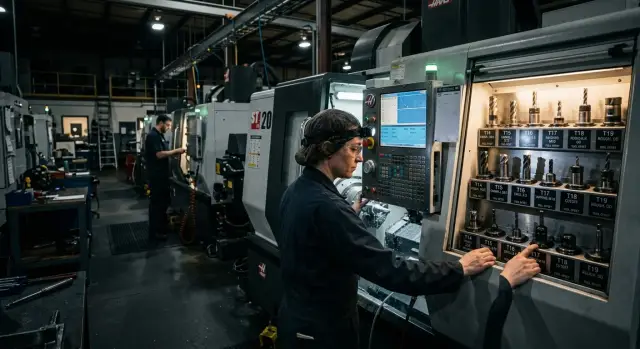
The problem starts with a simple limit: there are always fewer slots in the magazine than the technologist, setter, and shift supervisor would like. Each of them keeps a reserve for their own risk. One thinks about tool breakage, another about changeover time, and a third about the next order already waiting in the queue.
That is why duplicates look like an easy fix. Put in a second identical cutter or insert tool, and the machine will not stop in the middle of the cycle after wear or chipping. For a night shift, that logic makes sense: there are fewer people nearby, the setter takes longer to reach, and a 40-minute stop at night costs very differently than it does during the day.
But duplicates have a price. They take up slots that could be used for a drill of another diameter, a gauging tool, or tooling for the next part. On a small magazine, you feel that immediately: one backup quickly eats up the flexibility of the whole machine.
There is also a second problem, less visible but common. The more similar positions there are in the magazine, the higher the risk of confusion during setup. The operator has to check offsets, lengths, wear, pocket assignment, and call logic. If there are two almost identical tools, mistakes usually happen not because of the machine, but because of rush.
On CNC lathes this is especially clear. When a batch runs for a long time without stopping, a duplicate can easily justify its place: the same operation repeats hundreds of times, and a stop hurts output. With short batches, the picture is different. Today you make 20 parts, then switch to another item, and half the duplicates you prepared in advance are never used.
Short batches change the meaning of a reserve altogether. Here you lose time not only on a possible tool replacement, but also on loading extra positions, checking offsets, and cleaning unnecessary calls out of the program. Sometimes a duplicate saves 15 minutes of downtime, and sometimes it adds those same 15 minutes before the first start.
Duplication itself is not the problem. The problem appears where two tasks collide: keeping the machine from stopping and not filling the magazine with unnecessary tools. The more often the part mix changes and the fewer people are on shift, the sharper this question becomes.
When a duplicate is truly needed
A duplicate is needed not for peace of mind, but for those positions where one failure immediately stops production. If a tool carries the main load, runs for a long time without pauses, and noticeably wears out by the end of its life, a backup of the same kind is often more useful than another rare tool.
This is especially clear on a long cycle. The part is machined for 20–30 minutes, and one insert, drill, or tap is under load for almost all of that time. If it goes out of size or chips during the night, the machine simply waits until morning. For the night shift, one occupied slot is often cheaper than that stop.
It also makes sense to give up a slot for a duplicate when the whole batch depends on one operation. That happens in rough turning, deep drilling, or a finishing pass that sets the size. The other tools may last a long time, but this one position creates the main risk.
A duplicate is usually justified in four cases: when tool life is close to the length of the shift or batch, when the part cannot continue through the cycle without it, when there is no setter nearby at night who can replace the tool and adjust the offset quickly, and when a similar failure has already happened on the same material or mode.
A simple example: a batch of bushings is running, and the roughing tool takes up one third of the cycle time. On the 40th part, the insert may chip because of stock allowance or a hard spot in the blank. If the duplicate is already prepared with the same overhang and a clear offset, the machine switches faster and the batch does not stop until morning.
You should not duplicate everything. But for positions with predictable wear and an expensive stop, it is a sensible insurance policy. That is especially true where the shift works without a setter at the machine and the operator needs a simple, clear backup option.
When it is better to leave a slot free
A second identical tool is not always needed. If the batch is short and the insert, drill, or tap comfortably lasts through the order, the duplicate only takes up space in the magazine. Along with the slot, you spend time on assembly, referencing, and extra checking.
A common mistake is installing a second set “just in case.” For an order of 15, 20, or 30 parts, that rarely pays off. By the time the setter prepares the duplicate and enters the offsets, part of the batch could already have been made with the first tool.
The simple rule here is: the shorter the order and the more stable the tool life, the less sense there is in keeping a copy in the magazine. This is especially noticeable on CNC lathes, where slots are quickly filled by drills, cutoff tools, finishing positions, and a probe.
A duplicate usually gets in the way in clear situations: the batch is small and one tool easily lasts to the end of the order, the cutting mode is calm, the second set needs separate referencing and a test pass, and the magazine already lacks space for more important positions.
Imagine a short batch of bushings. The whole order is 24 parts, and the finishing tool usually lasts 80–100 parts before the insert needs changing. Putting a duplicate into that job makes no sense. It is better to leave the slot free for a tool that may actually be needed during the run, or simply not overload the magazine.
There is another point that is often underestimated. A second tool does not live on its own. Someone has to check the overhang, radius, offset, feed direction, and pocket number. If there is even one unclear point in setup, the duplicate stops being insurance and becomes an extra chance for error.
On machines where the magazine is already almost full, a free slot is often more useful than a spare copy. It gives you room for a process change, an urgent tool addition, or moving another job in. That is more practical than keeping a tool that will most likely never be called once.
If you are unsure, count it simply: how many parts need to be made, how many parts the tool lasts, and how many minutes it takes to prepare the duplicate. In short batches, the answer is usually the same: an empty slot is more profitable.
How to decide for each position
Each magazine position is better judged on its own instead of installing a duplicate “just in case.” One tool may pass through the whole shift without any issue, while a neighboring tool on a similar operation may wear out sooner because of allowance, material, or a heavier cutting mode.
First, count life in parts, not hours. If an insert lasts 160 parts and the machine must make 90 overnight, a duplicate is usually not needed. If life is 120 and the plan is 110, the margin is already too thin. Here you do not look at the catalog figure, but at the real spread from previous runs.
Then compare tool life with the shift or batch size. For short batches, the logic is simple: if a tool with plenty of life covers the whole order, a second identical position only steals a slot. For long night runs, the calculation is stricter, because even a short stop can leave the machine idle until morning.
The night shift changes the decision more than it seems. During the day, the operator often changes a tool in a few minutes. At night, there may be no setter nearby, or one person may be watching several machines at once. If nobody can replace the tool, the risk is judged differently.
For each position, it helps to answer four questions: how many parts does the tool reliably process in this operation, is that enough to reach the end of the shift without forcing it, who will replace it at night and how long will that take, and what costs more - losing 20–30 minutes of production or taking up one magazine slot.
A slot also has a price. If a duplicate takes space, you may run out of room for a drill, tap, or special turning tool needed for the next setup. On CNC machines, that quickly turns into extra rearrangements and delays between batches.
A simple example: the roughing tool lasts about 70 parts, and the night plan is 95. There is no setter at night. A duplicate is needed. A different case is a drill with a life of 1,500 holes for a batch of 60 parts. A second identical drill in the magazine is usually unnecessary.
Leave a duplicate only where a machine stop would cost more than an occupied slot. This keeps the magazine organized and avoids filling it with reserves that do not help.
What changes on the night shift
At night, a tool-related mistake costs more than during the day. If the operator is not standing right there, the machine can lose an hour, and sometimes the whole shift, because of one worn insert or broken drill.
That is why duplicates make sense where the operation runs for a long time and without constant supervision. Most often this is rough turning, deep drilling, boring with noticeable wear, and passes over blanks with variable stock allowance.
Unstable material also changes the decision. If the batch includes forgings of different hardness, cast blanks with scale, or parts with varying allowance, the tool may wear out sooner than expected. In that case, a duplicate is protection against downtime, not a pointless luxury.
You can rely on a few signs. A duplicate is worth planning when the tool often wears out before the estimate, a failure stops the cycle immediately, the operation runs for a long time and the operator will not see the problem right away, the material behaves unevenly, and a night replacement takes longer than one free slot is worth.
But you should not duplicate a rare tool out of habit. If a special boring bar handles 20 parts with no wear, and the night batch is only 6 pieces, a second identical bar only takes up space. The same goes for expensive tooling that takes a long time to set and is hard to justify.
Also check how the program will switch to the duplicate. You cannot simply place a second identical tool in the next slot and hope the machine figures it out. The program must call the second number, with the right offset and at the right moment: by life limit, by part counter, or by wear-control logic.
Confusion in names is especially dangerous at night. If the magazine has "T08" and "T08-2" with no explanation, the next shift can easily mix up the main and spare tools. It is better to name them directly: "Drill 12 main" and "Drill 12 spare." Then the operator, setter, and program all speak the same language.
The rule is simple: duplicate what can really stop the shift. Everything else should be judged by life, batch length, and the cost of a taken slot.
Example for a short batch
Imagine a night start: you need to make 60 steel housings in one shift. The magazine is not unlimited, so there is no point putting a duplicate in every position. For this kind of batch, it is better to look not at the number of operations, but at where a machine stop would cost the most.
In this example, duplicates are justified only for the most heavily loaded holes. If two drills work on dense material, go deep, and lose sharpness quickly, they should get a duplicate. Then the machine will not stop in the middle of the night because of one worn position. The operator sets up the second drill in advance and does not waste time on an urgent replacement at the machine.
A cutoff tool in this setup can be left without a duplicate. For a batch of 60 parts, it often lasts to the end of the order without any issue if the mode is chosen properly and the allowance does not jump from blank to blank. Taking another slot for it is usually not profitable. That slot will do more good somewhere else.
Free positions are better used for what most often interrupts the whole batch: a probe for checking and referencing, and a spare tap in case of chipping or poor thread exit.
That choice may look less “perfect” than a full set of duplicates, but in practice it works better for short batches. The machine stays flexible, and the shift does not get stuck in unnecessary rearrangements. This is especially noticeable at night, when the full setup crew is not there and even the smallest issue has to be solved on the spot.
A good scheme for such a batch is simple: duplicates only where wear is predictable and costly in time, one reliable cutoff tool for the whole order, and several slots reserved for inspection and emergency replacement. In the end, the operator is not running tools back and forth between cycles, and the machine keeps running without extra pauses.
To put it plainly, an extra duplicate made just for comfort often eats up space that is needed for real protection. For 60 housings, you feel that immediately.
Where people make mistakes most often
Most often, people add duplicates “just in case” and do not count how many slots they consume. It feels like a safe choice until a new order arrives or an urgent tooling change is needed. Then it turns out that half the magazine is occupied by tools that hardly ever work.
On short batches, this habit is especially expensive. If the series is 20–50 parts, part of the tooling simply will not wear out in time. Keeping a second copy for every position makes no sense. It is better to leave space for a probe, a measuring tool, or tooling for the next operation.
Another common mistake is installing a duplicate that differs from the original. It may have a different overhang, a different assembly, a different holder, or an insert from another batch. Outside, the tool looks similar, but the machine sees not a copy, but a different position. After the first change, size drift, extra touches, and scrap risk begin.
It is especially unpleasant when the second tool was prepared in advance but the offsets were not checked before startup. During the day, you can still catch that quickly. On the night shift, there are almost no hints: the machine simply takes the next position, and the part comes out off size. A duplicate by itself does not help if the length, radius, and offset number do not match the program logic.
Another confusion happens between a spare tool and a second working tool. A spare is kept nearby and waits until the main one wears out or breaks. The second working tool is already in the magazine, has its own offset, and is ready to be called without stopping the cycle. If those roles are mixed up, the setter expects an automatic swap and instead gets a manual change in the middle of the batch.
After an order change, many people forget to remove old duplicates. That is how the magazine quickly fills with “dead” positions. After a few setups, nobody remembers anymore which part the second cutter or drill was meant for, or why it is still sitting in the slot at all.
A simple routine usually helps: count as a duplicate only a tool with the same overhang and the same assembly, check a separate offset for it before the first run, keep only those second positions in the magazine that are truly needed in that shift, and after a changeover remove duplicates that are no longer needed for the new order.
The most expensive mistake is not having too many or too few duplicates. The mistake is installing them without a rule. If the second tool does not match the first one in geometry and setup, you can treat it as if you do not have a duplicate at all.
Pre-start check
Before the shift starts, a duplicate should be checked against one simple rule: it must truly replace the main tool without a pause and without guesswork from the operator. If it cannot do that, it is only taking up a slot.
First, look at tool life. If the main tool will certainly last to the end of the batch or shift, a second copy is often unnecessary. But if the cutter or drill is already close to its limit, and a night without a setter is ahead, the duplicate gives a calmer start.
Then check the program. It is not enough to place a second tool in the magazine. The program must be able to call it by the right number, and the replacement logic must be clear. Otherwise the machine will stop at the first wear limit even though a spare tool is sitting right there.
Then check the tooling itself. The duplicate should match in holder, overhang, and offset. Even a small difference can ruin the size or move the surface. On a CNC lathe, that quickly turns into scrap, especially if the batch runs at night without constant supervision.
Another common slip is occupied slots. If the duplicate steals space from a drill, tap, or cutoff tool that will definitely be needed in the cycle, that reserve only gets in the way. For short batches, this is especially obvious: the magazine is full, but the benefit is small.
Before startup, it is enough to run a short check: will the current tool life last to the end of the shift or at least to the planned break, does the program call the second tool without manual intervention, do holder, overhang, and geometry offsets match, are there free slots left for all operations in the cycle, and does the operator know which tool is main and which is the duplicate.
If even one point is unclear, it is better to fix it before the start. In practice, this check takes only a few minutes and saves hours of downtime and one very unpleasant night stop.
What to do next
Do not try to rebuild the whole magazine in one day. Start with the three operations that stop the shift most often: the tool wears out quickly, breaks without warning, or takes a long time to set up again. Usually that is already enough to show where a duplicate brings real value and where it only eats up slots.
Next, create a simple working list. You do not need a complex system for this. A regular table is enough if the supervisor and setter fill it in after each batch start and after each stop.
Such a table only needs a few lines for each position: which tool is in the magazine, how many parts it usually lasts, whether there is a duplicate and in which slot it sits, why it was added, and whether it actually worked in a real shift.
After two or three batches, the picture becomes clear. If a duplicate never saved a start and the main position reliably lasts longer than the shift, free the slot. If the tool does stop the program at night, during material changes, or on a heavy pass, the duplicate should stay.
For short batches, the rule is even stricter. Do not add a duplicate just because it once helped on a different job. Look at the risk in this batch only: material, cycle length, tolerance, and the cost of a stop. On a batch of 40 parts, a second tool is often not needed. On a batch of 200 parts with a night start, the decision may be different.
It is useful to review the magazine layout after every new batch, especially if the material or process route changes. The same cutter behaves differently on steel and stainless steel. What was unnecessary yesterday may solve a serious problem for the operator tomorrow.
If you are choosing a machine and magazine capacity for night work, it is better to discuss these things in advance with EAST CNC. The company supplies CNC lathes for metalworking and helps with selection, commissioning, and service, so the conversation can start from your parts, shift length, and real slot reserve.
FAQ
Do I need to place a duplicate for every tool?
No. Duplicates are only placed where a breakage or fast wear would stop output immediately. If a tool can comfortably finish the whole batch with margin, a second identical position only takes up a slot and adds setup time.
How do I know if I really need a duplicate at night?
Look at three things: the tool’s real life, the length of the night shift, and who will replace it if something goes wrong. If the tool is running close to its limit, the operation is long, and no setter is nearby, a duplicate usually pays for itself with one avoided stop.
When is it better to leave a slot empty?
When the batch is short and the tool’s life is much longer than the order size. In that case, a free slot is often more useful: it leaves room for a probe, a tap, a drill of another diameter, or an urgent change during the shift.
How should I calculate tool life when deciding on a duplicate?
Count tool life in parts, not in hours. If a tool insert lasts 160 parts and you need to make 90 in a shift, a duplicate is usually not needed. If life is 120 parts and the plan is 110, the safety margin is already too small and the risk is higher.
Where do people make mistakes most often with duplicates?
Most often people install a second tool that does not match the first one in overhang, assembly, or correction. It may look the same from the outside, but in production it gives a different size. That kind of duplicate does not protect the shift; it only raises the risk of scrap.
Does a duplicate make sense for a short batch?
Usually not. For a batch of 20–60 parts, a duplicate makes sense only on the most heavily loaded positions where wear is fast and a stop is expensive. Other tools are better kept as single items if they reliably last to the end of the order.
What should I check before starting a duplicate tool?
Make it a true copy of the main tool. Same holder, same overhang, same geometry, and its own verified offset. Then check that the program calls the second number without any manual guesswork from the operator.
How is a duplicate in the magazine different from a spare tool kept nearby?
Yes, and the difference is big. A spare tool next to the machine only helps after a manual change. A duplicate in the magazine is already ready to be called by the program and can bring the machine back into production faster.
Which positions are usually duplicated first?
Usually the tools that carry the main load and wear out fast: roughing tools, deep drills, sometimes taps, and finishing tools that hold the size of the whole part. Rare fixtures with a long life are usually not duplicated.
How can I apply this rule without rebuilding the whole magazine?
Start with the three operations that stop the machine most often. Record tool life in parts, the reason for the stop, and whether the duplicate actually worked. After two or three batches, it becomes clear which spare positions are truly needed and which can be removed from the magazine.