
Axis B or Rotary Table: Which to Choose for Housing Parts
Axis B or a rotary table: we break down which is better for housing parts, where cycle time grows and when an expensive option won’t pay off.
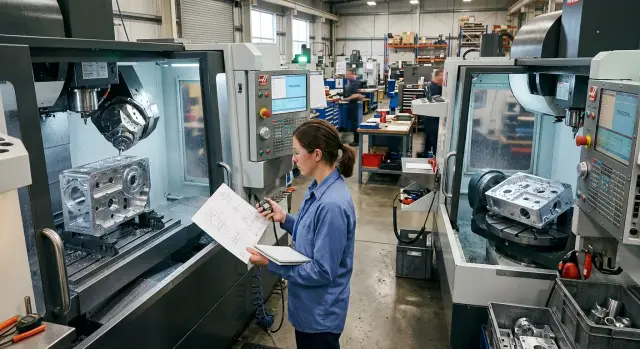
What's the practical difference
The same drawing of a housing part can lead to very different machine layouts. On paper holes, pockets and faces look the same. In the shop, what matters is: from which sides the tool can reach, how many times the workpiece must be re-clamped, and where errors will appear.
When a part needs machining from several sides at different angles, the choice between Axis B and a rotary table quickly becomes practical. One option reduces setups and cycle time. The other can do the job cheaper if the part geometry allows avoiding complex tool tilting.
A rotary table rotates the part itself. The spindle stays in its usual orientation while the workpiece is indexed to the needed angle. This works well when the housing can be clamped rigidly and the necessary surfaces open up without complex tooling.
Axis B works differently: the spindle head tilts. The part more often stays in a single datum while the tool approaches different zones at the required angle. This is especially useful if the housing has angled holes, deep pockets, tight spots near ribs or strict coaxiality requirements between several faces.
The most noticeable differences show up in three things: the number of setups, access to faces and angled surfaces, and accuracy between machined features. Every new setup adds not only minutes but risk. The operator re-fixtures the part, checks tool reach, and verifies dimensions. For a simple part this is acceptable. For a housing with multiple related holes even a small shift later becomes scrap or long rework.
So don’t look at a neat spec sheet—look where the part loses time and money. That might be an extra flip, a complex fixture, a long vibrating tool, or repeated checks after each reposition.
If most operations can be done by rotating the part without losing accuracy, a rotary table usually solves the task more sensibly. If the part breaks the datum and needs the tool brought in at an angle in one setup, Axis B gives a clearer benefit.
When Axis B really helps
Axis B pays off where a housing requires work at different angles, not just on four main sides. This is clear on pump housings, hydraulic blocks, gearbox covers and medical assemblies that have side holes, angled faces, angular fittings and channels that don't fit a simple coordinate scheme.
When the spindle can tilt, the tool approaches the machining zone more directly and with a shorter reach. The operator doesn’t need to re-clamp the part several times, and the process engineer doesn’t need to reach the feature with a long tool through an awkward angle. In practice this often gives a calmer cut, less vibration and a lower risk of spoiling the surface.
Axis B brings a noticeable gain if the part has many holes and faces at different angles, when tight dimensional relations between features on different sides must be met, when the part itself is expensive and mistakes are costly, and when batches repeat so time savings accumulate.
In these tasks the number of setups often drops from three to one or two. That matters not only for cycle time. Each re-clamping changes the datum and increases the chance of shift between holes, faces and fits. When the machine processes multiple zones in one clamp, it better preserves mutual positions of features.
A small example: a housing has a top face, two side holes and another hole at 30°. A rotary table handles the top and sides easily, but the angled channel may require separate tooling or a fresh setup. Axis B solves this more simply: the spindle tilts to the required angle while the part stays put.
Here the debate stops being abstract. If you run many such parts and tolerances between features are tight, Axis B clearly helps. If angled features are rare and most work is on simple faces, the extra kinematic capability often remains unused.
When a rotary table is enough
For many housing parts a rotary table solves the job without extra cost. This is especially true when you need to rotate the whole part and then machine several faces sequentially in one clamp. If the main angles are fixed rather than arbitrary, complex kinematics are often unnecessary.
A good example is a pump or gearbox housing. On one side you mill a base, on two adjacent sides you make holes and threads, and on the fourth you remove a pocket and machine a bore. If this is all at 0, 90, 180 and 270 degrees, a rotary table does the job calmly and predictably.
This option is convenient when the part lacks complex angled channels, curved surfaces or machining at constantly changing angles. For standard housings rotating to fixed faces is often enough; continuous 5-axis motion does not usually bring a significant time gain.
A rotary table also simplifies fixturing. You can clamp the part once on a clear datum and then just index it to the required position. That reduces re-fixturing errors and makes the fixture easier to build and repair.
Maintenance is often easier too. The construction is simpler, the setter can check datums more easily, and the operator can more quickly identify if an error came from the setup, the fixture or the program. For the shop this means fewer disputes and less downtime searching for the cause.
If your work mainly consists of housings machined on three to five faces, with holes and pockets but no complex spatial angles, repeated batches and parts that can be clamped once for the whole cycle, a rotary table is often the most practical solution. It delivers the needed result without paying for capabilities that will remain on paper.
How to calculate the benefit for your parts
Measure the benefit on your recurring orders. Take 5–10 housing parts that load the machine most often in a month. Don't pick a rare complex item as a showcase. You need typical parts your shop runs regularly.
The answer rarely sits in a catalog. It’s in the numbers for your parts: how many times the operator re-fixtures a workpiece, how many minutes are spent on datuming, where a tool has poor access and where inspection after a new setup raises scrap risk.
For each part make two lines in a table: Axis B and rotary table. Compare not only pure cutting time but the whole route through the machine. Five useful columns are: setups per part, minutes for setup and datum check, extra tool changes or long tools due to poor access, time lost on indexing and inspection, and cost of fixturing plus average scrap per part.
Also check access to all zones. If with a rotary table the spindle cannot reach a sidewall or a deep pocket with a short tool, the cycle increases not by seconds but by minutes. That happens often on housings.
Then convert the difference into monthly hours. Multiply extra minutes per part by monthly volume and divide by 60. If a hydraulic block runs 180 times per month and a rotary table adds 7 minutes from an extra setup and checks, the shop loses 21 hours. That’s a noticeable number.
People often count only machine price and cutting time. But money also goes into fixturing for repeated setups and into scrap after re-fixturing. Sometimes one spoiled batch a month eats the advantage that looked good on paper.
If you choose a CNC machining center, ask for a calculation on your drawings and your volumes. When the difference gives less than 4–5 hours per month, paying extra for complex kinematics usually won’t pay back. When 15–20 hours accumulate and setups drop, the picture changes.
Example with a typical housing part
Consider an aluminum housing about 220 x 160 x 110 mm. On top it has a pocket with two openings, sides have M8 and M10 threads, inside there are several walls, and one side has a transverse channel that must be machined close to an edge. On such a part the difference between the two schemes becomes very visible.
On a machine with a rotary table the route often looks like this: the blank is placed in a fixture, datumed and in one setup you machine the top—face, pocket, openings and some holes. Then the table indexes 90° and you do side holes and threads. Then you rotate again for the opposite side. If the channel goes low near a tall wall, the operator often must use a longer tool to reach under a vertical spindle. Sometimes even that is insufficient and the part is re-fixtured again to open the problem zone.
Each such step eats time. The table swing is quick, but after it you must check reach, safe approach and sometimes re-measure a point and reduce feed in a tight place. A long cutter or drill brings its own problem: the tool deflects more and the risk of hitting the part with the holder grows near walls.
With Axis B the housing can stay in one low, rigid clamp. The spindle tilts to the side zone and approaches the channel at a comfortable angle. This often lets you use a shorter cutter and a regular drill without extra overhang. In tight geometry that yields clear benefits: fewer idle approaches, fewer checks and fewer cautious passes “just in case.”
If you sum it up, the difference comes down to four things: number of setups, tool length, risk of touching a wall and actual cycle time. It’s the last one that decides which option is more profitable, not the number of axes on the spec sheet.
Assume net cutting takes 24 minutes. On a rotary-table machine you might add 10–14 minutes for indexing, checks and careful passes with a long tool. On Axis B the same zones can sometimes be done with an extra 6–8 minutes. For one part that difference looks moderate. In a run of 100 housings it becomes many machine hours.
When the extra cost won't pay back
Expensive kinematics don't always pay off. Start by looking at the part route, not the machine spec. For simple housings machined on three or four sides a rotary table often finishes the job with no notable time loss.
Overpay rarely returns in shops with small, mixed batches where parts change constantly. Today a pump housing, tomorrow a bracket, then a one-off revision. In such work profit is eaten by setup hours, finding datums, changing clamps and checking the first piece, not by axis tilt.
Another common mistake is buying an expensive 5-axis configuration and then using it as a standard CNC center. The operator indexes the part to fixed positions, runs standard cycles and barely uses complex trajectories. Expensive features remain on the spec sheet, not in daily work.
Overpay rarely returns if most housings have faces, holes, threads and pockets on three or four sides, if re-fixturing takes longer than cutting, if fixtures are weak or too universal and the datum floats, if programmers and operators rarely prepare continuous 5-axis paths, and if batches are small and non-repetitive.
A simple example: a small aluminum housing with side holes, a top bore and bottom relief. If it can be done in two setups or one indexed rotation, Axis B won't dramatically increase throughput. Much more often the solution is a good table, a rigid fixture and a clear datuming scheme.
Spend money where the shop loses it every day: good fixtures, a probe, tooling, training for the setter, or a larger tool crib. If most housings don't require continuous 5-axis cuts, an expensive tilting axis will idle and payback stretches over years.
Mistakes when choosing a configuration
Often a machine is purchased with headroom that then sits unused. For housings this is especially visible: catalogs encourage the most flexible option, but in the shop most parts run on simple indexed positions and repeatable setups.
When comparing two schemes people look at what the machine can theoretically do, not at the surfaces their parts actually have every day. If a housing has some angled holes and side access, it doesn't automatically mean you can't handle it with a rotary table. Sometimes a rotary table covers the job more calmly and cheaply.
A second common error is counting only the machine price. After purchase expenses on fixturing, chucks, holders, probes, tooling and sometimes CAM tuning for complex kinematics quickly appear. The difference between the two options grows, although it seemed acceptable in the quote.
Another underestimated factor is tool length. In deep pockets and bores a long cutter loses stiffness quickly. Surface quality degrades, feeds must be reduced and cycle time rises. If the part is tall and access awkward, consider not only the tool path but how the tool behaves in cutting.
There is also a practical oversight: training. Complex kinematics give more freedom but require more confident setup, collision checking and postprocessor understanding. If operators and setters are used to a simpler scheme, the learning curve costs time. Not a fatal problem, but an added expense.
Before buying, verify four things: which parts load your machine most, how many setups you can realistically remove, which tool lengths are needed for the deepest zones, and how long first-batch setup will take.
Another mistake is basing the decision on one showpiece—the most complex part. For a series that’s a poor guide. If batches run regularly, focus on total cycle time, dimensional stability and ease of re-fixturing. Axis B can look impressive on one part but deliver little for twenty similar housings per month.
Quick check before ordering
Before ordering look at the last 15–20 real orders, not the single most complex drawing. Such a sample usually shows quickly whether you need Axis B, a rotary table, or a simpler solution.
If most housings are machined in one or two clamps and angles are almost always 0, 90 or 180 degrees, expensive kinematics rarely pay back. If parts are repeatedly re-fixtured, datums re-found and dimensions checked after each rotation, the extra convenience and time savings are meaningful.
Five honest questions to answer:
- How many faces do you actually finish in one clamp versus how many require re-fixturing?
- Do orders include angled holes, slanted pockets or surfaces that are hard to reach with standard fixturing?
- How often does the operator remove and re-clamp a housing between operations?
- How many minutes are spent on setup and re-datuming rather than cutting?
- What percentage of orders constantly demand complex angles versus only a few times a year?
If four out of five answers are "often" or "many", a simple rotary table may already be insufficient. If complex angles are rare and most work is on standard faces, paying more for complex kinematics often stays in the supplier’s quote.
A simple rule: when angled features appear in at least one in three batches and re-fixturing costs 20–30 minutes per cycle, 5-axis processing starts to show a clear advantage. If most orders are housings machined on straight faces, a CNC center with a rotary table usually covers the job without extra cost.
A quick check example: you make a pump housing with main faces on top, threads on the side and one angled channel. If that angle is rare, a rotary table can work without big losses. If there are several such places and they repeat in series, Axis B removes extra setups and smooths the process.
Before buying ask your process engineer to calculate not only cutting time but all stops between operations. That's where money is usually hiding and where the decision about payback is made.
What to do next
Don't pick a layout from a catalog or based on someone else’s experience. For housings the difference shows only on your operations: where extra re-fixturing appears, where tool approach eats time, and where error risk grows.
First collect one clear data package: drawings with dimensions, tolerances and datums, photos of the finished part and current fixtures, a process route with operation times, material, batch size, shift loading and problem points like long setup times, scrap or hard access.
Then ask the supplier to compare the two schemes on those exact parts, not "on average." Ask them to show number of setups, estimated cycle time, where long tools are needed and how collision risk changes. When calculations are done on the same parts the difference is usually obvious.
Look beyond machine price. Money often goes into commissioning, training, tooling, postprocessor work, tool stock and future service. Buying a cheaper machine doesn’t mean you’ll have it running fast in a month.
Ask the supplier direct questions: who will commission the machine on site, how long will startup take, is there local service, and which spare parts are available quickly. For production these are not small details but common sources of delay and cost.
If you want a concrete calculation, EAST CNC usually examines drawings, typical batches and the process route rather than a generic spec. That makes sense: the company handles supply, selection, commissioning and service, so the assessment can include how the machine will fit your shop, not just its price.
A final check is simple: compare both schemes on the three to five most frequent housing parts. If the gain is only a few percent, overpay rarely returns. If the new layout removes two re-setups and noticeably shortens cycle time, the decision becomes much clearer.
FAQ
What is usually better for housing parts: Axis B or a rotary table?
For simple housing parts, a rotary table is usually enough. If machining is done on fixed sides and there are no complex angles, it solves the job more cheaply. Axis B makes sense when a part needs machining at different angles in one clamping and when extra re-setups already hurt time and accuracy.
When does Axis B really pay off?
Axis B pays off where there are angled holes, deep pockets, tight zones near ribs, and strict coaxiality requirements between different faces. If such parts appear in series, savings add up quickly: fewer setups, shorter tools, smoother cutting and lower scrap risk.
In which cases is a rotary table sufficient?
If a part is machined at 0, 90, 180 and 270 degrees and there are almost no complex angled channels, a rotary table usually covers the work without extra cost. This suits repeated housings like pump or gearbox casings where you clamp once and just rotate the part.
What affects accuracy between sides of a part the most?
Accuracy between sides is affected more by the number of re-setups than by the axis name. The fewer times an operator un-clamps and re-clamps the part, the easier it is to keep hole, face and fit relationships. If Axis B allows more operations in one clamping, it usually improves relative accuracy. If a rotary table already lets you do everything in one setup, the difference can be small.
How to quickly calculate the benefit for my parts?
Take 5–10 parts your shop runs most often and compare two routes for each. Look not only at cutting time but at the whole cycle: number of setups, minutes spent on fixturing, where long tools are needed and where extra inspection is required. Then convert the time difference into monthly hours. That shows the real load for your orders.
Is it worth buying Axis B for one complex part?
Usually no. It's better to focus on the parts that make up the main load, not one showcase item. If complex geometry occurs rarely, expensive kinematics will sit idle. In that case invest in fixturing, probes or tooling instead.
Why does tool length affect the cycle so much?
Because long tools lose stiffness. They vibrate more, hold dimensions worse, require gentler cutting parameters and raise the risk of hitting a wall with a holder. If Axis B lets you reach the zone with a shorter tool and a better approach, cycle time often drops by itself.
Which costs are most often forgotten when choosing a configuration?
People often count only the machine price and forget tooling, probes, holders, training, CAM setup, postprocessor, commissioning and service. That makes the initially cheaper option more expensive when you run it in production.
What monthly savings look convincing?
If the difference gives less than 4–5 hours per month, paying extra for complex kinematics usually takes too long to pay back. When you save 15–20 hours per month and remove one or two setups, the picture changes significantly. Always consider scrap and dimensional stability, not just minutes of cycle time.
What should I ask the supplier before ordering a machine?
Ask for a calculation on your drawings and your batch sizes. You need clear numbers: number of setups, cycle time, tool length in difficult zones, setup time for the first batch and collision risk. Also clarify who will commission the machine locally, how long commissioning takes and what service coverage exists in your region. For EAST CNC, this review is done on real parts because supply is only part of the task.