
Automatic Lathe or Universal CNC Lathe: How to Choose
We break down when an automatic lathe or a universal CNC lathe is the better choice: batch size, setup, material, lead time, and shop workload.
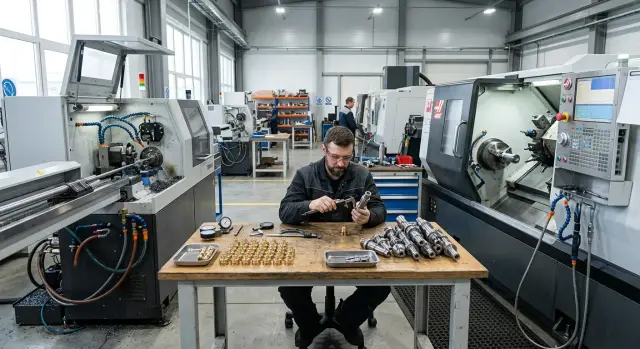
Where the choice starts
When people decide between an automatic lathe and a universal CNC lathe, they should look not at the machine’s spec sheet, but at the job itself. The same drawing can produce a very different cost if the batch size, changeover frequency, and material requirements change.
For a small run, the cost of a part often depends not on cutting speed, but on how long it takes to reach the first good part. The setter installs the tool, positions the blank, makes a test pass, measures the size, and applies corrections. If the batch is only 50 pieces, those minutes and hours have a strong effect on the cost of each part.
When the batch grows to 5,000 pieces, the picture changes. Preparation still takes time, but now it is spread over a much larger volume. In that case, a machine that takes longer to prepare may turn out to be more profitable if it then produces parts steadily, one after another, with less operator involvement.
Many people only count the machining cycle and ignore the time between the first part and the next one. That is often where the money is lost. The shop spends time changing bar stock or blanks, bringing the tool in, checking the first parts, clearing chips, changing jaws, and adjusting the program after the first measurements.
It helps to answer four simple questions:
- how many parts are needed now, not "someday later"
- will the order repeat every month
- how many different operations are needed in one setup
- how often the material changes from one order to the next
A wrong choice is usually not obvious on the day of purchase, or even on the first order. At first everything seems manageable: the part runs, dimensions hold, and scrap stays low. Then the shop schedule starts to reveal the problem. One machine is in changeover too often, another keeps the operator busy with simple tasks, urgent jobs get pushed back, and short runs start interfering with long ones.
Put simply, the choice starts with two numbers: how many parts are in the batch and how many minutes the shop loses between jobs. Only after that does it make sense to compare the machine type, tooling, and material for turning operations.
What jobs usually go to an automatic lathe
An automatic lathe is often chosen for repeat parts where the sequence of operations barely changes from piece to piece. These are usually bushings, pins, fittings, shafts, small housings, and similar items that run in long series and do not require constant manual adjustment.
This kind of machine performs well where the cycle has to stay within a narrow time range. If one part comes out in 2 minutes 40 seconds and that rhythm does not drift during the shift, it is easier for production to plan workload, delivery dates, and cost. For serial orders, that often matters more than flexibility.
An automatic lathe works best on parts with a clear and repeatable machining scheme. For example, external turning, facing, drilling, grooving, and threading. When the route is stable, the machine runs steadily for a long time and does not require frequent stops.
There is another point that many people remember too late. On an automatic lathe, a setup mistake quickly becomes expensive. If the setter shifts a tool once or misses a dimension, the risk is not limited to one part, but to the entire batch. That is why these jobs are best suited to parts with an already proven drawing and a process verified on the first pieces.
Automatic lathes are usually used for jobs with these characteristics:
- the part is repeated in a large batch
- the operations are short and identical
- the cycle must stay stable throughout the shift
- machine downtime costs more than a long initial setup
- scrap in the series must be kept to a minimum
Another typical case is a shift where the machine has to run for a long time without frequent stops. If the shop needs to process a batch for many hours in a row, an automatic lathe is often more convenient than a universal center. It is not as good when the order changes every day, but it is very strong when the same part has to be produced consistently, predictably, and without unnecessary fuss.
When a universal center wins
If the choice is between an automatic lathe and a universal CNC lathe, the universal center usually wins where the product mix changes every week. It does not always give the shortest cycle on one specific part, but it handles frequent job changes better.
This kind of machine is convenient for small and medium batches. Today the shop machines 80 bushings, tomorrow 40 shafts, and the day after that it runs a trial batch of housings with two nonstandard transitions. On an automatic lathe, that kind of turnover quickly eats up changeover time. A universal center usually handles such shifts more calmly.
Frequent changes in dimensions and tooling also work in its favor. If the operator regularly has to change jaws, tools, stickout, the program, and the datum, flexibility matters more than a record-breaking time per part. Losing 15 seconds in the cycle is sometimes cheaper than spending half a day on a new machining scheme every time.
A universal center is especially useful when the part keeps evolving until the very end. The designer adjusts a dimension, the technologist adds a chamfer, or the customer asks for a groove or a second operation. These changes are often inconvenient on an automatic lathe. On a universal center, they are part of normal work.
It works best in these cases:
- the batch is small, but there are many part numbers
- drawings change during the order
- the part has complex geometry or several transitions
- the shop needs to switch quickly between different materials and series
There is also a simple practical sign. If the master machinist is thinking every day not about squeezing a few more seconds out of the cycle, but about how to finish different jobs without idle time, they usually need a universal center. It gives the shop freedom: taking urgent work, launching test batches, and making adjustments without separate long preparation.
This is especially visible in contract manufacturing and in shops that do not have one permanent part lined up for the next month. There, the winner is not the fastest machine, but the one that slows the workflow less every time a new order arrives.
Where the batch-size boundary lies
The same 500 parts can lead to different decisions. One order goes easily to an automatic lathe, while another is more profitable on a universal center even if the quantity is large.
In the debate between an automatic lathe and a universal CNC lathe, the boundary is often not the number of parts, but how many times you will have to reset the machine. If the batch is large but needs long preparation, complex setup, and a separate tooling set, the benefit quickly fades. If the order repeats often and runs with almost no changes, the automatic lathe starts to work much better.
Look at two times separately. First, how long it takes to reach the first good part. Second, how long one part takes in the series. It is the difference between these numbers that shows when a long setup begins to pay off.
Imagine a simple case. On an automatic lathe, the first part comes out after 3 hours, but after that the cycle runs in 45 seconds. On a universal center, the setup takes 40 minutes, and the serial part takes 70 seconds. For a batch of 80 pieces, the center is often cheaper. For a batch of 800 pieces, the picture may reverse.
It helps to quickly check four questions:
- How many changeovers will there be for this order in a month?
- Will the same part return in a week or in six months?
- Can the time to the first good part be reduced with ready-made tooling?
- Can similar parts be run under one setup?
The last point is often underestimated. If you have several similar bushings or shafts with one bar diameter, similar cutters, and the same chuck, they can sometimes be combined into one production scheme. Then even a medium-sized batch of CNC parts starts to look like a series, not a set of separate launches.
Order repeat frequency changes the calculation more than it seems. A one-time batch of 300 parts and a monthly batch of 300 parts are not the same thing. In the second case, you are no longer paying the full price every time for process search, tool checking, and test parts. Part of the work has already been done.
Put simply, an automatic lathe likes stability: identical parts, frequent repeats, and minimal changes. A universal center tolerates variation better. It usually wins where batches fluctuate, drawings are often revised, and machine changeovers eat too much time.
How to calculate changeover time step by step
Changeover is often calculated too narrowly: remove the old tool, install the new one, load the program. In reality, it also includes the test part, measurement, correction of offsets, material change, and even pauses while the operator waits for the blank.
If you are comparing an automatic lathe and a universal CNC lathe, do not count only the "pure setup." Count the full period from the last good part of the old job to the first stable series of the new one.
It is easier to use the same method for both options.
- Record the preparation time. This includes removing and installing tooling, tools, jaws, collets, program loading, coolant setup, warm-up, and entering offsets.
- Measure the time to the first good part separately. This is not the same as the cycle time in a series. The first part often takes longer because of test passes and dimension checks.
- Add everything people usually forget: inspection after the first part, tool changes due to wear, feeding bar stock or single blanks, chip removal, and batch marking.
- Turn the calculation into a time period. See how much time is spent per shift, per week, and per month if there is not one changeover but several.
The formula is simple: total time = setup + time to the first good part + auxiliary operations + losses during series start-up.
Where mistakes happen most often
The most common mistake is taking the cycle time from the machine brochure and assuming it will remain the same on a real batch. On an automatic lathe, the series may run very fast, but if the order changes every day, the advantage fades. On a universal center, the cycle may be longer, but switching to a new part is easier and faster.
There is a second mistake as well: not separating first-part inspection from series inspection. If the operator measures the first part for 12 minutes and then every tenth part for 40 seconds, those are two different time items.
A small example. Suppose the automatic lathe requires 2 hours 20 minutes to start a new order, while the universal center needs 55 minutes. But in the series, the automatic lathe makes a part in 50 seconds, and the center in 1 minute 35 seconds. For a batch of 80 pieces, the center may be cheaper in time. For a batch of 800 pieces, the automatic lathe will almost certainly recover the longer setup.
That is usually how it is done in metalworking practice: not by feeling, but by the total number of minutes over a period. For machine selection at EAST CNC, this approach is also the fairest, because it immediately shows where you lose time every day, not just on paper.
How material changes the decision
The same drawing can behave differently already at the blank stage. If the part is turned from straight bar stock, the machine works predictably. If a forging or a round stock with varying allowance goes into production, the cutting conditions have to be handled more carefully, and it is better to leave a larger time cushion.
For the topic of an automatic lathe versus a universal CNC lathe, material often matters just as much as batch size. An automatic lathe likes repeatability: stable bar diameter, predictable chips, and even hardness along the length. A universal center usually handles blanks with uneven allowance or harder sections more easily.
Bar stock is convenient when long series of small and medium parts are needed. Feeding is continuous, with fewer pauses, and the operator can keep the cycle uniform more easily. A forging behaves differently: on the first passes, the tool takes shock loads, and the actual metal removal can vary from part to part. A round blank from rolled stock sits somewhere in the middle: it is easier to machine than a forging, but it still does not always offer the same stability as calibrated bar stock.
Hard materials quickly show the difference between machines. Stainless steel, heat-resistant alloys, or simply steel with high hardness put more load on the tool and spindle. On an automatic lathe, this is noticeable in a long series: wear grows, size has to be checked more often, and any unplanned stop hits output. A universal center often loses on speed in this kind of work, but gains in tolerance for difficult cutting.
Another hidden factor is chips and heat. In a short order, they are easy to underestimate. In a series of 500 or 1,000 parts, long sticky chips begin to interfere with removal, heat the tool, and reduce dimensional stability, especially on thin sections of the part.
A simple guide:
- Stable bar stock geometry usually pushes the choice toward an automatic lathe.
- Forgings and blanks with varying allowance usually justify a universal center.
- Hard materials make cycle calculations more sensitive to tool wear.
- Material quality that varies from batch to batch can ruin the time plan.
The last point is often underestimated. On paper, a batch of CNC parts may look profitable for an automatic lathe, but variation in hardness, roundness, or surface condition quickly eats away that advantage. Then machine setup time no longer feels like the main problem: more money goes into unplanned tool changes, dimension checks, and operator downtime.
A simple example with two orders
A shop received two orders for the week: 300 steel bushings and 40 aluminum housings. This kind of mix quickly shows where it is better to use an automatic lathe and where a universal center is the better fit.
The bushings are fairly straightforward. The part is simple, the batch is decent in size, the material is uniform, and the dimensions repeat. On an automatic lathe, the setter spends more time at the beginning, but then the machine runs in a short cycle and holds the same result from the first part to the three-hundredth.
Let us say the automatic lathe takes 2.5 hours to set up, and the cycle for one bushing is 1.5 minutes. The whole order is completed in about 10 hours. A universal CNC lathe can be prepared faster, say in 50 minutes, but the cycle will be longer, about 4 minutes per part. In that case, the batch would take almost 21 hours. The difference is too clear to ignore.
The housings are different. The batch is small, the shape is more complex, and aluminum often requires calm adjustment of clamping, tooling, and cutting conditions. A universal center is more convenient here: the operator quickly changes the program, jaws, and tools, makes a test part, and immediately starts production.
If the center spends 1.5 hours on setup for 40 housings and 12 minutes per part, the order is finished in about 9.5 hours. If the same order is sent to an automatic lathe, 4 to 5 hours can be lost just in preparation. The cycle time itself will not save the situation because the batch is too short.
That is how the practical boundary for CNC part batches is usually drawn. For 300 bushings, a short cycle and repeatability matter more. For 40 housings, fast machine changeover matters more.
A wrong choice can be deceptive. The machine is busy, the people are busy too, but the plan is not being met. If the housings are put on an automatic lathe, it takes too long to prepare for a small batch, and the bushings wait their turn. If the bushings are assigned to a universal center, the order will run, but it will consume almost all of the shift capacity.
Mistakes that make the choice more expensive
The most expensive mistake is looking only at the purchase price of the machine. The machine itself may cost less, but that does not mean the order will be cheaper. If the equipment sits idle between batches, and the operator changes tooling and the program several times per shift, the shop loses hours, not just a few percent in the price list.
The debate between an automatic lathe and a universal CNC lathe often comes down to exactly that. An automatic lathe is great when parts run for a long time and consistently. But if you need one part today, another tomorrow, and then another small batch with a new size the day after that, frequent changeovers quickly eat up the advantage.
The same mistake happens in shops of different sizes: they buy an automatic lathe for infrequent orders because it is faster in series. On paper it all looks logical. In reality, two or three part changes per day turn a fast machine into an expensive source of downtime.
There are four signs that the choice is heading in the wrong direction:
- the shift is filled with short orders rather than a series
- changeover takes a noticeable part of the working day
- the first good part is not obtained right away
- the material behaves inconsistently in a long series
People especially often misjudge the first good part. Many count only pure machine time and forget how much time goes into a test pass, measurement, correction, and repeated checking. If the operator spends 25 minutes before the first good part and the batch has 40 pieces, that is one economy. If the batch has 4,000 pieces, it is a completely different one.
Material is also easy to underestimate. In a short run, brass, aluminum, and ordinary structural steel often do not create surprises. In a long series, the picture changes. Bar stock may cause different tool wear, chips may start to wrap around, and the dimension may drift after several hours of work. Then the machine that seemed profitable requires extra stops and more inspection.
A simple example: a shop chose an automatic lathe for infrequent orders in stainless steel. The series is small, the parts change often, and the first good part does not come immediately. In the end, the fast cycle does not save the situation. A universal center is often cheaper in this type of work because it handles frequent changes in product mix more easily.
When choosing a lathe, do not add up only the purchase price. Count shift load, time to the first good part, number of changeovers, and how the material behaves in a long series. That is where the extra costs are usually hidden.
A quick check before deciding
The debate over an automatic lathe versus a universal CNC lathe is often decided not by the catalog or the machine price. Usually, it comes down to four numbers from your real work over the month.
The first number is the output of the same part. If you consistently run a large volume without frequent changes in product mix, an automatic lathe usually looks stronger. If batches are small and orders jump from one part to another, a universal center usually gives less downtime and less stress.
The second number is the minutes spent not on cutting, but on preparation. Count everything: tool installation, setup, the first test part, measurements, and corrections. On paper, setup often looks short, but in the shop another 20 to 40 minutes can be added for inspection and small fixes.
It helps to quickly go through these questions:
- How many parts of the same type do you make each month without long breaks?
- How many minutes are spent on setup and checking the first good part?
- How often does the customer change the drawing, size, or tolerance after production has started?
- Which material most often stops work because of chips, tool wear, or unstable blanks?
The third point is often underestimated. If the customer likes to revise the drawing during the job, the automatic lathe loses some of its purpose. It is best where the process repeats. When the tolerance suddenly tightens from 0.05 to 0.02 mm or the groove changes, a universal center is usually easier to adjust without extra fuss.
The same is true for material. Brass, aluminum, and predictable steel behave calmly. Stainless steel, gummy alloys, and blanks with quality variation more often cause stops, long chips, and extra checks. In that situation, not only cycle speed matters, but also how quickly the operator can return the process to normal.
There is a simple rule of thumb. If you have a large repeat order, rare changes, and a predictable material, an automatic lathe is usually justified. If at least two of the four factors keep changing, a universal center is often safer in terms of time and cost.
Before buying or reallocating orders, write down these figures for at least the last 8 to 12 weeks. After a mini-audit like that, the choice usually becomes much clearer.
What to do next
Do not decide by catalog or by habit. Take one real order that the shop handles regularly and break it down into numbers. The argument over an automatic lathe versus a universal CNC lathe usually ends by itself once you see the real cycle time, setup time, and scrap rate.
First, put together a simple table of your orders from the past few months. You do not need every detail, only the ones that change the decision:
- the usual batch size and how often the order repeats
- the part material and how it behaves during machining
- the full setup time, not just the tool change
- the actual cycle time for one part
- losses: test parts, stops, corrections
Then compare two scenarios using the same order. Do not use an "average annual plan." It often hides the truth. One real order of 300, 800, or 3,000 pieces will tell you more than a pretty summary in Excel.
For example, if the batch repeats every month, the material is stable, and the geometry barely changes, an automatic lathe often provides calmer and more predictable work. If orders keep changing in the product mix and the setter is constantly resetting tooling and the program, a universal center often ends up cheaper in practice, even if its cycle per part is a little longer.
If you are choosing a machine for a shop in Kazakhstan, it makes sense to discuss the task with the engineers at EAST CNC. The company works as the official representative of Taizhou Eastern CNC Technology Co., Ltd. in Kazakhstan and helps not only with machine selection, but also with bringing the project to start-up and normal operation in the shop. That is useful when everything looks clear on paper, but questions about material, tooling, start-up, and service come up on site.
Look beyond the machine price. The supplier should help with selection, delivery, commissioning, and ongoing service. Otherwise, the mistake in the choice will show up not on the day of purchase, but six months later, when the shop runs into long setup times, unstable quality, or a service-related stoppage.