
Automatic Deburring in the Cycle Without Manual Finishing
Automatic deburring removes the need for a manual operation after turning and drilling. We'll cover suitable edges, passes, common mistakes and how to verify results.
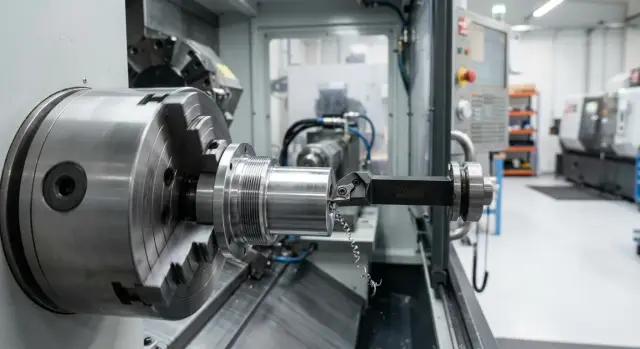
Where the extra manual step appears
The extra manual step usually doesn't appear at the end of the process, but where the tool exits the material or crosses an edge. That's where burrs most often remain and are later removed outside the machine. On CNC lathes it's obvious: the part is almost finished, yet the operator still reaches for a knife, abrasive or file.
Most often the problem appears where the drill exits a hole, after cutting off a part, at intersections of holes and slots, on the face after parting, and on external or internal edges after the finishing pass.
Each burr alone seems small. But those small things add up into extra work. The machine has done the main geometry, while a person spends time on an action that could often be handled in-cycle with a standard tool.
On a single part it may not be noticeable. If an operator spends 20–30 seconds on one edge, the shop section barely feels the loss. But in a run everything changes quickly. A batch of 300 parts turns those seconds into hours of repetitive manual finishing, slowing throughput without improving size or shape.
There is another problem: manual finishing is rarely consistent. One operator removes the burr lightly, another presses harder and changes the chamfer, leaves a scratch or nicks an adjacent surface. As a result the shop gets extra variation where the program should provide repeatable results.
It's especially annoying when the manual step appears on simple parts. For example, a bushing after drilling and parting is ready for the next stage, but it's held up by one sharp edge. The machining takes a couple of minutes, then the part sits in a bin waiting for someone to remove the burr by hand.
If this happens every day, it's not a minor process defect but a steady time loss. Automatic in-cycle deburring shows the biggest effect in such places because it removes the extra action people are used to.
Which burrs can be removed in-cycle
Programs typically target not heavy burrs but the ordinary burr left after cutting. If an edge is slightly raised but the metal hasn't torn or pulled, it can often be removed on the same machine with a couple of short passes. That's the point of automatic deburring: eliminate small manual finishing where it eats time but doesn't add accuracy.
In-cycle deburring works best where the tool is already close to the edge and no complex approach is required. On turning and drilling operations this usually means the external edge after turning, the internal edge after boring, the drill exit, transitions after grooves or parting, and edges where a slight rounding is enough rather than a precise chamfer.
These zones respond well when the burr is small and repeatable. If on one part the burr is fine but on another it's torn and stubborn, the cause is usually the cutting itself: a dull tool, wrong feed, or poor exit from the material.
A simple rule: if the operator now removes the burr with two or three movements of a stone or knife, that operation is often removable from the workflow. If they spend a long time blending the edge, leveling torn metal, or rescuing a hole form, a single standard pass won't be enough.
In practice simple parts benefit the most: bushings, rings, flanges, housings with holes and grooves. There manual finishing looks minor but can easily eat tens of minutes per shift.
When a standard tool is enough
A standard finishing insert often solves the problem when the burr is small and the edge is accessible. If the insert already crosses that area during the finishing cycle, a short overrun or a light finishing pass with reduced feed is often enough. In such cases automatic deburring requires no extra holder, brush or manual step.
A good example is an outer face, a shoulder, the entrance to a groove or an outside edge after parting. If the insert exits the edge cleanly and doesn't pull metal, the burr will come off during the finishing pass. This works best on a rigid setup with a sharp tool that has little wear.
On many parts a small chamfer replaces a separate operation. A 0.2 x 45° or 0.5 x 45° chamfer often removes a sharp edge right after the finishing pass. This is convenient on shafts, faces and hole entrances where a sharp edge isn't required by the drawing.
But chamfers don't solve everything. If the part must have an almost sharp edge, if the chamfer size is tightly constrained, or if there's an adjacent seating surface, an extra pass may harm geometry. In that case a different mode or a specific method is needed to deburr in-cycle.
Material greatly affects the outcome. Gray cast iron and many carbon steels break the edge cleanly. Aluminum and ductile stainless steel behave worse: the metal pulls and smears on the edge and can leave a thin "tongue" even after a careful pass. In that case a sharper tool, higher cutting speed or an additional light pass helps.
Edge shape also sets limits. One pass rarely helps if the burr hides on the far side of an intersection, inside a deep hole, at a thin wall, or after interrupted cutting. There the tool simply can't reach where the metal has curled.
A simple check: if the tool can see the edge in the same setup and can pass it without risking the dimension, try the standard insert or a chamfer first. If the burr only partly disappears, repeating the same pass many times isn't useful — it's usually a sign that the part geometry prevents removing the burr in one go.
How to integrate deburring into the program
Automatic deburring usually starts not in CAM but by watching the operator. If after removing a part they always touch the same edge, that point should be returned to the cycle. Most often operators manually clean drill exits, faces after parting, groove edges and outer corners after finishing passes.
Take the first part from a batch, mark problem areas with a marker and compare them to the program. This quickly shows where a burr is consistently present and where it depends on tool wear.
Next look at the turret or tool magazine. In many cases no new tool is needed: the finishing insert, boring bar or drill can remove the burr with a short move after the main cut. This is simpler and cheaper than adding a separate manual operation.
The usual logic: finish the main cut, retract to a safe point, make a short low-feed pass along the edge, and retract without dwelling on the edge.
Place the short pass immediately after the operation that creates the burr. The dimension is still fresh, the tool is in position, and cycle time barely increases. On a turned part this might be a 0.2–0.5 mm chamfer after finish turning or a light pass at the drill exit.
Approach and exit should include clearance. If the tool starts exactly on the corner it can leave a mark or break a thin edge. It's better to start 1–2 mm off, touch the edge, run along it and leave, without lingering in one spot.
Check the first part after program changes by hand and eye, not just simulation. If the burr remains, reducing the feed on that pass or shifting the path by fractions of a millimeter usually helps. If the edge becomes too soft, shorten the pass.
On a simple shaft such a trick often saves minutes per batch. On paper it looks small, but over a shift the difference shows.
Which simple passes work best
Most often the burr goes away not because of special tooling but because of one short additional movement in the same program. For in-cycle deburring a standard insert, drill or finishing tool with the right approach and a small extra travel is often enough.
In practice short and clear passes work better than complex cycles. They barely affect cycle time but noticeably reduce manual finishing.
Five passes worth trying
A short chamfer on the tool exit often solves burrs that pull outward when exiting a sharp edge. A light reverse pass along an edge helps on faces and shoulders where a thin metal residue remains after cutting. After drilling it helps to add a short countersink touch, a boring tool touch, or the next tool in the sequence if geometry allows. On the face after parting an additional very small axial offset pass cleans only the edge, not the whole surface. And if the burr sits only in one problem area — for example near a groove or diameter change — a local repeat finishing pass is enough without repeating the whole operation.
The point is the same: the tool should not leave the material abruptly at a sharp boundary. A softer exit reduces the metal tearing. So in-cycle deburring is often a trajectory tweak rather than a new tool.
On a simple bushing it looks like this: finish turning the OD, then a short chamfer, then a light reverse pass 1–2 mm along the edge. After drilling add a small touch at the hole entry. In many cases this is enough to make the operator stop reaching for a scraper.
If a burr remains, don't rush to complicate the program. First check the feed on exit, the length of the extra pass and the cutting edge condition. Often the cause is there.
Example on a simple part
Take a common bushing: OD 38 mm, length 30 mm, 1 x 45° chamfer on the face and a 6 mm cross hole. The part is simple, but manual cleaning often hides in those places. After drilling the cross hole a thin burr appears on the exit; after the finishing pass and chamfer the face may still have a small edge the operator cleans by hand.
Previously the cycle ended the same way: the machine processed the bushing, the operator removed the part, went to a bench and cleaned edges with a knife or abrasive stone. One piece took little time, usually 20–30 seconds. But on a run it became a separate operation plus inconsistent results from part to part.
The solution was not a new tool but one short pass in the program. After drilling the cross hole we added a light finishing pass on the OD in the hole area with about 0.1 mm allowance and reduced feed. This cut the raised ridge around the hole. Immediately after, the insert took one more pass on the face chamfer after all operations so no thin burr remained on the edge.
The sequence became: drill the cross hole, short finishing pass on the OD in the hole area, and final chamfer pass.
On a batch of 200 bushings the difference was noticeable the first day. Previously the operator spent about one and a half hours on manual cleaning. After the program change the machine added about 8 seconds per part. Overall the shop saved almost an hour, and the edge became more consistent because the machine formed it instead of a hand.
The operator stopped doing the most annoying part between cycles: picking each bushing, feeling for a burr, cleaning the hole, checking the edge again and only then loading the next blank. He simply removed the finished part and loaded the next one.
This worked because the burr was thin and the drawing allowed a small finishing cut on the OD. If the drill already tears the metal or the burr is thick, one pass won't fix it. But on simple bushings automatic in-cycle deburring often starts with such small cycle tweaks.
Mistakes that leave the burr
Most often the issue isn't the lack of a special tool. The burr remains due to small errors in the program and cutting modes. With automatic deburring this becomes obvious quickly: the part completes the cycle but the edge still catches a finger or glove.
One common mistake is making the chamfer too large. The operator wants to be sure and removes extra tenths of a millimeter, creating a new problem: the edge is clean but the dimension is lost. This is especially unpleasant on mating surfaces. If the burr is small, remove just enough metal for a clean edge, not a large chamfer with safety margin.
The opposite mistake is using the same roughing parameters for the edge pass. High feed and heavy cut will tear the edge rather than clean it. The burr changes shape but doesn't disappear. For that pass use a calm mode and a short, clear trajectory.
Typical misses
Chip flow direction also affects the result. If the chip drags across the edge, the metal can curl again on exit. One side of the part looks fine while the other keeps a thin sharp whisker. This often happens on holes and pockets where the entrance edge was checked but the exit was forgotten.
Another simple error: only checking the first edge after startup. If the part has two working sides, check both. Otherwise the first side will be clean and the second will reveal the problem during the run.
Finally, many add a deburring pass without a proper safe retract. The tool hits adjacent areas, catches chips or runs too close to a shoulder. Sometimes no crash occurs, but edge stability suffers from part to part.
During setup a short check is enough: compare the chamfer with the required size, lower the feed relative to roughing, watch how chips leave the edge, check both entry and exit sides, and leave clearance for tool retract.
On machines supplied by EAST CNC these errors are usually found on the test part: inspect both edges after the first cycle and correct mode or trajectory before the issue becomes a series problem.
Quick check after startup
The first 3–5 parts quickly show whether automatic deburring worked or the operator still needs a scraper, abrasive stone or grinder. Look not only at the edge itself. Often the issue is visible from rubbing marks, chip behavior, and how the part behaves on repeated cycles.
Start with a simple test. Run your finger along the edge without pressing, then lightly drag a cloth. A normal edge won't cut skin or catch the fabric. If the cloth snags or tears at one point, a local burr remains even if it looks clean visually.
Next check dimensions. A chamfer or small radius should be consistent part-to-part. If the first part is neat but the third shows a changing chamfer, the edge pass is too sensitive to tool wear, feed or exit point. Correct the mode immediately rather than hoping the run will be fine.
Watch the chips. If after the edge pass they come off as long ribbons and stay near the part, there is a risk they will curl the edge again or scratch the surface on the next cycle. Sometimes the burr is removed but the process is unstable due to poor chip evacuation.
Another good test is several parts in a row without manual checks between cycles. If the edge stays the same on the third, fourth and fifth parts, the method is working. If the operator still reaches for an abrasive occasionally, the burr wasn't fully removed or the result depends on tool condition.
What to do next on your shop floor
Don't try to change the whole flow at once. Choose one position where the operator manually deburrs a part after the machine every day. If that finishing takes 5–10 minutes per shift, it's worth testing the cycle.
Focus on one problem edge. Manual finishing typically repeats in the same spots: drill exits, faces after parting, grooves, or diameter transitions. In those places automatic deburring often works with a standard tool that's already in the turret.
In many cases a light chamfer, a repeat finishing touch or a short reverse pass with reduced feed is enough. It's better to test this on one part than immediately order a new tool and change the whole process.
The approach is simple: pick the part the operator cleans daily, mark the specific edges with burrs, add one short pass without changing tools, run several parts and compare the cycle to manual finishing. If it works, save it as the standard program.
This often gives quick results. For example, on a simple bushing after drilling and boring the operator usually cleans the edge by hand. Adding a short chamfer at the exit and a light touch after finishing can eliminate manual finishing entirely or reduce it to rare cases.
When the method works, don't leave it only with one setter's notes. Put the pass into the main program, label it clearly and ensure the method is preserved for the next batch. Otherwise the shop will quickly return to the old habit of removing burrs by hand.
If you're selecting a new machine or moving a process to another shop, build these passes in from the start. EAST CNC supplies CNC lathes and machining centers and helps with selection, commissioning and service. At that stage it's useful to discuss where to remove manual steps in the cycle and how to set edge treatment with standard tooling so no extra finishing is needed after launch.