
What spindle assembly delivery time is acceptable?
A method for determining the allowable delivery time for a spindle assembly using downtime cost, failure risk, repair time, and exchange-unit cost.
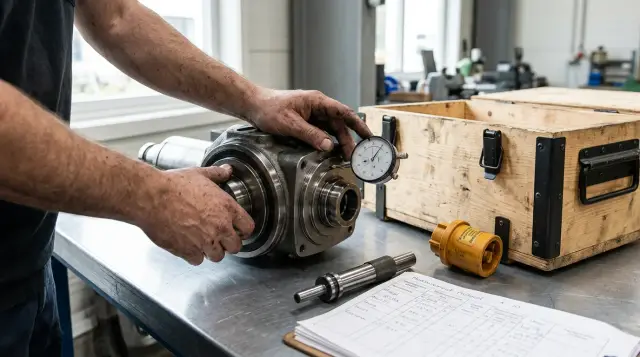
The allowable delivery time for a spindle assembly cannot be set by saying, “usually two weeks.” In continuous production, the limit is set by what the company will lose between the failure and the return of output. For one shop, twenty production days may be reasonable. For another, even two days may be too long.
A practical decision links four values: the cost of each blocked hour, the probability of failure over the chosen period, the total recovery time, and the economic cost of an exchange unit. A fifth value often changes the result more than the others: the actual number of production hours per day that cannot be moved to another machine or covered by finished-goods inventory.
The allowable time is an economic threshold
The limit in days shows when the expected cost of downtime equals the cost of having an exchange unit available in advance. It is not a forecast of actual delivery and not a supplier promise. It is an internal production requirement, after which waiting costs more than the chosen protection measure.
First, define the decision horizon. For a serial order, it may be the duration of the production program. For an annual service agreement, it is usually the contract term. Once a diagnostic warning appears, count only the period until the planned shutdown. The probability of failure must apply to the same horizon. You cannot take an annual probability and multiply it by losses for a month without recalculating it.
You also need to distinguish three similar time periods:
- the time from request to the unit arriving on site;
- the time from shutdown to the machine being mechanically ready;
- the time from shutdown to the first accepted good part.
The third period is the one that matters economically. A machine with an installed spindle is not producing yet if the team has not completed warm-up, runout checks, clamping tests, vibration checks, trial machining, and part acceptance. I have seen calculations where installation ended on Friday evening and the process engineer approved the process only on Monday. The report showed a one-day repair, while production lost three days.
Count production days, not calendar dates. If delivery takes seven calendar days but includes only five working shifts, the model should show five lost production days. On a 24-hour line, there is no difference: every calendar day carries up to twenty-four hours of risk.
The hourly downtime cost starts with lost margin
The hourly downtime cost equals the lost economic result of the entire blocked chain, not the hourly cost of operating the spindle and not the machine's revenue. Overstating this figure makes any spare stock appear profitable. Understating it leads to savings on the unit until a shipment is missed.
A useful expression is:
Cчас = Qчас × Mдет + Cнепер + Cсроч + Cштраф
Here, Qчас is the number of good parts the line will actually fail to produce per hour. Mдет is the contribution margin on one part after excluding variable costs that will not occur during the stoppage. Cнепер includes shift pay, rent, and other costs that cannot be eliminated or moved. Cсроч reflects expected costs for overtime, expedited transport, and schedule recovery. Include Cштраф only when the contract or production plan supports both the amount and probability of a penalty.
If the operation is not the line constraint, use the lost output after redistribution. Suppose a second machine can take forty percent of the program and finished-goods stock covers another twenty percent of demand. In the first hours of downtime, the economic loss may be almost zero. After the stock is exhausted, it rises sharply. One average figure for the entire period will hide that change.
For this situation, split downtime into intervals. For example, work-in-process inventory covers the first eight hours, the next two shifts operate with a sixty-percent loss, and then the line stops completely. Calculate the cost of waiting for each interval instead of multiplying the maximum hourly rate by the entire duration.
Do not include the cost of repair or of the exchange unit in the hourly rate. These are separate cost options that the model compares with downtime. Do not include recoverable revenue if the order can be completed over a weekend without a penalty and without displacing another program. But if moving one batch delays the next one, the loss does not disappear: it only moves on the calendar.
Failure probability must reflect the current condition
You need the probability of failure for the chosen period and the current machining regime. The average service life of the fleet does not answer the question for a spindle with rising vibration, more frequent overheating, or a changed lubrication system.
The best starting point is your own history of identical or comparable units. For each event, record operating hours, operating mode, removal cause, signs before failure, and whether secondary damage occurred. Dividing the number of failures by the number of machines is nearly useless: one machine may have run three shifts throughout the year while another stood idle half the time.
When there are no signs of wear and the failure rate is roughly constant, you can use a simple exponential model:
Pотк(t) = 1 - exp(-t / MTBF)
MTBF and t must use the same units, preferably operating hours. This formula is convenient, but it makes a strict assumption: the risk of the next failure does not increase with age. For a bearing assembly with a developing defect, that assumption is often wrong. Do not hide a lack of data behind a neat exponential curve.
The Siemens Condition Monitoring S guide separates general vibration-condition assessment from frequency-spectrum diagnostics. A trend in RMS values shows deterioration, but locating the damage requires analysis of characteristic frequencies and the envelope. The practical conclusion is simple: one exceedance of the overall level does not provide a reliable failure date, while a sustained trend combined with a confirmed bearing frequency changes the conditional probability.
For a precautionary order, use a stepwise estimate when no precise model exists. Assign a probability to each interval before the planned shutdown, align it with the mechanic, diagnostician, and process engineer, then calculate the result at the lower and upper bounds. If the decision changes with a small shift in probability, the data is not sufficient for a long contract without a backup scenario.
Do not average different operating modes. Heavy interrupted cutting, prolonged operation at maximum speed, and finishing create different loads. A probability obtained for one product mix does not automatically transfer to a new program.
Repair time includes every wait
Total recovery time starts when production loses the ability to make the required part and ends after the process is accepted. The repair technician's working hours occupy only part of that period.
ISO 14224 was developed for oil and gas equipment, not CNC machines, so it should not be presented as an industry standard for spindle service. Still, the standard usefully distinguishes active repair time, total repair time, and restoration time. It also calls for collecting maintenance consequences and downtime. For a shop, this is good discipline: do not confuse hands-on work with the calendar seen by production.
Break recovery into measurable intervals:
- fault confirmation and shutdown authorization;
- removal, packaging, and handover to the carrier;
- transport, incoming diagnostics, and agreement on the defect assessment;
- repair, balancing, return delivery, installation, and acceptance.
A typical failure looks like this. The buyer records five repair days from a commercial quotation. After the failure, the first day goes to checking the drive and sensor, and the second to removal and making a transport support. The carrier picks up the unit on the third day. The service provider starts the five-day period only after incoming diagnostics, then waits for estimate approval and a missing sensor. Return transport, installation, and process acceptance add several more days. The original table shows five days, while the actual shutdown lasts more than two weeks.
To avoid repeating this calculation, store event timestamps for every repair rather than one “duration” field. After three or four cases, you can see where the delay lies: repair, logistics, approval, or the readiness of your own team. An average is risky too. For a continuity commitment, use a duration that covers a poor but observed case, or calculate a separate time reserve.
The formula sets a threshold, not a decision
You can obtain an initial delivery-time threshold by equating expected losses with the cost of an exchange unit. It is suitable for comparing “keep an exchange unit available” with “restore the machine after failure and wait for delivery.”
Cдень = Cчас × Hсут

Dпредел = Cобм / (Pотк × Cдень) - Rбаза
Hсут is the effective number of blocked production hours per day. Cобм is the economic cost of the exchange unit. Pотк is the probability of at least one critical failure over the chosen horizon. Rбаза includes removal, installation, setup, and acceptance that remain necessary even if the unit is available immediately. The result, Dпредел, is expressed in production days.
The meaning of the formula is easier to see from the underlying equation:
Pотк × Cдень × (Rбаза + Dпоставка) = Cобм
If confirmed delivery is longer than the threshold, expected losses exceed the cost of the exchange unit. You then need to shorten the lead time, keep the unit closer to the site, secure exchange stock, or prove that backup equipment will truly remove part of the loss. If the result is negative, even the baseline recovery creates expected losses above the unit cost. That is a strong argument for a prepared reserve, though not automatic approval to buy one.
The formula is deliberately conservative when Cобм uses the full price. An exchange unit does not vanish after installation, and the removed core may receive a credit or return after repair. For annual budgeting, it is more sensible to use the economic cost of ownership over the horizon: cost of capital, storage, preservation, inspections, insurance, obsolescence risk, and the unrecoverable part of the exchange. For a decision after a failure has already occurred, probability equals one, and you should calculate the direct loss from every additional day.
Do not round the result up for purchasing convenience. A result of 6.7 production days means a requirement of no more than six full days if the seventh day already pushes expected losses beyond the established threshold. Determine the calendar equivalent from the schedule of the specific line.
Calculation for a hypothetical production line
This hypothetical example shows the calculation order, but its figures cannot be transferred to another company's budget. Suppose the spindle is installed on an operation that blocks output. After available redistribution, the company loses KZT 450,000 in contribution margin and unavoidable expenses per hour. The line operates twenty effective hours per day.
Over the production-program horizon, the probability of a critical failure is estimated at 0.25. Baseline recovery after a working unit arrives takes four production days. The net economic cost of the exchange unit, including delivery, installation costs, and the expected credit for the removed core, is KZT 24,000,000.
Cдень = 450 000 × 20 = 9 000 000 тенге

Dпредел = 24 000 000 / (0,25 × 9 000 000) - 4
Dпредел = 6,67 производственного дня
The internal requirement will be no more than six full production days from a confirmed request to the availability of a compatible unit on site. If the line runs seven days a week, that is almost the same six calendar days. With a five-day week, the calendar duration depends on the day of failure, so the agreement needs a counting calendar rather than vague “supplier working days.”
Now check sensitivity. If the diagnostician estimates the probability not as 0.25 but as a range from 0.15 to 0.35, the threshold changes from roughly 13.8 to 3.6 days. That spread is too large for one figure in an internal memo. The decision should show both ends and explain what risk management is prepared to accept.
If a neighboring machine can reliably cover half the volume, the cost of a blocked day falls. But you cannot enter that half in the calculation until the process engineer confirms the tooling, program, accuracy, and available capacity. The note “we will move it to another machine” often falls apart on the day of failure: the machine is busy with its own program, the chuck differs, and the inspection operation is not approved.
A reverse check is useful as well. With an agreed six-day limit, the allowable economic cost of the reserve is:
Cобм.предел = 0,25 × 9 000 000 × (4 + 6)
Cобм.предел = 22 500 000 тенге
If the actual offer, after all costs, is noticeably higher, it does not meet the selected assumptions. Then revise the service arrangement rather than adjusting the hourly cost until it produces the desired answer.
The cost of an exchange unit is not the line in a quotation
For comparison, you need the cost of a working, compatible unit at your site, not the factory price without the surrounding conditions. Pay particular attention to an exchange arrangement in which the supplier first ships a refurbished unit and the removed spindle must then be returned for inspection.
The economic cost includes delivery, packaging, customs and nonrecoverable charges, installation, process acceptance, a possible surcharge after inspection of the core, and the cost of required adapter parts. Recoverable tax is not an expense, but it affects working-capital needs. Core credit reduces the price only when the acceptance criteria and maximum surcharge are known.
A cheap exchange unit does not reduce risk if it does not fit the machine. Before signing the agreement, document the housing version, taper type and size, maximum speed, power and torque, drive interface, encoder, orientation, sensors, tool-clamping system, unclamping pressure, lubrication, cooling, and connectors. A base model number can conceal several revisions.
Request test results for the supplied unit itself: runout on an agreed arbor, vibration in specified modes, temperature after warm-up, clamping function, taper condition, and balancing. The phrase “tested on a stand” defines nothing without the mode, measurement point, tolerance, and unit identifier.
The popular advice to buy the cheapest refurbished spindle is wrong for a simple reason: the cost of removing it again, transport, and acceptance may exceed the difference between quotations. Compare the expected cost of restoring output. Warranty length matters, but it does not compensate downtime by itself.
The agreement must measure the path to a good part
The time commitment in an agreement should be split into events with a named owner and verifiable confirmation. A single promise of “delivery in ten days” leaves the start of the clock, completeness, customs clearance, installation readiness, and the response to nonconformity open.
Document the time when the request is confirmed, the response time for availability, the handover point of responsibility, the transport calendar, the document set, and the delivery contents. Separately define time for remote diagnostics, site visit, removal, installation, and process acceptance. If timing depends on the return of the removed core, state whether the replacement shipment proceeds before its inspection.
When sourcing through EAST CNC, it makes sense to provide more than the machine designation: include a photo of the unit nameplate, serial information, an interface map, symptom history, and the required recovery date. This package reduces the risk of ordering the right family in the wrong configuration.
Do not confuse delivery time with readiness to restart. Acceptance should have a measurable result: the machine has completed warm-up, its parameters are within agreed limits, the test part meets the inspection plan, and the responsible person has signed off the result. If the supplier is responsible only for a crate at the gate, secure internal installation resources and tooling through a separate plan.
A delay penalty does not replace a reserve. It is useful for contractual discipline, but it usually does not restore production margin or customer relationships. A critical unit needs two independent answers: who pays for the breach and how the shop will continue production.
Recalculate the threshold whenever the program changes
An approved number of days remains valid only while the underlying assumptions do not change. A new part can increase margin loss, an additional shift increases hours at risk, a backup machine reduces the loss, and a diagnostic trend increases the probability of failure. After such a change, the old time limit becomes an opinion written in a spreadsheet.
The decision record only needs the calculation version, horizon, hourly cost, effective hours per day, probability and its source, baseline recovery time, economic exchange cost, and the resulting threshold. It should also name data owners: production is responsible for output, finance for margin, service for the recovery timeline, diagnostics for condition assessment, and purchasing for the confirmed route.
After every repair, compare the plan with actual results. If five days were lost approving the defect assessment, a new bearing will not fix the procedure. If the exchange unit arrived on time but the team waited two days for a crane and a geometry specialist, shortening external delivery will not solve the problem either.
One metric deserves special attention: the safe remaining operating window after a diagnostic warning. If confirmed delivery is longer than this window, the machine cannot be considered protected just because an order has been placed. Production needs a load-reduction mode, an early planned shutdown, an available backup, or a unit from exchange stock.
Write the allowable delivery time as a requirement with conditions: no more than a specified number of production days at the stated utilization, failure probability, and availability of a backup route. Then the buyer understands exactly what can be discussed with the supplier, and the production director sees the cost of every additional day. The word “urgent” in a request does not provide that clarity.
FAQ
How many days can you wait for a CNC machine spindle?
For a machine that constrains the output of the whole line, the safe lead time comes from a loss calculation, not industry custom. If one day of downtime costs more than the economic cost of an exchange unit, waiting a week is not acceptable, even if the supplier calls that lead time standard.
How do you calculate the hourly cost of CNC machine downtime?
Add lost margin from good parts that were not produced, labor costs that cannot be moved, restart costs, expedited logistics, and expected penalties. Do not use revenue instead of margin, and do not treat every shift hour as lost if some output can move to another machine.
Where can you get the probability of spindle failure?
If better data is unavailable, calculate it from the history of identical spindles and their actual operating hours. A formula based on MTBF applies only when the failure rate is roughly constant. When vibration or temperature is rising, use a conditional estimate based on the current condition.
Can MTTR be used as a spindle repair time?
No. MTTR often combines active work with total recovery time. A spare-unit decision needs calendar intervals from the machine stoppage to the first approved good part, including waits for people, transport, and acceptance.
Is it safe to buy a refurbished exchange spindle?
Usually yes, if the exchange unit has been tested, matches the machine configuration, and has clear acceptance criteria. Unknown history, unverified balancing, or an incompatible sensor can turn a fast delivery into an expensive repeat stoppage.
Is a matching exchange spindle model enough?
No. Check the housing version, taper, drive, sensors, clamping system, lubrication, cooling, connectors, orientation, and acceptance parameters. A matching family designation does not prove interchangeability.
When should a spindle assembly be kept in stock?
If failure blocks a critical operation and the calculated limit is shorter than the confirmed delivery time, holding a reserve is usually justified. For a noncritical machine with an available backup, an exchange or repair agreement with a committed lead time is more economical.
Does a warranty replace a delivery-time commitment?
A warranty defines responsibility for a defect, but it does not automatically restore lost output. The agreement should separately define the time to confirm availability, ship, deliver, install, test, and respond to nonconformity.
How often should the allowable delivery time be reviewed?
Recalculate when the production program, part cost, equipment utilization, failure history, or supply route changes. For a critical machine, a quarterly review is useful, and after every failure the calculation should be updated using the actual timeline.
What should you do after a spindle condition warning?
First, record the unit configuration and confirm whether operation can continue without secondary damage. Then compare three dates: the safe remaining operating window, the full repair time, and the confirmed arrival of the exchange unit.