
5-axis or 3+2: how to choose the part’s machining scheme
When to choose 5-axis or 3+2: compare part geometry, cycle time, fixturing and common mistakes when selecting the machining scheme.
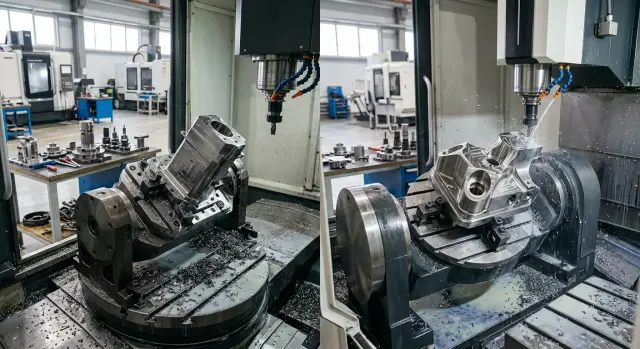
Why the choice often fails
The same part can often be machined either on 5 axes or using a 3+2 scheme. The difference commonly comes down to two things: how many times the part must be re-fixtured and whether the tool can reach the required areas without excessive overhang.
A typical mistake is simple. Someone sees a complex model and immediately sends it to 5-axis machining. Someone else insists on keeping it in 3+2 at all costs because the hourly rate of that machine seems cheaper. Both choices can fail if nobody counted setups, base changes and the risk of accumulating error between operations.
If a part has angled holes, side pockets and several surfaces with strict mutual references, geometry alone is not enough to decide. You can make such a part in 3+2 if the number of indexed positions is small, the bases are stable and the tool reaches without excessive overhang. It will also run well on 5 axes, but only if that actually reduces setups instead of shifting the same work to a more expensive machine.
Before choosing, it's useful to check four things: batch size, tolerances between surfaces from different setups, tool access and time spent on each setup and referencing.
Batch size affects the calculation more than it seems. For five parts it’s often better to reduce manual operations and get the first acceptable part faster. For three hundred parts the picture changes. If in 3+2 you built a simple rigid fixture and the operator repeats the same cycle without long adjustments, the unit cost can be lower.
Machine hourly rates also steer the decision. Looking only at that, 5-axis often seems too costly. But an expensive hour is not the same as an expensive job: if 5-axis removes two setups, reduces inspections between operations and lowers the risk of base-related scrap, the final cost can fall. And the opposite is true: if a part indexes easily and precise surfaces lie within a single base, paying for continuous 5-axis makes no sense.
A good choice starts not with “which machine is better” but with a more down-to-earth pairing: what are the part’s bases, how many times do you touch it by hand, and where will the tool be cramped.
What geometry fits 3+2 well
3+2 works well where a part is made of clear zones with a few fixed angles rather than smooth complex surfaces. If planes, pockets and holes lie, for example, at 0°, 90° and 45°, an indexing table is usually enough. The machine rotates the part to the required position, locks the axes and then cuts like a normal 3-axis job.
For such geometry the tool should enter the zone roughly straight on, without needing a constant tilt during cutting. This is common for housings, flanges, brackets and prismatic parts where several sides must be machined but each side’s toolpath remains simple. If the cutter doesn’t have to skim along a wall at an angle and can keep its attack angle during the pass, 3+2 usually solves the task without quality loss.
A good sign is when a part keeps its dimensions after two or three re-setups. If the bases are clear and tolerances between sides don’t fall apart after reclamping, there is little reason to go to continuous 5-axis. For many production parts this is more practical: setup is easier, programs are shorter and the risk of error is lower.
3+2 is most suitable when:
- there are several groups of holes at different fixed angles;
- side faces have flat pockets and machined flats;
- chamfers and features are taken by indexed rotation;
- finishing does not require a smooth tilt of the axes during the cut.
One more important point is fixturing. Geometry may look “5-axis”, but if the fixture doesn’t block access after two rotations, 3+2 remains a valid choice. Conversely, if jaws, vises or the plate cover half the part, the theory quickly ends.
A simple example: a housing with holes on the end and the side, plus a pocket at 45°. If all surfaces are accessible and finish and size are achievable without continuous axis tilt, there’s no point converting it to full 5-axis. 3+2 does the job calmly and without extra complexity.
When 5 axes give a real advantage
The choice changes sharply when the tool needs access at different angles inside the same zone. If a part has a deep cavity, side walls and closed pockets, 3+2 quickly runs into the limits of fixed orientations.
On such geometry the technologist often lengthens the tool to reach a far wall or a corner by the bottom. Then the familiar chain starts: the cutter vibrates, the wall gets ripples, dimensions drift and feed must be reduced. With 5-axis you can tilt the tool and shorten the overhang. Cutting becomes smoother and the machine holds the surface straighter.
The gain is especially noticeable on parts that in 3+2 require two or three setups. Each reposition adds time for fixturing, inspection and trial passes. Worse, after a new setup it's easy to get a small misalignment between zones. On a housing this shows as a seam at the joint, and the finish surface often needs grinding or polishing.
If transitions between surfaces require a constant tool tilt, 5-axis is almost always more convenient. That happens on curved channels, blades, deep pockets with radiused transitions and inclined ribs. In 3+2 the spindle sits at one angle, machines a section, then moves to another — borders between such zones often show steps or noticeable differences in milling marks. A continuous 5-axis trajectory cuts through these areas without changing orientation, so the surface comes out cleaner.
A good example is a housing with a deep chamber, a side window and angled holes. In 3+2 the operator machines the top, then re-fixtures, re-references and uses a long cutter for the far wall. In 5-axis these zones are often closed in a single setup without excessive overhang. The benefit is practical: fewer re-setups, less risk of dimensional shift, fewer visible seams and less hand finishing after the machine.
How geometry affects cycle time
When choosing between 5-axis and 3+2 don't treat cycle time as a single number. A part’s cycle usually has at least four time components: roughing, finishing, axis rotations and setup changes. Until you split the cycle into these pieces, any comparison will deceive.
In 3+2 the machine stops cutting, rotates the table or head, moves to a safe point and makes a new approach. One such transition often takes tens of seconds, not just a few. If a part has six or eight angled zones, indexing and approaches alone can add several minutes.
Against that, 5-axis often wins not because of continuity itself but because it lets you use a shorter tool. With a shorter tool the machine can run higher feed, vibrates less and requires fewer extra finishing passes. On deep pockets, inclined walls and complex transitions this is immediately visible in both time and surface quality.
But on a simple prismatic part the picture is different. If there is a top plane, a couple of pockets and side holes at fixed angles, continuous 5-axis often gives no noticeable benefit. The metal is removed almost the same way, while setup time and verifying safe positions can eat any gains.
Small batches feel this especially. For one or two parts a three-minute difference in cutting time is not critical if the setup and collision checks take forty minutes. In series production, two extra minutes per part quickly become hours.
Therefore, count CNC cycle time in parts: cutting, indexing, re-fixturing and setup. Such a breakdown usually sobers up any debate faster than arguments.
A short example shows the difference. A housing with two inclined faces easily runs in 3+2: rotate, cut, rotate again. A part with a deep pocket and a radiused wall comes out faster on 5 axes because a long cutter in 3+2 cuts slower and leaves more work for finishing.
Cycle time depends not just on axis count but on how many times the machine stops cutting, how long the required tool overhang is and whether a surface can be completed in one pass instead of several stops.
What happens to fixturing
In the fight between 5-axis and 3+2, fixturing sometimes decides more than the machine itself. If a part can be clamped once and accessed from almost all sides, 5-axis feels more confident. If a part must be firmly located on clear bases and rotated at several fixed angles, 3+2 often proves simpler.
3+2 typically needs more thought-out clamping. Shops quickly build rotary vises, angle plates, prisms, adapter plates and special bases for a part. This is not always bad: such fixtures often provide good stiffness and repeatability but make preparation longer and more expensive.
5-axis asks for something different: not necessarily a complex clamp but free tool access and unobstructed part overhang. If a vise covers a side wall or a plate overlaps a low pocket, the advantages of 5-axis quickly vanish. That’s why simple tall clamps, soft jaws, thin shims or clamping on a machining allowance often work better. The idea is the same: hold firmly but don't block the toolpath.
The problem is that cheap or inconvenient fixturing can eat the whole cycle advantage. For example, a part may be machined in 14 minutes instead of 19, but the operator spends an extra 8 minutes on awkward clamping, alignment and access checks. On paper the scheme is faster, but in the shift it’s not. Worse, a weak clamp causes vibration and forces feed reduction.
Every additional rotation raises the risk of a base-related error. The part is slightly skewed, chips get under a support, the operator over-tightens one side — and the dimension drifts. For 3+2 this is the usual price for machining several faces. For 5-axis the risk is lower if the part is completed in one setup, but only with good access and a clear support scheme.
Before starting, check four questions: how many setups are needed for the whole part, which surfaces the clamp covers, is stiffness sufficient for the required overhang, and how much time is spent on repositioning rather than cutting. Sometimes a new fixture solves the problem better than an expensive tool or switching schemes. A simple plate with accurate bases and normal access can eliminate one rotation and bring more benefit than changing the whole technology.
How to choose the scheme for a new part
It’s better to analyze a new part using the model, not a calculator. If you start counting minutes first, you can pick a scheme that looks good on paper but falls apart during setup due to long tools or extra re-setups.
A convenient order is this. First count surfaces that can’t be machined along the spindle axis. If these are few and lie at a few fixed angles, 3+2 often covers the job without loss. Then mark zones where the tool must be tilted during the cut, not just indexed before the pass. These are usually deep walls, undercuts, complex transitions and places where a long cutter starts to sing.
After that compare the number of setups. For 3+2 write down all real re-fixturings and rotations, not the idealized version on paper. Then do the same for 5-axis. Next find the longest tool in the route and honestly assess its stiffness. If the part requires large overhangs on most complex zones, 5-axis often provides a shorter, stiffer tool thanks to tilt. Only then does it make sense to count cycle time, setup and scrap risk.
A simple rule of thumb: if 3+2 can take the part in two or three setups, the tool remains short and all complex places open on fixed angles, continuous 5-axis may not give a noticeable benefit. You will pay for a more complicated program while time gains remain small.
The opposite is common too. A housing with angled pockets, long walls and an area that a cutter can only reach with overhang is better done on 5 axes. In 3+2 the technologist assembles a route of many rotations, inserts a long tool and faces vibration traces. On 5 axes the same area can be machined shorter, cleaner and with fewer setups.
If you choose equipment or a machining scheme for such parts, look at the specific part geometry. It shows where a continuous tilt is needed and where indexed rotation is enough.
Where mistakes happen most often
Most errors come not from the machine choice but from misjudging the part. A simple part with holes at different angles and open planes is often sent straight to 5-axis, although 3+2 would handle it without a long cutter, complex paths or tricky setup. If the tool enters short and stiff, continuous 5-axis motion may bring no real advantage.
The opposite mistake is costlier. A housing with narrow openings, deep walls and a pocket the endmill can only reach with a long overhang is left in 3+2 just out of habit. In practice you then use a long cutter, reduce feed, chase vibration and do manual finish. For this geometry 5-axis is often simpler: tilt the tool, shorten the overhang and machine the wall cleaner with fewer passes.
Many people count only machine time. On the CAM screen 3+2 can look fast: position, cut, another setup. But then the part is removed, the base checked, re-fixtured and checked again, and actual cycle time for a batch grows by tens of minutes. If a part needs three or four setups, tally the whole route, not only cutting minutes.
Fixturing also frequently breaks a good plan. Universal vises and standard clamps are convenient at the start but can block access to machining zones. The programmer shortens passes, changes angles and adds setups. The scheme is then chosen not by part geometry but by what the fixture allows.
There’s another subtle mistake: overlooking chip evacuation from a deep pocket. For steel and ductile alloys this quickly becomes repeated cutting. The tool heats, the wall gets marks and dimensions drift. If the pocket is deep and the opening narrow, check in advance whether tool tilt and coolant will help or whether chips will still clog.
The error happens when the scheme is chosen by habit instead of by tool access, number of setups and chip evacuation.
FAQ
What is the simple difference between 5-axis and the 3+2 scheme?
3+2 is suitable when the machine indexes the part to the required angle, locks the axes, and then cuts like a standard 3-axis job. 5-axis is needed where the tool must change its tilt during the cut. In practice, the choice usually comes down not to the part shape itself, but to the number of setups, tool overhang and access to the cutting zone.
When does 3+2 usually suffice without losses?
Keep a part in 3+2 when all complex zones lie on a few fixed angles, the fixtures are stable, and the cutter reaches without excessive overhang. This often covers housings, flanges, brackets and prismatic parts. If a part keeps its dimensions after two or three re-setups, switching to full 5-axis usually gives no noticeable advantage.
In which cases is it better to move a part directly to 5-axis?
Consider 5-axis when the part requires a long tool, multiple reorientations, or a constant tilt in the same zone. This is common for deep cavities, radiused walls, curved channels and narrow windows. If 5-axis removes at least a couple of setups and allows a shorter tool, you will often gain both in quality and total time.
If a 5-axis machine hour is more expensive, will the job always cost more?
No. An expensive machine hour alone doesn’t decide the total cost. If 5-axis reduces setups, intermediate inspections and the risk of base-related scrap, the order can become cheaper. Conversely, a simple part with fixed-angle holes may be cheaper in 3+2 because setup and fixturing are easier.
Why does the number of setups so strongly affect accuracy?
Each new setup adds time for fixturing and a chance to shift dimensions between surfaces. On simple parts that risk is manageable, but on housings with tightly related zones it grows quickly. If a part accumulates three or four setups, a technologist should re-evaluate the route.
How does tool length change the choice of scheme?
When a cutter runs with large overhang it loses stiffness. The machine then reduces feed, surfaces pick up chatter, and dimensions start to drift. 5-axis often fixes this: by tilting the spindle you can use a shorter cutter. If a short tool is not needed, there’s usually no reason to complicate the scheme.
What geometry behaves poorly in 3+2?
Surfaces that require a continuous change of attack angle don’t suit 3+2 well. At the borders between indexed zones you often get steps that need extra finishing. For such areas, 5-axis is more comfortable because the tool follows the surface without stopping to reorient.
Can fixturing eat up all the advantages of 5-axis?
Yes. Fixturing can ruin a neat calculation. If jaws, clamps or a plate block a side wall or pocket, the CAM path becomes theoretical and programmers add setups or use a long cutter. A good clamp holds the part rigidly and doesn’t obstruct the toolpath. Sometimes a new plate or soft jaws do more good than switching machines.
What should be checked before the first run of a new part?
First check the real number of setups, the longest tool, and access to cutting zones. Then look at chip evacuation from deep pockets. If, at this stage, many re-setups, weak rigidity or poor access are already visible, rework the route before the first part.
How to fairly compare 5-axis and 3+2 on a new part?
Take the same model, one blank and identical requirements for accuracy and roughness. Compare not only cutting time but also setup, re-fixturing, inspection after each setup and how the tool behaves. This test quickly shows where 5-axis actually removes work and where 3+2 achieves the same result more simply.