
4 or 5 axes for a hydraulic manifold body: how to choose
We explain when 4 or 5 axes deliver the right result for a hydraulic manifold body: hole groups, undercuts, setup time, scrap risk, and unnecessary costs.
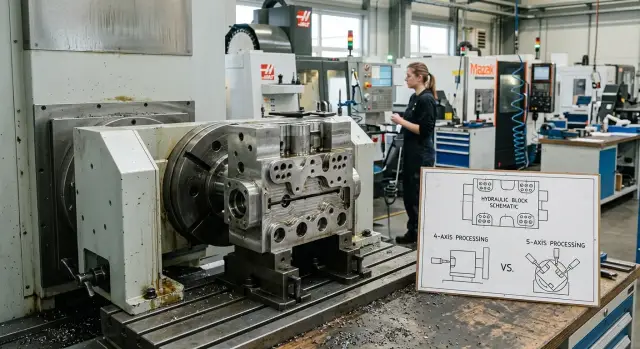
Why a hydraulic manifold body is easy to get wrong
With a hydraulic manifold body, the mistake often starts with the very first look at the drawing. The part seems simple: a rectangular block, a set of channels, a few faces. But the question “4 or 5 axes for a hydraulic manifold body” is almost never decided by the outside shape.
The problem is access. On one part, holes can be on three, four, or even five sides, and some channels intersect inside the body at different angles. On paper, it looks like a normal grid of holes, but in the shop it quickly turns out that some areas need another setup, a longer tool, or a part rotation with very strict control of the datum.
Mistakes also happen when hole intersections are underestimated. If channels meet at an angle, even a small detail affects the result: drill wander, burrs at the intersection, or a difficult tool exit. Because of this, a machining plan that looked cheap on 4 axes starts losing time to re-clamping, checking, and finishing.
Undercuts change the picture even more. As long as they are not there, the part can often be made safely on a 4-axis machine with a well-planned series of setups. But if an undercut sits in a difficult area, a standard tool no longer works. Then the stickout grows, rigidity drops, and accuracy drops with it. Sometimes just one such feature pushes the project toward 5-axis machining.
At the same time, an extra axis by itself does not make the part cheaper. A 5-axis machine can reduce the number of setups, but its hourly rate is higher, programming is more complex, and setup requirements are stricter. If the body geometry can be handled reliably on 4 axes without risking accuracy or time, paying extra for a more complex setup will not pay off.
The worst case is when the decision is made from just one sign. For example, someone sees angled holes and immediately chooses 5 axes. Or, on the contrary, they try to stay on 4 axes at any cost, even though undercuts and difficult areas already make the process stressful and slow. For a hydraulic manifold body, what matters is not the machine headline, but the combination of three things: access to the areas, the logic of hole groups, and the number of setups.
When 4 axes are enough
For many hydraulic manifold bodies, a 5th axis is not needed. If the main holes, threads, and faces are on four sides, the part can be machined confidently on 4 axes with rotation, without extra complexity or extra cost.
This usually works when the body can be rotated without losing the datum. You set a clear reference once, then index the part to the needed angle and continue machining the same hole groups. If you do not have to re-find critical dimensions after rotation, the process stays simple and predictable.
Tool access matters just as much. When a drill, end mill, or reamer reaches the needed area comfortably without a long stickout, accuracy is easier to maintain and the risk of vibration is lower. For a hydraulic manifold body, this is especially noticeable on deep holes: a short, rigid tool is almost always better than a long one.
In the “4 or 5 axes for a hydraulic manifold body” debate, a good rule of thumb is simple: if the channels run along the main axes and there are only a few angled transitions, a 4-axis setup is usually enough. The same goes for pockets that are open from the top or side and do not require the tool to tilt at a complex angle.
A 4-axis approach is usually reasonable when the following conditions are met:
- holes and seats open on the four main sides;
- the body keeps its datum after rotation;
- the tool reaches the machining zones without a long holder;
- there are few angled channels and hidden pockets in the part;
- the batch is not a one-off, and simple fixturing pays back quickly.
The last point is often underestimated. If you are making not one body but at least several dozen, simple fixturing with rigid stops pays for itself quickly. Setup is easier to understand, the cycle is stable, and the operator spends less time on unnecessary checks.
A simple example: the body has main holes on the front, back, and two sides, while the top contains a face and some threads. In such a part, you can move through all the needed areas with rotations without switching to 5-axis machining. In this case, paying extra for 5 axes often brings little benefit, because the geometry can already be handled without workarounds.
When 5 axes justify the cost
5-axis machining is needed not because the part looks “complicated.” It is needed when the geometry of the hydraulic manifold body itself leads to extra re-clamping, long tools, and a risk of missing the relative position of the channels. In that case, the machine costs more, but the cost of an error is usually even higher.
The first clear case is holes at several angles. If channels intersect not only along X, Y, and Z, and some holes run at an angle, 4 axes are often no longer enough. Yes, the part can be rotated and finished in another setup. But after a re-clamp, it is easy to lose accuracy between the channels, especially if the body has tight tolerances for hole alignment.
The second case is undercuts and zones that standard tools cannot reach directly. On 4 axes, you have to find a workaround: use a longer cutter, extend the tool farther out, or change the machining strategy. This almost always hurts rigidity. The tool starts to chatter, the surface quality drops, and the size drifts more than you would like.
5 axes usually justify the cost in parts like these:
- when there are holes at 2–3 angles in one body
- when undercuts block direct access to the cutting zone
- when a long tool is needed only because the approach angle is awkward
- when the body is expensive and scrap after a second setup would hurt badly
The biggest advantage here is a single setup. If the machine can machine more surfaces without removing the part, it holds the relative position of channels, faces, and seats much better. For a hydraulic manifold body, that is often more important than the cycle speed itself. One ruined body from an expensive blank can eat up the price difference between the two approaches faster than you might think.
If you are choosing between 4 or 5 axes for a hydraulic manifold body, look not at the overall shape, but at tool access and how many times the operator will have to re-clamp the body. When there are many re-clamps and the channels must line up precisely, 5-axis machining is no longer a luxury, but a way to avoid paying twice for the same part.
How to look at hole groups
Start by drawing a simple map of the part. Not by dimensions, but by access: top, bottom, side faces, and angled areas. When choosing 4 or 5 axes for a hydraulic manifold body, such a sketch is often more useful than a long table.
Then group the holes by the side from which the tool reaches them. If all the main channels, threads, and seats can be reached from two or three direct directions, the picture is usually calm. If part of the holes run into an angled face or hide behind a protrusion, the complexity rises quickly.
Mark the places where channels intersect separately. For a hydraulic manifold body, this is important: drilling two independent holes is one thing, and bringing them together exactly at one point inside the body is another. Also mark blind zones, where you cannot go through and where an error in depth quickly becomes scrap.
A simple check order works well:
- which holes can be machined from one side without rotating the part;
- which ones require a new setup;
- where two holes must keep strict coaxiality;
- where the chuck, holder, or tool itself may hit the body wall.
Coaxiality is better checked not “in general by the drawing,” but by groups. For example, if the valve hole and the plug bore sit on the same axis, it is better to make them in one datum logic. Otherwise, each new setup adds its own small shift. On paper, that may be only hundredths of a millimeter, but in the real part the channels no longer come together as cleanly as they should.
After that, compare the number of setups for each hole group. If one group is done in one setup and the neighboring one needs two more rotations and separate fixturing, the part cost changes noticeably. Sometimes 4 axes are fully enough, but only if you are willing to accept extra re-clamping. Sometimes one axis rotation on a 5-axis machine removes two problems at once: it holds geometry and saves time.
Another common mistake is to look only at the hole axis and forget about the tool body. The drill may fit, but the reamer holder or boring bar may hit the body. So check not only the entry point, but the entire tool path to the required depth.
If this layout shows 2–3 clear groups without access conflicts, it is usually not worth overpaying. If there are many groups, channels intersect at angles, and coaxiality must be maintained between different sides of the body, the part is already asking for a more flexible machining setup.
What undercuts and difficult zones change
An undercut changes the machine choice faster than another face or a couple of deep holes. The mistake often starts with a simple assessment: people look only at depth and forget the shape. But shape is what decides whether a standard cutter can reach the area without extra risk.
If a pocket runs under a wall, has a small corner radius, or sits next to a partition, a 4-axis setup alone may not be enough. The tool needs to approach at an angle. Sometimes the part can be rotated and the machining zone can be reached from the other side. But sometimes even after rotation, the tool axis still runs into the wall. Then tool tilt is no longer a luxury, but a working necessity.
Tool stickout is looked at separately. The longer it is, the weaker the tool holds size. Chatter appears, surface marks get worse, and the finish suffers. On hydraulic manifold bodies, this is twice as unpleasant: after assembly, any extra roughness near a channel or seat can create a problem that takes a long time to find.
Usually, two paths are compared:
- use a special tool and keep the process on 4 axes;
- rotate the part in the fixture and approach from another side;
- move to 5-axis machining and tilt the tool in the most difficult area;
- slightly change the part geometry, if the designer allows it.
The cheapest option on paper is not always the cheapest in the shop. Special tools cost money, do not last forever, and often hold size worse with a long stickout. Rotating the part is not free either: it needs extra setups, datum control, and operator time. If there are several difficult zones facing different directions, 5-axis machining is often calmer and more predictable.
There is another practical point: how will you inspect this area after machining? If a probe, gauge, or measuring tip cannot reach the surface, you end up with a part that is hard to accept properly. That is why an undercut should be evaluated not on its own, but together with the future inspection method.
For 4 or 5 axes for a hydraulic manifold body, this is often the decision point. If the difficult zone can be machined with a short tool and inspected without tricky fixturing, 4 axes are usually enough. If you need strong tool tilt, a large stickout, and difficult inspection, the savings from 5 axes disappear quickly.
How to choose the setup step by step
Mistakes usually happen not in choosing the machine, but in the order of evaluating the part. If you look only at equipment price, 4 axes will almost always seem cheaper. But for a hydraulic manifold body, the final result is decided not by catalog numbers, but by geometry, the number of setups, and the risk of scrap at each operation.
Start with the input data. You need not only a drawing, but also actual tolerances, channel cleanliness requirements, and the batch size. For a pilot run of 20 parts, one approach may be fine, while for a series of 2000 pieces the same approach will eat a lot of time in changeover and inspection.
Next, count how many sides of the part need machining and how many times the operator will have to re-clamp the body. If the main geometry is accessible from several clear directions, 4 axes are often enough. If there are many setups and each new re-clamp shifts the datum, the cost of error rises quickly.
Then mark the difficult areas separately. This includes angled holes, intersecting channels, pockets, and undercuts. This is the stage where the question “4 or 5 axes for a hydraulic manifold body” becomes practical rather than theoretical. If these areas can be machined with standard tools without extra part rotations, 5 axes may not pay off.
It helps to go through the part in this order:
- Mark all surfaces and holes that require precise alignment with each other.
- Count the setups for the 4-axis setup and for the 5-axis setup.
- List separately the operations that need tool tilt or complex fixturing.
- Compare cycle time, fixture cost, and possible scrap rate.
- Check how much time and money fewer changeovers would save.
After that, compare not the machines, but the full route of the part. Sometimes 5-axis machining wins not by cutting speed, but by removing one or two re-clamps and making the result more stable. Sometimes the opposite is true: 4 axes cover the task without overpaying, if the hole groups are simple and there are no difficult zones.
If you discuss the project with a supplier such as EAST CNC, it is better to bring not only the drawing, but also a setup and batch calculation. Then the conversation goes straight to the point: where 5-axis machining is really needed, and where a well-tuned 4-axis setup is enough.
Where people most often overpay
Overpayment usually starts not with the machine price, but with the wrong decision logic. The “4 or 5 axes for a hydraulic manifold body” debate is often reduced to one question: does the part look complicated or not? You cannot decide that from appearance alone.
Many people choose a 5-axis machine just because the body has many faces, pockets, and channels. But if the main datums are convenient and the hole groups open to accessible sides, four axes often do the job without any loss of quality. In that case, the extra money goes into a more expensive machine that brings no real benefit for this specific part.
The opposite mistake is expensive too. A shop sticks to four axes even though the part has to be re-clamped too many times. Each new setup shifts the datum and hurts coaxiality, especially when several channels must meet exactly inside the body. On paper, that setup seems cheaper, but in reality the shop pays for scrap, hand fitting, and a slow start-up.
People also often forget to count not just the machine and the cycle, but everything around them. Fixturing, soft jaws, special datums, test parts, and setup time can easily change the project economics. It can happen that a 4-axis option needs two fixtures and a long adjustment, while the more expensive machine pays back the difference on the first batch.
Another quiet source of extra cost is inspection. If the probe cannot reach a difficult area, the operator removes the part, takes it for separate measurement, and then mounts it again. That wastes time and accuracy. For hydraulic manifold bodies, this is especially painful because an error may only show up after channel-intersection inspection.
Money is also lost when people do not think one step ahead. The designer later changes the approach angle, adds a thread, or shifts one hole, and the old setup no longer works without reworking the fixture. If such changes are likely, a setup that is too tight on the edge of its capability quickly becomes expensive.
In practice, equipment suppliers, including EAST CNC, usually look not at “complexity in general,” but at the actual geometry of the part, tool access, and the inspection method. That approach is less flashy than choosing from a catalog, but it protects better against overpaying.
A simple example for a real part
Imagine a hydraulic manifold body for a construction machine. It has three groups of straight channels: from the top, from the side, and from the end face. Another channel runs at an angle to connect two cavities by the shortest path. When deciding whether 4 or 5 axes are right for a hydraulic manifold body, the size of the part is not what matters most, but the channel geometry and tool access.
On a 4-axis setup, this part can be made. First, the datum and the top hole group are machined. Then the body is rotated for the side channels. After that, one more re-clamp is often needed to reach the end face confidently and hold the size on the angled channel through the fixture or an angle head. In total, that means two re-clamps beyond the first setup.
For a small batch, that is not always bad. If you need 10 or 15 parts, a 4-axis option often looks good both in cost and launch time. The fixture is simpler, the program is shorter, and the time difference per part is still not that noticeable.
The problems start later. Each re-clamp adds a new datum reference. The operator re-finds the body position, and the error builds up a little between hole groups. If channels must meet exactly in one zone, even a small shift can ruin the part. Scrap is expensive here: from the outside, the body looks fine, and the problem only appears during leak testing or assembly.
On a 5-axis setup, the part is often finished in one clamping. The body is clamped once, after which the machine itself brings the tool to the top, side, and angled channels at the right angle. 5-axis machining does not make every operation magically fast, but it removes two re-clamps, lowers the risk of shift, and keeps repeatability much steadier.
That is why for a one-off or small batch, 4 axes are often enough. For repeat orders, the picture changes. If that body is produced in series, even in lots of 50, a 5-axis machine often saves more than it seems at first: less setup time, fewer checks, and less scrap from mismatched channels.
Quick check before making a decision
The mistake usually happens not when buying the machine, but earlier — when the part is judged too roughly. For the topic “4 or 5 axes for a hydraulic manifold body,” a short check is enough: look not at the overall size of the body, but at the geometry of the zones where the machine must hit accurately and without extra re-clamping.
First, count the sides of the part that need precise access. If all critical faces and holes can be machined reliably in 2–4 setups without losing the datum, 4 axes are often enough. If accuracy holds only with complex part rotations, extra setups quickly eat up the savings.
What to check on the part itself
- How many sides require precise machining in one coordinate system.
- Whether there are intersecting holes at an angle where coaxiality and a clean channel exit matter.
- Whether there are undercuts, narrow pockets, or areas where a straight tool runs a risk of hitting the wall.
- How many setups you are really planning, not just “ideally on the drawing.”
- What will cost more in your case: 5-axis machining, or a batch with scrap, finishing, and lost time.
Angled holes often decide the debate. If channels intersect inside the hydraulic manifold body on different planes, every new setup raises the risk of shift. On paper, the deviation may look small, but in the finished part it becomes sealing problems, burrs inside the channel, or long manual rework.
With undercuts, the story is even simpler. If there are few of them and they can be reached with a special tool without gymnastics in the fixture, a 4-axis setup is still reasonable. If there are several difficult zones and the tool must be extended far out and run right at the edge of rigidity, 5 axes often give a calmer and more predictable process.
A good quick test is this: imagine the part’s route through the shop. If the body is constantly removed, flipped, re-datumed, and rechecked, you are not paying for a cheap setup — you are paying for hidden complexity. For a machine supplier or a process engineer, that list is usually enough to make the conversation practical right away.
What to prepare before talking to a supplier
When people discuss whether 4 or 5 axes are needed for a hydraulic manifold body, the conversation often turns to machine price too early. A proper calculation starts with your inputs. If the files are missing or incomplete, the supplier will either add extra margin to the price or give an overly optimistic estimate.
First, gather two main documents: the 3D model and the working drawing. The model shows the part shape, while the drawing removes the gray areas — datums, dimensions, threads, tolerances, and inspection requirements. If the model is simplified, say so upfront, not after the calculation.
Do not leave these things undescribed:
- stock material and its condition
- dimensional and positional tolerances for holes
- surface finish and cleanliness requirements in working areas
- batch size and start date
- angled holes, channel intersections, and undercuts
These details directly affect the machining setup choice. For a batch of 20 parts, a longer cycle may be acceptable. For a series of 2000 parts, the same route will create many extra hours of work and noticeable overspending.
Mark all difficult areas separately on the drawing or in a note. Angled holes and undercuts often change the decision more than the overall size of the body. If the supplier sees them in advance, they can more quickly tell whether 4 axes are enough or whether 5-axis machining is needed to avoid extra re-clamping, long tools, and accuracy risk.
Another useful file is a short note with project priorities. Write clearly what matters most right now: part price, launch time, or accuracy margin. For a hydraulic manifold body, this is not a formality. Sometimes it is smarter to choose a simpler machine and make good fixturing. Sometimes it is better to choose a more capable center right away so tolerances do not have to be assembled across several setups.
If you are still not sure which center you need, discuss not an abstract machine, but your part and your batch. At EAST CNC, that conversation is usually built around the production task: they help choose the equipment, then handle commissioning and service. That is useful when you need to evaluate not only the spec sheet, but also how the machine will behave on a real hydraulic manifold body.