
15-Minute Risk Map Before Starting a New Part
A risk map before starting a new part helps you check the drawing, clamping, tool, and inspection in 15 minutes so you do not lose the first batch.
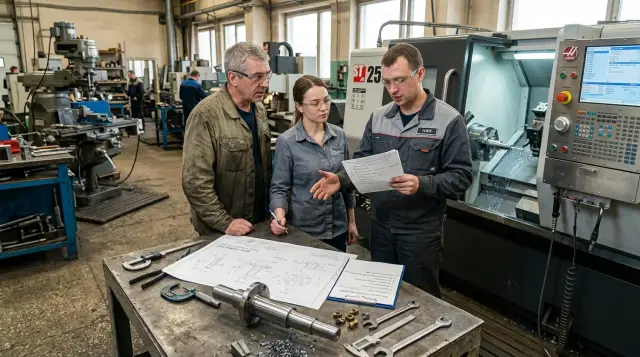
Why a quick review is needed before the first part
The first run of a new part rarely fails because of one big mistake. Usually the reason is simpler: the size on the drawing was understood in two different ways, the blank was clamped differently than planned, or the program still contains a tool that is set up on the machine with a different length. On paper, that looks like a minor issue. In production, it means scrap, lost time, and a tense start to the shift.
A short conversation before the start almost always costs less than reworking the first damaged part. Five to ten minutes spent checking the datum, critical dimensions, and tools can easily save an hour on re-setup. If the part is complex, expensive, or part of an urgent order, that pause pays off immediately.
The purpose of a quick review is not reporting. The point is simple: the technologist, setter, and supervisor must understand the same thing about what is being started and where the risks are. The technologist is responsible for reading the drawing and identifying dimensions that cannot be missed. The setter is responsible for clamping, tools, the program, and the safe first pass. The supervisor decides whether production can go ahead or whether the issue needs to be stopped right away.
Most first starts fail because of three things: a disputed dimension on the drawing, weak or inconvenient clamping, and a tool that does not match the overhang, rigidity, or actual setup. The danger is that these errors are rarely visible one by one. For example, a bushing may go out of tolerance not because of a bad program, but because the blank sat deeper in the chuck than expected during setup. At that point people start changing offsets, even though the first thing to check is the datum.
It is better to stop earlier than to let the batch go into production. If the drawing can be read in two ways, if nobody can say out loud what the datum of the first setup is, if there is doubt about the tool, or if the trial pass gives an unstable size, it is too early to start the series. One pause here costs less than ten defective parts.
In practice, most time is lost not on cutting, but on fixing things that could have been discussed in advance with a few precise questions. That is why a risk map before starting a new part is not a formality, but a normal working tool.
What to gather before the short discussion
This kind of discussion only works when everyone is looking at the same data. If the technologist is reading one drawing, the setter is looking at a different program version, and the supervisor remembers the blank dimensions “roughly,” the discussion quickly turns into guesses.
Before the start, it is worth gathering a simple set of facts:
- the current drawing;
- the NC program version that will actually be loaded on the machine;
- the blank dimensions and material grade;
- the list of tools already at the machine;
- the measurement plan for the first part and the measuring tools needed.
The drawing and the program should be checked as a pair. A common situation at the first start looks like this: the drawing has already been updated, but the old NC program is still in use. One changed radius, step length, or chamfer can cost an extra hour of troubleshooting later. If the revisions do not match, it is better to stop the discussion right away and clarify which version is the working one.
The same goes for the blank. The nominal value in the documents is not very helpful if the actual allowance is different or the material has been replaced. For a turned part, this immediately affects the datum, the depth of cut, and the cycle time. It is better not to rely on memory, but to place the measured blank or the routing sheet next to the machine.
A clear tool list is also needed. Not the one that “usually sits there,” but the one that is actually available now: tool holders, inserts, drills, cutoff tools, and a probe if one is needed. Otherwise the risk map will only look good on paper.
It is also worth preparing the measurement plan for the first part separately. Who measures, with what, and after which operation. If there is no way to check the base diameter, length, runout, thread, or groove immediately, it is better not to start blind.
Usually five minutes are enough to collect this information. If that is not enough, it means the information for a proper start is not there yet.
What to clarify on the drawing and tolerances
A drawing may look clear, but the first defect often comes from two places: the wrong dimension being chosen and a vague tolerance. A few minutes are enough for this conversation, but it is often what saves a shift from extra re-setup.
First, separate the ordinary dimensions from the ones that actually control how the part works. For a bushing, that is often the fit diameter, stop length, face runout, and concentricity of the outer and inner surfaces. If a dimension does not affect fit, assembly, or the movement of the part, it can be checked later. If it does, it should be put under control immediately.
It helps to quickly go through four questions:
- Which dimensions define the fit, and what happens if you go to the upper or lower limit?
- Where do runout and concentricity depend not only on the program, but also on the datum or re-clamping?
- Which tolerance is the tightest, and can it be measured properly right at the machine?
- Which drawing elements can be understood in different ways: chamfers, radii, grooves, and tool exit?
The tightest tolerance should be named out loud with no vague wording. Not “somewhere there is a small one,” but specifically: hole 20 H7, shaft h6, face runout 0.02. After that, the team can decide how to measure it. A diameter in hundredths is checked with a micrometer, an internal dimension with a bore gauge, and runout or concentricity with a dial indicator. If the required measuring tool is not nearby, that is already a risk before the start, not after it.
Chamfers, radii, and grooves often cause arguments not because they are complicated, but because of small unclear details. The drawing may say “0.5 × 45°,” while the process sheet lists a different pass. A radius at the root of a groove may not be possible with a standard tool. These points are better marked right away, otherwise the setter will do it “the usual way,” and inspection will later uncover a dispute for no reason.
If the drawing and the process sheet conflict, it is not worth correcting that from memory at the machine. One working document must be chosen, the difference recorded, and everyone must agree on what is valid before the trial start. Otherwise one shift cuts to the drawing, another to the operation sheet, and the cause of the defect is lost later.
What to check on the blank, datum, and clamping
The first problems often start not in the program, but earlier - with the blank and the clamping. If there is a weak point here, the machine will faithfully repeat the mistake on every part.
Start by looking at the allowance. It must be enough for all operations, including the finishing pass and any correction after the trial part. If the allowance on one side is already tight, the operator will quickly face an unpleasant choice: leave material uncut or remove too much and go out of size.
Then define the first datum. You need to understand right away what the size chain is built from and whether that datum can be preserved later. If the datum changes after flipping or re-clamping without clear control, the dimension starts to drift and the reason becomes blurred between setup, tooling, and program.
Before the start, it is enough to answer a few short questions:
- Is there enough allowance for every pass, not only for roughing?
- Is the first datum clear to everyone involved in the start-up, and can it be preserved after re-clamping?
- Are the jaws, collet, or stop not crushing a thin wall, an edge, or a surface that has already been machined?
- Is the part overhang and tool overhang not too large for the selected cutting regime?
- Will chips clear freely, or will they pack into the cutting zone?
It is better to be a little more suspicious about clamping. A thin-walled bushing can be crushed even by normal force, especially if the jaws press on a narrow face. A long blank is just as easy to unsettle with too much overhang. Then the problem looks like vibration, although the root cause is often that the part is held too far from the support.
If the overhang is large, it is better to shorten it right away: use a shorter blank, move the clamping point, add support, or split the machining into two setups. A couple of minutes spent on that decision often save an hour of troubleshooting.
Chip flow should also be checked separately. On a turning operation, chips can wrap around, block the cutting line, and get under the edge again. Then the dimension drifts, the surface tears, and the operator thinks the regime is to blame. On a trial part, this is easy to see: if chips do not evacuate cleanly, the series should not start.
A good sign is simple: in one minute you can explain where the part is datumed, how it is clamped, where the weak point is, and what to do if the first part shows a shift. If there is no such answer, the start should be slowed down.
What to ask about the tool, program, and cutting conditions
If one holder or insert is missing on the machine, the start can fail even before cutting begins. So first look not at the screen, but at the tooling: are all positions from the tool list present, do the inserts match the geometry, are the drills and taps sufficient, and are they already worn out.
Next, it is best to assign responsibility right away. One person checks the part zero, another confirms the tool zero. When this task is shared by everyone, often nobody does it. It is easier to spend two minutes on a double check than to later figure out why the size drifted on the first pass.
The biggest scrap risk usually sits in one operation. On a turned part, that is often the finishing pass on a fit diameter, deep drilling, or threading a blind hole. That operation should be named directly, and the team should decide how to protect it: make a pause before it, check the tool overhang, look at the correction again, or leave more allowance first.
During the trial run, do not lower everything at once. If you reduce feed, speed, and depth of cut all at the same time, it becomes harder to understand the cause of the problem. It is better to change one thing at a time. Feed is reduced if there is a risk of impact during entry or edge chipping. Speed is reduced if the material is heating up, vibration appears, or there is doubt about the drill. Depth of cut is reduced when the clamping seems weak or the machine is struggling through the pass.
Another useful question: which dimension should be removed and measured immediately after the first pass. It should not be the easiest size to measure, but the one that will show a datum, offset, or program error the fastest. For a shaft, that might be the rough diameter after the first machining step. For a hole, it may be the size after drilling or boring, before the program moves on.
On a new bushing, two early measurements are often enough: the outside diameter after the first turning pass and the bore depth. They quickly show whether the zeros are set correctly and whether there is an error on the Z axis. That is more reliable than measuring the finished part at the end of the cycle.
How to keep it within 15 minutes
Fifteen minutes is enough if the discussion follows a clear order. The goal is not to discuss everything at once, but to quickly find the place where the first part may fail because of size, clamping, or the program.
This review works best when three roles take part: the technologist, the setter, and the supervisor. One person keeps the pace of the conversation, another is responsible for the machine and tooling, and the third records the decision immediately. If everyone goes off into their own topic, 15 minutes can easily turn into half an hour.
A practical rhythm looks like this:
- 2 minutes - the batch goal: trial start, urgent order, or a repeat part with new material. At this point, name the most critical dimension.
- 4 minutes - the drawing: tight tolerances, datums, surface finish, disputed references, and the method of inspection.
- 4 minutes - the blank and clamping: actual allowance, datum, overhang, stop, and the risk of crushing or shifting the part.
- 3 minutes - the tool and the program: is the right tool installed, where is the work offset, which operation should the trial begin with, and is there any dangerous first cut.
- 2 minutes - decision: start, make a quick correction, or postpone the start.
It is useful to keep one strict rule: if the team cannot name the risk and the way it will be checked, the start should be postponed. In practice, this pace saves not a quarter of an hour, but an entire shift.
Where people most often make mistakes when rushing
The first and most expensive mistake is running the wrong drawing. The operator opens a file that was already in the folder, the technologist looks at an old printout, and the shop is still working from the previous revision. As a result, the program and inspection are based on different dimensions.
This often happens with parts that look simple. One diameter stays the same, but the chamfer, groove, or tolerance has already been changed. If nobody checked the revision and date, everyone is sure they are doing everything correctly.
The second common mistake is judging the allowance by eye. The blank is “almost the same as last time,” so nobody checks the difference again. Then the roughing pass removes too much, the finishing pass has nothing left to work with, or, on the contrary, the part keeps extra material where nobody expected it.
Rushing also catches people on small tool-related details. The program was checked, the tool was installed, but the approach, safe retract, and real overhang were forgotten. On the screen everything looks fine, but on the machine the tool comes in differently, hits the jaw, runs into a shoulder, or simply does not reach the right area.
The first part measurement is also often done wrong. The outside diameter is checked with calipers where a micrometer is needed, and the internal size is measured with whatever is at hand. A number is there, but it cannot be trusted. Because of this, a part that “almost made it” goes into the series.
There is one more trap - becoming confident too early. One part comes out good, and the shop starts the batch right away. But the first piece may have been produced with a fresh tool, a cold machine, and a clean clamping setup. By the third or fifth part, the size may already start to drift.
A short pause with three questions usually helps: is this definitely the latest drawing and the same program, will the allowance be enough for all passes, and does the tool together with the measuring instrument really suit this dimension. If there is no clear answer to even one of these, it is better to wait a few more minutes.
Quick machine-side check
Before starting a new part, you do not need a long review. You need a quick check that catches simple but costly mistakes: the wrong offset, too much clamping force, an old program version, or the wrong zero.
Right at the machine, it is enough to check five things:
- do the part number, drawing revision, and program version match;
- does the clamp hold the part without crushing, misalignment, or the risk of rotation;
- are the turning tools, drills, and holders in the right places, and are the offsets mixed up;
- have the work offset, the first tool path, and the safe approach without cutting been checked;
- is there a clear measurement plan for the first part nearby.
That is usually enough to remove most of the risk before pressing “Start.” For example, a thin bushing can be ruined not by the program, but by clamping. If the jaws hold too hard, the part can move out of size after unclamping, even though everything looked normal on the machine.
It is best to review the first tool path without rushing. A dry run at a safe distance from the part, or single-block mode for the first few lines, often helps. That way the setter can immediately see whether the tool is heading into the jaws, the chuck, or the wrong direction.
The measurement plan is also needed before the start, not after the first mistake. When the list of first dimensions is already next to the machine, the supervisor and operator do not argue about what to measure first. Usually the first checks are the datums, the outside or inside diameter, the length, and the tolerance that is hardest to hold on the first parts.
Example: a new bushing without a long meeting
The batch is small - only 20 bushings. The material is ordinary, but the wall is thin and the tolerance on the internal diameter is tight. In this kind of work, defects often appear not because of a complicated program, but because of one simple thing: the clamp pulls the part slightly, and the size shifts after it is released from the chuck.
The team does not waste time arguing about details. The technologist opens the drawing, the setter checks the datum and jaws, and the supervisor clarifies how many parts must be delivered today. The first question is simple: where should the part be held so the wall is not crushed. The second: what datum should be used to measure the internal diameter honestly afterward. If there is no clear answer to these two points, it is better not to start.
In 15 minutes they manage a proper check: they look at whether the clamp is pulling the thin wall into an oval, whether there is enough support at the datum, whether the overhang is too large, whether there is enough stock left for the finishing pass on the internal diameter, and whether the inspection tool is ready.
The first part is not run at normal speed. Feed and speed are reduced slightly so the part behavior can be seen without extra risk. After the roughing pass, the outside diameter and runout are measured. After boring, they stop again and check the internal diameter. It takes only a few minutes, but it often saves the whole batch.
A typical small issue appears during the trial run: the tool enters too abruptly and leaves a burr on the edge of the hole. Because of that, the measurement becomes misleading and it seems like the size is already within tolerance. The team changes the tool approach, makes the entry smoother, and removes the burr before the final inspection. After that, the size repeats more consistently and the spread between parts becomes smaller.
That is how a risk map before starting a new part works: first the datum and clamping, then a careful first start, then small corrections based on the first part. For a small batch, this approach is more useful than a long meeting.
What to do after the trial run
The trial run does not end with “the part came out fine.” At that moment, the goal is to quickly turn one result into a clear working method. Otherwise the same issues will show up on the second or third part.
Right after the first part, it is best to record only what will be useful at the next start:
- the actual tool and axis offsets;
- the real cycle time;
- inspection notes: where the size drifts, where it is hard to measure, where a different inspection order is needed;
- any deviations in sound, chips, heating, and clamp marks.
If the first bushing came out in size, but the internal diameter has to be chased every time, that is already a signal. It means the problem is not in one measurement, but in the start-up process itself.
Before the series, decide what needs to be corrected right away and what can stay. Usually the choice is simple: the clamp, the tool, or the order of operations is causing the trouble. The clamp is corrected when the part shifts, marks remain, or repeatability changes after re-clamping. The tool is checked first if the spread grows, extra vibration appears, or the surface comes out worse than expected. The order of operations is changed when the program works in theory, but the machine makes unnecessary moves, wastes time on empty travel, or reaches a difficult dimension too late.
Do not carry a temporary fix into the series. If the operator is already working around a weak point manually during the trial, it will almost certainly become a permanent problem in production.
It is also useful to save a short set of questions for similar parts: is the clamp rigid enough, does the shape of the blank interfere with the first datum, and where does inspection take the most time. That kind of list saves not minutes later, but entire shifts.
If the problem is no longer with the part, but with the machine itself, commissioning, or service, it is better not to guess on the shop floor. In such cases, it makes sense to discuss the issue with the equipment supplier. For example, EAST CNC in Kazakhstan supplies CNC turning machines for metalworking, handles commissioning and service maintenance, so they are a good point of contact when the issue is not only in the program or tooling, but also in the machine setup itself.
A good trial-run result is simple: there are working offsets, clear corrections before the series, and a short note that will make the next start calmer.
FAQ
What is a risk map before starting a part?
It is a short check before the first run of a new part. The team quickly reviews the drawing, program, blank, datum, clamping, and tools so defects do not show up after the first piece.
Who should take part in this review?
Usually a technologist, a setter, and a supervisor are enough. The technologist checks the drawing and tolerances, the setter is responsible for the machine, clamping, and tools, and the supervisor decides whether production can move ahead or the issue needs to be stopped right away.
What should be prepared before the short discussion?
Keep the current drawing, the exact NC program version that will actually be loaded into the machine, blank dimensions, material grade, the list of available tools, and the measurement plan for the first part in front of you. If even one of these points is unclear, the discussion quickly turns into guesswork.
Which drawing questions should be asked first?
First, identify the dimensions that affect fit, assembly, and how the part works. Then clarify the tightest tolerance, the datum for the first setup, runout, concentricity, and any places on the drawing that can be interpreted in more than one way, such as chamfers, radii, or grooves.
When is it better to stop the start-up right away?
It is too early to start a series if the drawing revision and the program do not match, the datum is unclear, there is doubt about clamping, or the trial pass gives an unstable size. It is better to pause for a few minutes than end up with ten defective parts.
What should be checked on the blank, datum, and clamping?
Check the actual allowance, the first datum, the part overhang, and the risk of crushing from the jaws or collet. If a thin wall can go oval and a long blank is held too far from the support, fix the clamping first, not the correction values.
What should be checked on the tool and program before the start?
First look at the tooling on the machine, not the screen: are all holders and inserts in place, is the overhang suitable, and are the offsets mixed up? Then confirm the work offset, the tool offset, and a safe first approach without cutting.
Which dimensions are best to measure on the first part?
Choose the size that will show a base, offset, or NC-program error the fastest, not the easiest one to measure. For a turned part, that is often the outside diameter after the first turning pass, the bore depth, the base length, or runout after an early operation.
How can you stay within 15 minutes and not let the discussion drag on?
Keep it simple: spend a couple of minutes on the batch goal and the most critical dimension, then the drawing, then the blank and clamping, then the tool and program, and finish with one decision. If the team cannot name the risk and the way it will be checked, move the start.
What should be done after the trial run?
Write down the working offsets, the actual cycle time, the problematic measurements, and notes on chips, heating, vibration, and clamp marks right away. If the issue is already coming from the machine, commissioning, or service, do not guess on the shop floor and discuss it with the equipment supplier.